For context, I'm 52, 6ft, 80kg, still questionably fit, started sailing again at the end of March 2025 after a hiatus of almost 20 years. I try to sail twice per week, in winds from 5 to, (so far up to) 30 knots. I'm not sponsored, none of this is AI, feel free to laugh at any errors. Looking forward to hearing ‘other people’s experiences’ (OPE). Worth noting: Mark (from Surf Sail Australia) does give me a 10% discount and worth asking for. Also, no one needs to faff around like I do, all of Patriks great works perfectly out of the box.
It’s taken a while to write this review because the wind in Perth has been, well let’s say, it was….****. June - September, there was virtually no wind, or when it did come in, I was busy.
I have had the opportunity to ride a few different foil boards over the past year and a half; some are heavy, some too narrow and better suited to windsurfing, but others are F$King standout sensational. So far there seems to be a Goldilocks zone around 80 - 85 wide. Enough flotation to get going in 10-15 kts and aero enough to handle 25+ knots.
This year’s journey
I bought one of the precursor Prototype boards to the Gen3 (
www.surfsailaustralia.com.au/product/patrik-foil-slalom-windsurf-board-used-proto#surf-sail-clothing-hardware ). Initially, I thought it was too wild for me, coming off the 91 wide Foil One foil Board. It took me ages to get used to it. In short, I kept falling off, couldn’t hold it through any gybes, stuffed up all of my tacks and couldn’t find any balance- a real noob again.
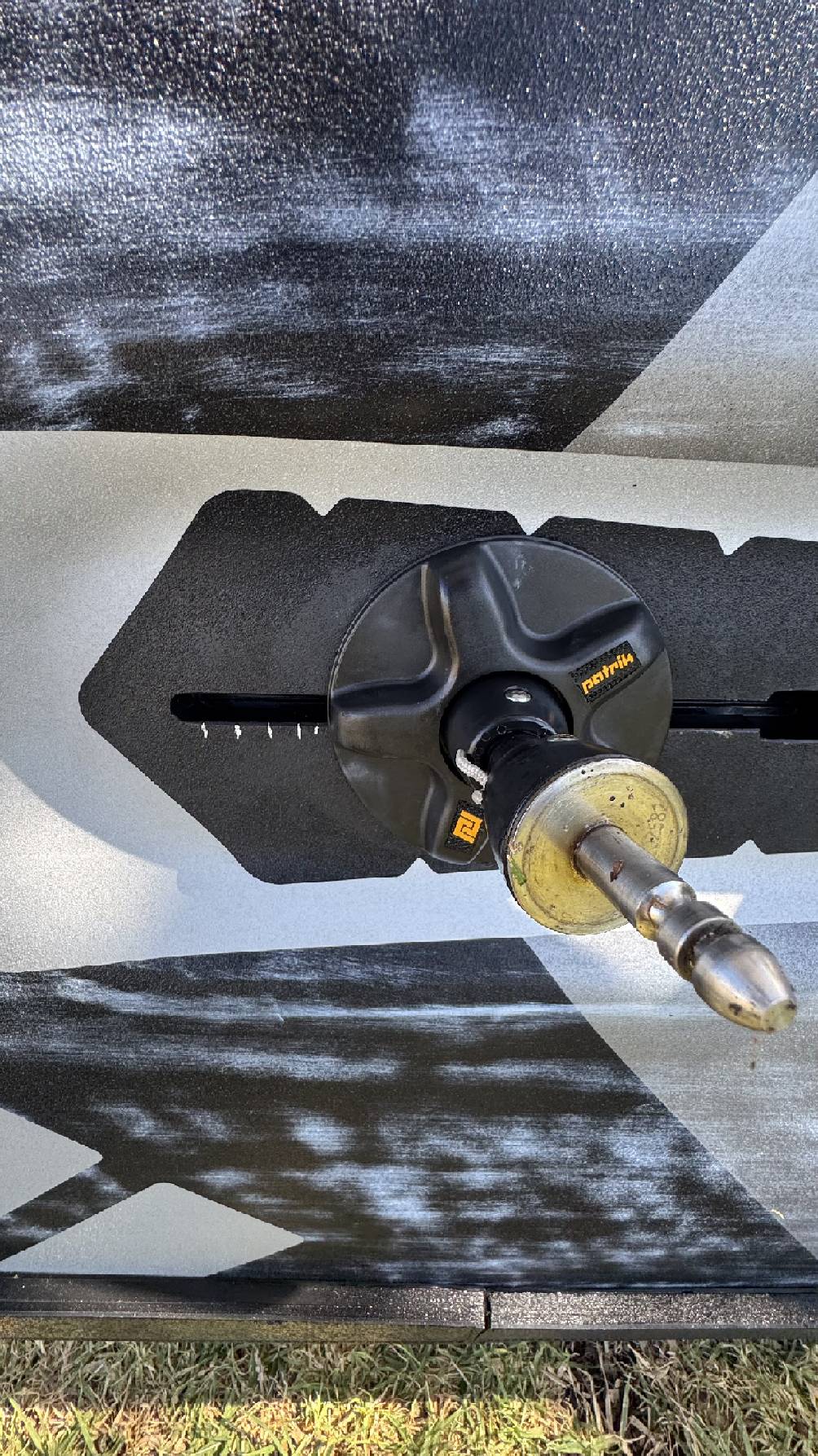
It took those first few sessions just to find the right footstrap and mast track positioning, as well as the right rake on the foil (2.8 - 3.0 degrees seemed to work best), with no markings or anything written on the board; I had no idea what I was doing. When I bought it, I assumed otherwise. I stuck with it, convinced I could get there with lots of errors and experiments. It felt like forever, and I cracked the ****s way too often, but with all this faffing I really got to figure out the board, the best settings and, most importantly, why. I added pen lines at 1cm increments alongside the mast track to help find a consistent place to start from. High winds move the mast foot forward 5mm. Lighter winds 5 mm - 1 cm back. These seemingly subtle differences made a huge impact on performance and the gear's balance.
5 sessions later something clicked, that one session where everything falls into place, a solid breeze, mast track, sail was rigged (6m Foil S2) tuned as best I knew how. I finally found the Goldilocks zone with this board. I could get going after 2 to 4 big sail and rear foot pump plus a few little back-handed wiggles as the board was planing, it only took a gentle rear foot stomp to bring it all up onto the foil and bang, endless flight time. Wow, it flew super easily; I could fly upwind and downwind effortlessly, stay on the foil during some gybes and shuffle across the board easier without disrupting the turning radius too much. I wasn’t perfect, but I felt like I finally cracked the next level in this wind foiling game.
It took a few more sessions in different conditions to figure out the most efficient techniques. Eventually, getting on the plane became super easy; a bit more off the wind, push off the top of any swell or chop, and a couple of timely pumps is all I needed. On the plane it felt like a smaller board, like a narrow slalom board. It gybed on the plane really well too, never digging in or forcing me to bail out. It’s fast; I realised it would have this sudden speed kick. It took a couple more sessions to figure out what was causing it and it turned out that, at a certain speed, the board was planing just on the centre of the hull; it performed like a small board, and it kept accelerating. It only took the smallest bias to the rear foot and it would bring me up on to the foil with little to no effort. What I loved the most was on the foil, the board seemed to disappear underfoot. I never felt it rebelling against me, driving me upwind or downwind, or rolling over, it was just there, just great sailing, no instability in the bigger gusts, slick, fast and perfect for flat water river sailing (On the Swan).
The Gen3 Foil Board: (& Gen2 HA sails)
Late March this year I bought the new (pre-production) HA Gen2 sails (6.8 & 5.6) and I didn’t realise it at the time, but another couple of levels were unlocking for me, my whole approach to foiling changed and by the time I bought the Gen 3 Foil Slalom board I knew I was reaching another new level. Not the top, not a noob, just felt more at one with the gear. The sails allowed me to consistently get into the Goldilocks zone; my techniques and confidence all improved within 2 solid sessions. I fell in less often, nailed a few more tacks and pulled off some sketchy gybes, and I just felt more relaxed because of the consistency. All the previous struggles were fading away.
Admittedly, those first few sessions, there were a few things to get used to in the first hour; these were full of experimentation, mostly the mastfoot and footstrap, shim, rake and sail rigging positions. The mast track started in the middle (105mm from the front on the usable 210 mm long mast track. (90 - 100 mm when the wind picked up)) The footstraps in the middle too, but needed to move the rear straps back 2 spaces and open the straps a bit, making it easier to get up on the foil and pulling the foot out when heading through a gybe. Once I was dialled in, it blew me away (pun intended) how different it was, and those great elements of the prototype were clearly in the new board.
The key differences in the Gen 3 board were the feel: more precise than the prototype, cleaner, crisper, and easier to direct on the water. The board sat in the water better, ready for action. I have no doubt it helped that the new sails made it easier to get going.
Interestingly, I found once the sail was powered up and I was building up a little speed I could get in the harness lines, lean back and kind of flick it forward like I was pushing it out from under my feet and it would start planing, as the speed built I could slide into the front foot strap and if needed turn slightly downwind picking my take off spot, its super easy to jump off small chop and launch it onto the foil, all within 10m, compared to 10 - 15m on the prototype, acknowledging less experience at the beginning and the different size foil would impact all of this. The Gen 2 sail and Gen3 board combo made all of this easier, allowing time to get into the rear straps and get comfortable; by that, I mean get into the Goldilocks zone. I recently posted a review on the new HA sails, and I used them mostly for this review, as they changed the dynamics of my sailing.
The Gen 3 board felt shorter, easier underfoot and lighter. I went from focusing all my attention on getting on the plane to chilling out and cruising onto the plane, but if I needed to I just needed to add a bit more effort to get going quicker. I had time to read the gusts and chop, pick better lines and actually know ahead of time where I was going to take off onto the foil. Everything seemed to have a flow to it, working in harmony together.
Where it comes into its own is choosing the right front wing for the wind range. Running a slightly larger wing seemed to be the right option 9 times out of 10.
For example: (my current preferred settings)
8 - 12 Kts, 900 - 1120 cm2 Front wing. 8-10m sail. (900cm2 Aeon and AIO 900 & 1120cm2 ((Power setting)250 cm2 Stab) Aeon - 195 cm2 Rear stab with .5° shim 10 - 15 Kts, I’d use the 650, 750 & 900 cm2 and a 6.8m - 8m sail. 160 cm2 Rear stab with 1.5° Shim 15 - 20 kts, 550 or 650 cm2, 6m - 6.8m sail. 160 Rear stab with 1.5° Shim 20 - 25 kts, 450 cm2 4.5 - 5.6m sail. 160 Rear stab with 1.5° Shim 25+ Kts, 365cm2, 4.5m sail. 160 Rear stab with 1.5° Shim
I experimented a lot with 1.25, 1°, .75° .50°, .25°, 0°, but I realised the hard way - everything must be balanced before pushing this. More on this later; the lift dynamics change, and it’s difficult to pin down exactly what is causing the disrupted balance if other things aren’t set right. 1.5° is the best. Typically, I aim for a 3.0° Rake; it’s harder to consistently attain the same rake once you cut the foil mast down to fit into both boards.
As a general rule, if it looks like it’s blowing towards the bottom end or dropping off, I’ll choose the larger sail and front wing combo. Flight time and average speeds increase, and I just let the trailing hand out in the stronger gusts. Average speeds go up, but those top 2-second PBs are harder to reach.
I learned the hard way, testing the 10m sail a couple of times, it is way too much sail (bulky, heavy) for the Gen3 board, it was a lot of effort and more fun with the 91 wide board. Unless the wind is really consistent, it’s just so much effort to get it out of grovel mode and planing, let alone up and onto the foil. Don’t get me wrong it can be done but why go through struggle town if there is an easier approach?
Last month (October) the sea breeze started to kick in, so the wind has been a bit more consistent. I’ve had the chance to try the board in a few different combos, starting with removing the rear foot straps, moving the front straps forward and the mast track up to 3 and 4 cm further back. This has been a fun experiment, especially now that the Gen2 HA sails are super consistent; I’m finding I can get into a stable, comfortable position quicker and am able to hold it up to 25-27 kts. (When the boats have cleared out)
After watching Surfcasper T’s Youtube video again
, I ordered the new 7.4 and 8m HA Gen2, so I am keen to test these in the right conditions and find the best combo.
Finding that perfect foil and sail combo for the wind has been the key, it makes this board so versatile, getting going in 10 knots is good fun once I’m up. The board disappears and lets me focus on flight time. Nothing in the way, no bulk to wrestle and bust a nut to keep it on the foil. When the wind picks up it’s the same, it’s just freaking reliable, solid and great fun.
Design, Graphics & where it’s important on the water.
-ShapeThe new design looks fast, ready for some serious sailing. It looks intentional, everything serving a purpose, working together, be it getting on the plane quicker, displacing the water during a touchdown, or managing speed turbulence at 40+ kph. The nose shape is is definitely short, but its wide enough to be useful in tacks if I’m quick enough but, small enough to not be affected by strong gusts or high speed sailing.
In strong winds and flat water I haven’t really experienced the board getting pinned down or uncontrollably wafting sideways during those big gusts, no rocking, no wobbling just a really comfortable ride on rails. This could also have something to do with the new sails, but the board feels more stable, like it's slicing through the air, it’s more reliable and predictable. I can hear the wind blasting around the sail but when I’m locked in there is very subtle and predictable movements.
In saying all the when sailing through the swells, chop and tidal movement there is a lot of movement and wobbles to adjust for. At this point of my experience, this is a constant rocking my weight forward and backwards while in the Seat Harness. Bending my knees during the gusts and straighter when it’s dropping off but, the rocking the weight forward and back movement is essentially the same.
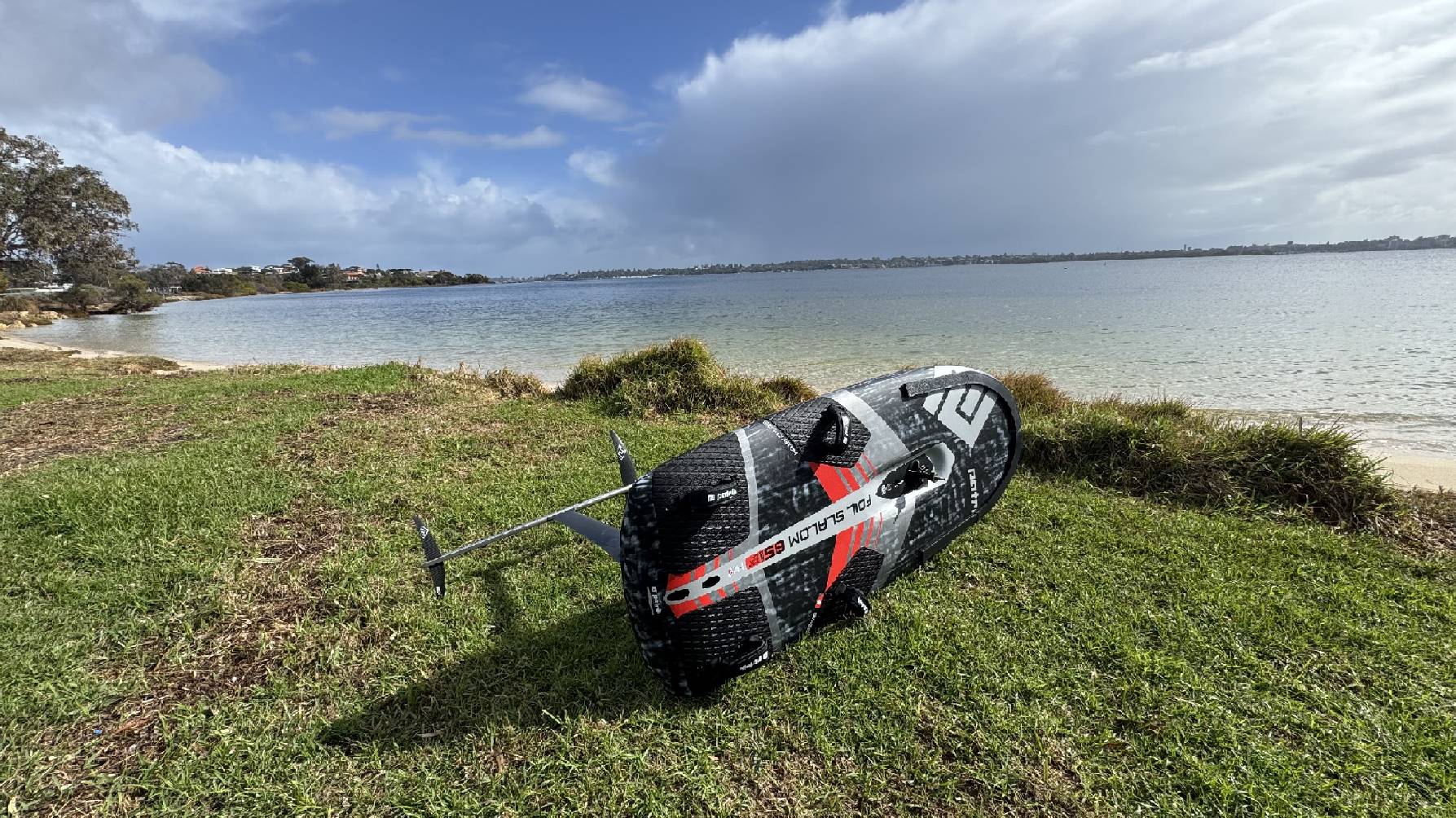
-Cutouts & hyper release systemIf I’m honest with myself, I thought the Hyper release idea was more marketing w%nk than practical on the water results. It looks cool but, how can that make a difference? I’m no expert in hydrodynamics, but based on the water feels, it is noticeable. After a few sessions I could literally see the water releasing further up the board as things got faster and depending on which front wing I was using, like the 650 and 750 cm it didn’t appear to have time to release all the way. As a result, the board feels smaller, lighter underfoot, like a fin slalom board, but easier to get on the plane.
-Deck padsTo be fair I haven’t really given these much thought. I use booties all year round (too many munted toes in my early years) so I don’t feel them much, they have ample grip, maybe they absorb some of the harsh slapping when building up speed but on the foil I don’t feel it. It’s only worth mentioning as they are really sturdy and stuck on there. They look like they have been baked on.
-GraphicsFor me maybe the graphics look cool but OTT, it looks premium, technical, designed for the business end of sailing. The new Silver looks classy in amongst the red, white and black & Carbon Biax board colours. Admittedly It’s grown on me since I bought it. I naturally seek out the subtle, less is more design aesthetic, but windsurfing has never been known for austere minimalism. I still shudder to think of all of the fluorescent yellows, pinks and oranges of the 80’s; don’t tell anyone, but I may or may not have been sucked into that movement, but only because there wasn’t much of choice.
-Deck Standing on the deck is easy, lots of real-estate to move around and for the most part unencumbered until it isn’t. (More on this in criticisms) Lately, I only occasionally fumble on or over the footstraps and edges of the centreline recess, but in the beginning, I would trip all the time, it made for some great comedy.
The leverage on the edges is great for reaching upwind and blasting across wind. I’m finding I can quickly slip into the footstraps without looking down too much now. Everything is easy, accessible, as you would expect from the Patrik brand. Notwithstanding all this, it is still a big step across the deck to go into gybes. If you don’t step just in front of the front footstraps, it can be difficult to quickly slide in on the flip side. It’s like slipping your feet into road bike cleats at the traffic lights, if it’s not done right on the first go it can be a quick holiday to the bitumen, in this case water thankfully.
-Hull, Rocker line & RailsIn the same way watching Suits made me a supposed qualified lawyer, I did a little bit of research into board (Hull shapes) designs to be better understand what I am looking at and experiencing on the water. It’s incredibly detailed and nuanced; so far, my understanding (the following is a simplified understanding) is there seems to be many trade-offs or something that has to give for something else to excel. It’s like that old conundrum; you can have a good Price, good performance or good quality but you can only pick 2. Somehow this board hits 9/10 on all 3.
To design something that meets everyone’s needs must be incredibly difficult; a top foil board needs to serve the ocean-going PWA athletes and the lake or river weekend warriors like me, but also get going… at speed. These requirements all call on opposite design principles and I can only thank the Patrik team for figuring this out.
For example, to take off quickly a board needs be light weight, have lots of volume, a pronounced v shape and cutouts that release the water flow and ‘un-sticking’ the board from the water but, on the flip side to fly fast through the air it needs to be small, little to no volume but wide for leverage.
It’s this secret recipe the Patrik team have almost perfected. I say almost with some ignorance, I haven’t raced (in years), made a board myself or been on the Ocean with this board and so far no plan to either. But I am sure there will be incremental updates and new exotic materials that improve things in years to come.
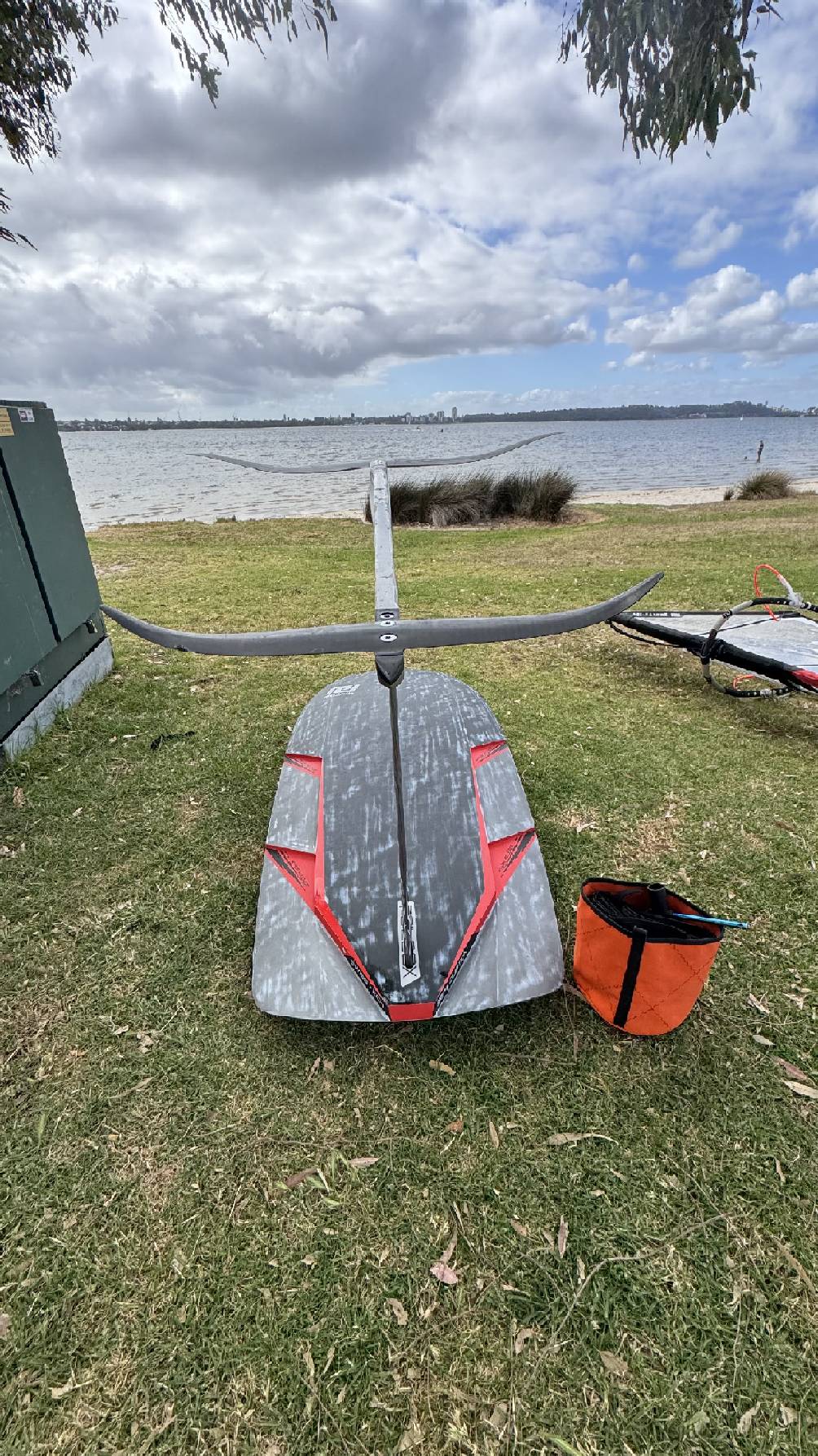
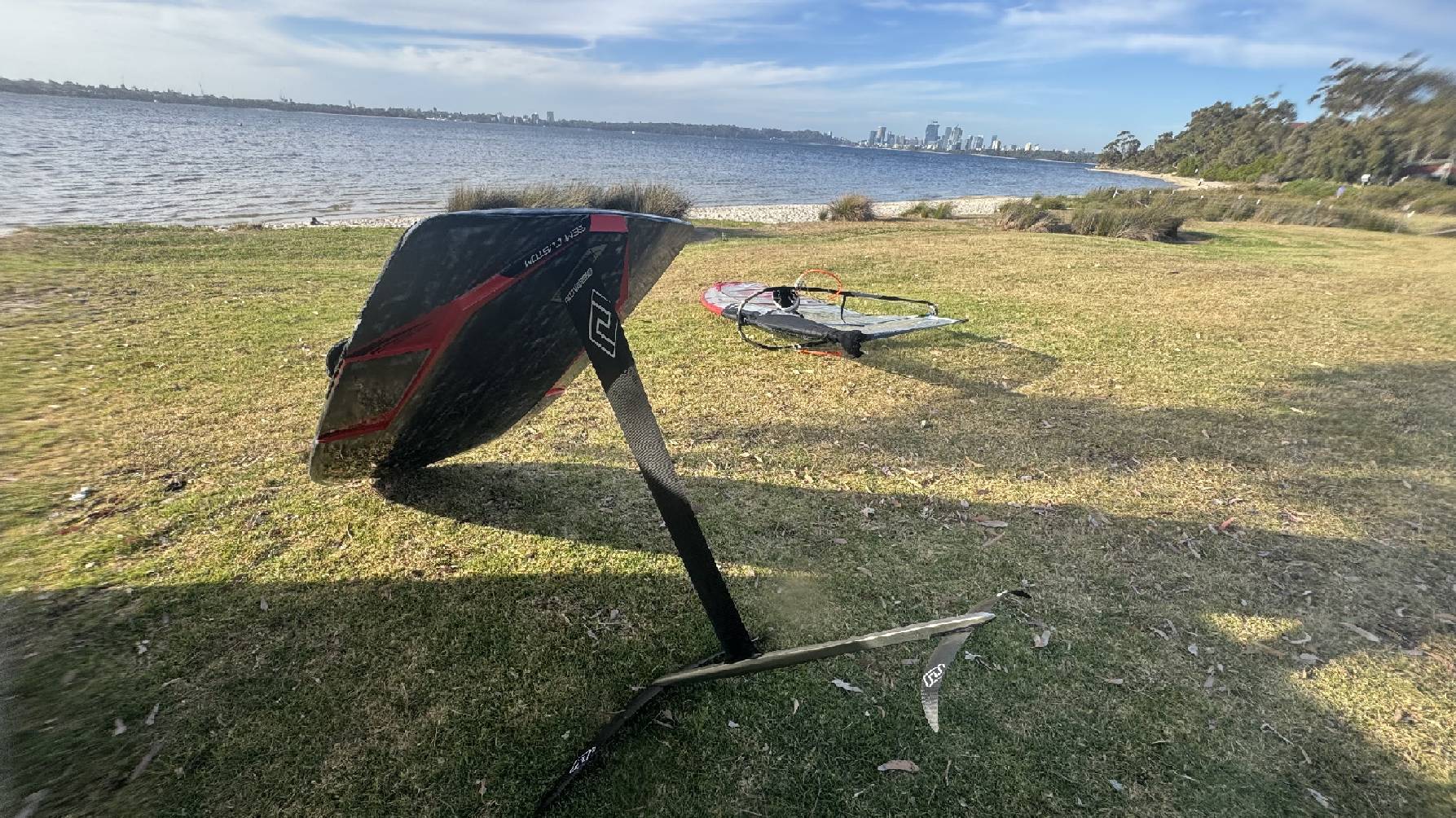
Looking at the board (upside down) from the nose, it has a slight V shape with slightly raised (or chamfered) edges around 5 cm in from the rails. It kind looks like a small Slalom board under a larger deck! The V shape takes care of early planing as well as touchdowns. The slight V delicately flattens out to a subtle double concave through the middle as the hyper realease relieves the raised edges. As we flow to the rear of the board and the Hyper realease has stepped ‘down’ 3 steps (about 4cm in total) it flattens out to surround the Flathead Deep Tuttle foil box leaving the centre of the board looking like a smaller slalom board. Somehow this recipe works both on and off the foil. Yes it takes some effort, but not as much as a smaller or narrower board.
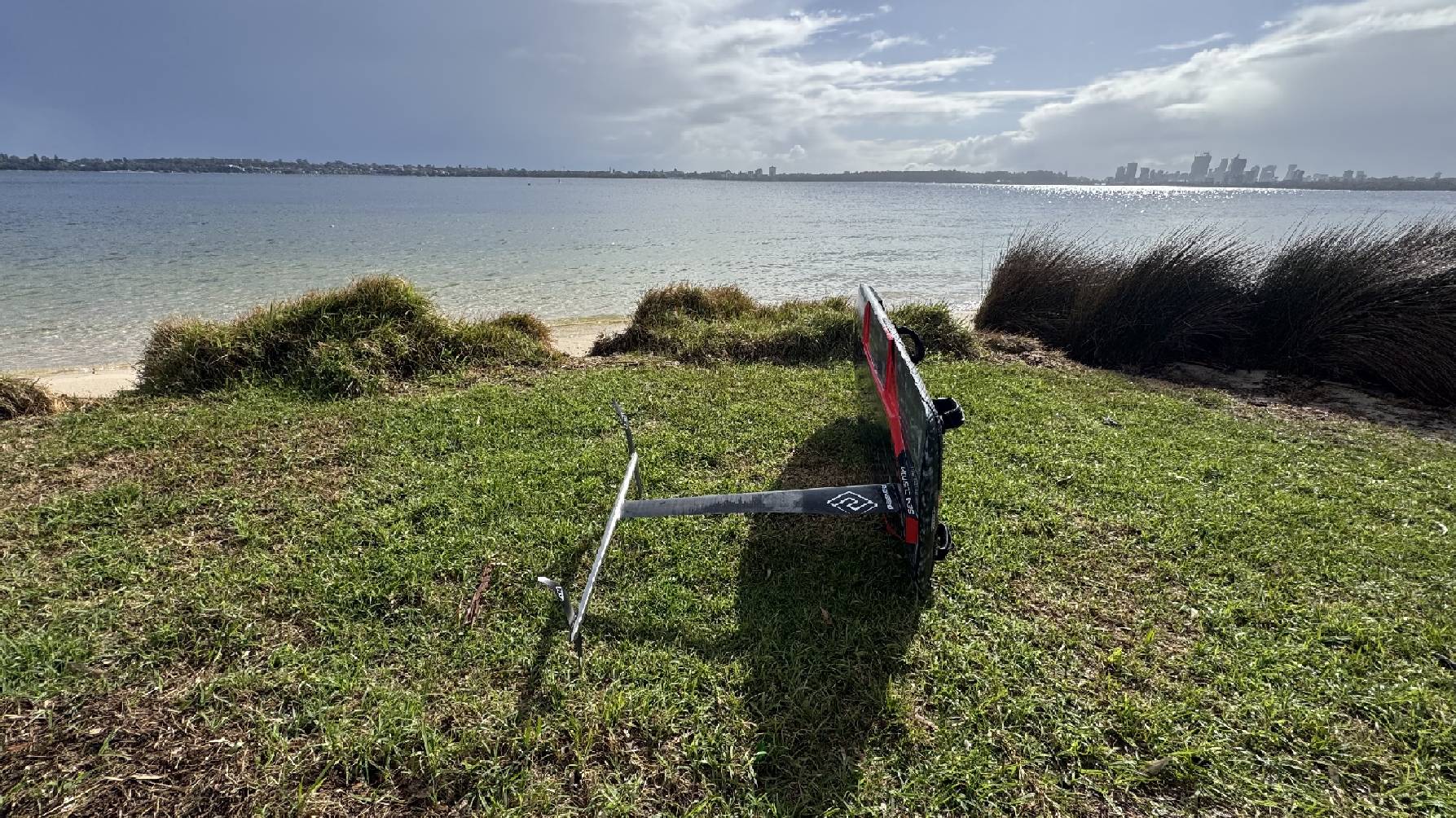
-Foil Mast Connection: Another aspect is the Aeon foil mast connection with the board. In short, this is a match made in heaven; it’s snug but easy to push in and pull out. I couldn’t feel any play or movement on the beach or in the water, it felt locked in and reliable. This becomes most noticeable shooting downwind and banking heavily into gybes. It’s like it has non-stop grip and very little flex, so it feels predictable. Other foil systems I’ve had feel like they skate around a bit under foot, the board would kind of head off in its own direction before I have to force it back in line with the foil.
-Sail mast Connection:These are all pretty standard these days; all I can say is it’s pretty snug too, maybe too snug. I have to spool the nut all the way out to get it to slide in without too much resistance.
-Tucked in rails:As the slightly raised edges hit the rails, there is a subtle tucked-in curve up to the deck. Pronounced more from the front and easing off towards the Hyper release system. I’ve found this super easy to gybe off the foil. Its smooth doesn’t dig in unless my weight is too far forward or crazy chop gets in the way. This was most noticable on the fin. With the shortened nose it’s easy to step forward and bury the nose in chop, especially when railing too hard. I’ve noticed the usefulness of this in those occasional touchdowns coming down on a slight angle or catching some chop; the V shape takes the brunt, and the rails seem to displace the water cleanly. I’m yet to trip over the rails. The Gen3 board feels thicker along the rails around the front foot straps; however, this is soon relieved by the hype release system just in front of the front foot straps.
Aerodynamics:As mentioned, I’m definitely not an aerodynamicist. I’m good at falling out of an aeroplane and pulling the chute, but not flying the plane. So far, at speed, I haven’t noticed any weird instability or turbulence that I can’t explain; it's definitely a lot calmer than any other board I tried in higher winds, it was so good I didn’t even realise I hit over 25 knots the first time. This was in partly due to the 4.5m HA Gen1 (& 5.6m HA Gen2) sails and the Aeon foil, but, stating it again, the board never entered my mind it felt fast, but never on the edge of control until I would run through boat chop.
Occasionally I would hear a bit of wind rush over the board in a wind shift, but it didn’t bob around unpredictably; it was louder through the sail than the board.
Regarding those conditions, when the water was flat, all the boats and their swells had dissipated; everything feels right, so I found a long gust I could see pushing through ahead of me and went for it. The board never came into my field of attention; I was just enjoying the ride. The Foil takes over the stability and control over 20 knots (of board speed) and its fun just winding it up and looking forward to another gust.
Speed:Perhaps I’ve touched on this enough in aerodynamics. I don’t think I’ve hit the speed limits with this board. I’m guessing here but I would say it’s fully capable of hitting 40+ knots (board speed) in the right conditions. The only thing that would slow it down is the rider's appetite for speed, too much chop, gusty conditions, seaweed, fish and fishing line, ohh a sandbar would do it too.
Upwind:While this board isn’t exactly made for upwind or course sailing, it can still do it surprisingly well. In some of the big gusts I’ve flown upwind with absolutely no effort, just a tweak in my stance, leaning back and the board windward, and she just ploughs upwind until the gust runs out of puff. Lately I’ve only been using the V3 fuselage, I can still push upwind when I need to or if I’ve caught the right gust. Maybe not to the same extent as other people I’ve occasionally sailed alongside, but the speed more than makes up for it. Occasionally some of the expert slalom fin guys on the river have managed to point higher than me in certain gusts but the foil is more consistent at pointing higher.
Crosswind:Across the wind and downwind, this board comes into a class of its own. It just keeps accelerating, and if I can pick the troughs in the swell, I can maintain that speed with confidence. I’ve been able to keep up with some of the mid-level fin guys, but it looks and feels like I’m doing it easier than they are.
This is the fun part for me. Nothing beats belting along across the top of the chaos silently and banking it over on the other side of the river, flipping the rig and jumping back into the Goldilocks zone for the return trip 10 or 20 times. It’s like a meditation session and the Dali lama’s on speed dial. It’s like the gear is no longer there I am literally flying across the river, I can hear the waves below, the wind in my ears, birds flying overhead it’s like nothing else I’ve experienced. Like how I would imagine an out-of-body experience, I’m too much ‘in my head’ in the noise on the fin, except on glassy flat water.
Downwind:As mentioned, this is where this board really shines. At speed the foil is doing all the heavy lifting here, the board, sail and I are just here for the ride. Again, the board is like a flying carpet, I can feel every movement of the foil through the board it’s a real tangible connection, instant feedback. I can feel & hear when it’s going to fall off the foil, when it starts to rumble from the prop-chop behind a passing boat or kissing an innocent Jellyfish. It’s smooth, predictable and stable. It’s like a good quality surfboard on a 6ft wave, I feel connected to it. The huge deck real estate means I can move around to suit the gusts and swell; I can pump the foil easily, bridging gusts and playing with the optimum positioning and step back into the footsteps without upsetting the foil's balance. In the bigger swell, (Rottnest Boats) it can be a bit tricky when kissing the top of the wave with the board and the front wing breaches at the back of the next wave below. I tend to just slow down now around the boats wake, too much going on for me.
Touchdowns:All touchdowns suck; the main reasons for my touchdowns have been foil breaches. The foil lift collapses under the board, forcing everything down - quickly. These can end badly and have been my worst kind of touchdowns. The other has been overpowered by the wind, forcing the sail forward and pushing the front of the board up. I haven’t had a bad one for a while, thankfully; I think this is due to the new sails, improved technique and knowing what's going to happen.
The last foil breach I had was testing out the 5.6m, the same day I hit 25kts. A couple of the Rottnest boats came through and kicked up their nasty swell. Everything was fun and flat until it wasn’t; thankfully, I had just unhooked prior, I suddenly found myself walking on water on my own without the board and sail and a 20m swim to catch up with it. Rig and rider survived unscathed.
Since then, at the end of most sessions I’ve found some flat spots nearer to the shore to practice breaching in a controlled way to get a feel for the foil as it nears the top and try recovering from the fallout. I have even started practising kind of jumping off the foil, so I know what to do when it breaches or when things are about to go tits up. The gear is heavier, so I’ll have to keep practising this one. So far, apart from the extreme situations, the board seems to do touchdowns with ease, when it does happen, most of the time I can splash down, pump the sail and board, hold the line and get back on the foil all without losing too much momentum. The board makes it easy.
Price performance & quality:If I start complaining about costs, remind me this is the wrong sport for me. It’s a bit like buying nice cuts of steak from the supermarket; it’s expensive, but there is absolutely no f$cking way I’m going to slaughter a cow, and there is no way I could make this gear any better than this. In comparison, a really good Road bike is between $15,000 - $25,000 AUD. (9,000 - 15,000 Euro) One crash and that whole carbon bike can be a write-off.
Break a board, it can be fixed; sail it can be patched; mast - replace the half that's broken, etc.
This is my back-of-the-napkin calculation (in AUD) it maybe less, but lets say it takes 20 - 25 hours to make a board at $100 per hour, (2,000 - 2,500 + Materials + Shipping + Taxes and 20 - 50% profit for the brands experience, sacrifices, hard work and skill) to buy new is just under $5,000 AUD (3,150 Euro) I still think we’re getting a bargain. Plus, windsurfing has really stepped up over the last 20 years, lighter, more robust, easier and with lots of niche styles all evolving from those One designs. Full respect to anyone who has been evolving the sport to where it is today!
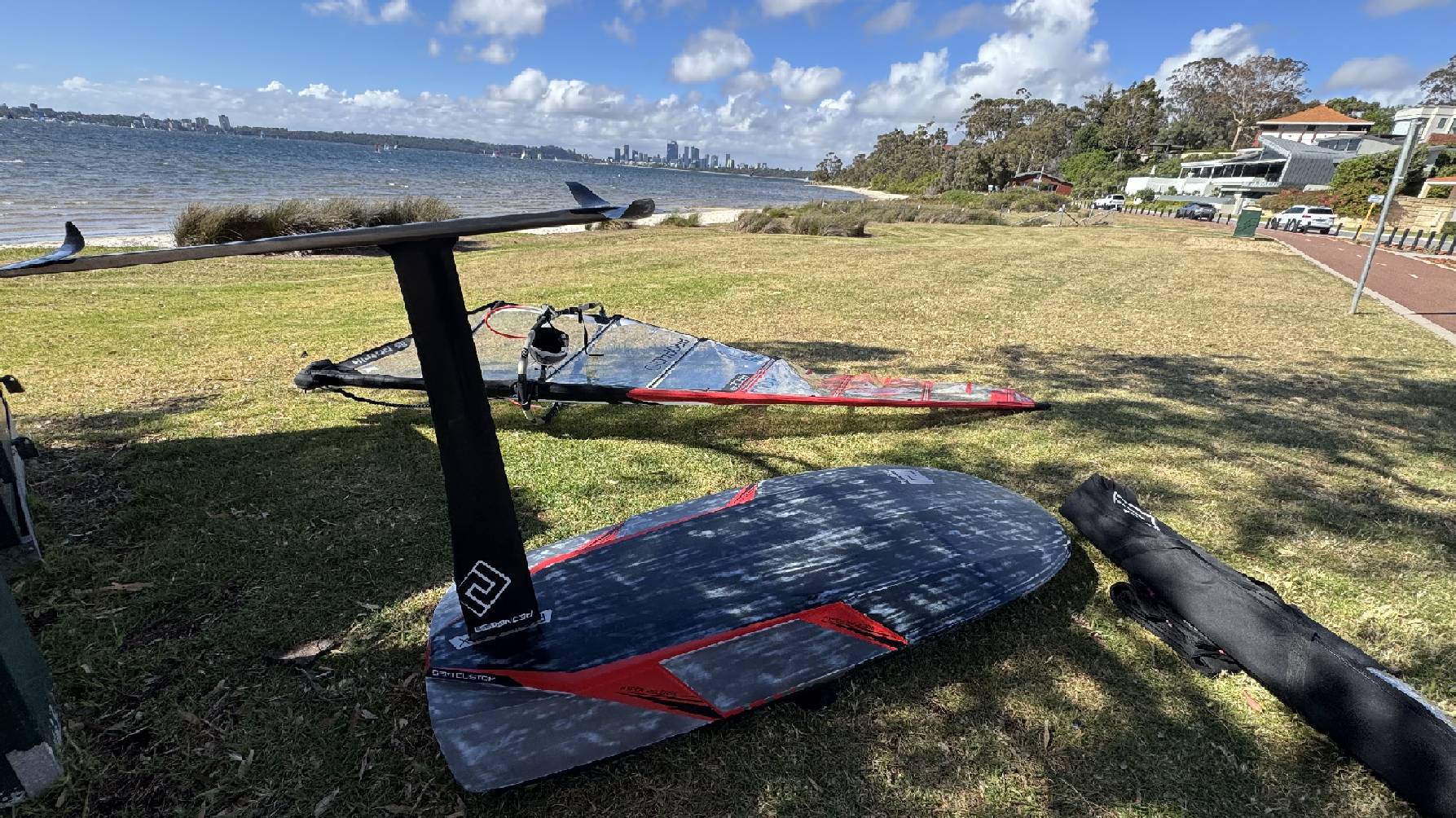
Off the water feels:Getting ready; Slipping the board out of the bag is a umm… intoxicating. I feel like that little 10-year-old getting my first board all over again. (it was Surf Partner - RAD. I loved that thing, so much so I cut and polished the hull weekly with Dad’s car polish to make it go faster - faster in my 10-year-old head) . The Gen 3 is surprisingly light and easy to move around; however, it can catch the wind and take a bit of effort to get on or off the car if I’m not careful.
The grip is full-on; it’s great if you need a bit of skin removed or the wetsuit is looking a little new! It’s really stuck on there and not wearing out anytime soon.
I’ve been using the 55 & 65mm bolts to connect the Foil Mast, plus a washer and plastic bush, I bought the pack of bolts, washers etc from the guys at the Wind Lounge (
en.windlounge.de/products/schraubenbox-fur-windsurfer?variant=45876290846987) - excellent purchase; these guys are great!, but freight to Australia was more than the pack of bolts .
The Foil mast fits like a glove, every time. I subsequently cut my Foil Mast so it could work in both my Foil One Board too, This hasn’t affected things, only the bolts are 10mm longer for the Foil One Board. Setting up the Aeon Foil is easy, possibly easier than other Foil boards, it just works.
Similar to getting it off the car, carrying the board to and from the water can be tricky on the windy days, its a big board, just need to be careful in the wind.
-Cleaning: Not much to say here; I either hose it down by the river once I’ve finished or later at home and dry it out on the rack before putting it back into its cover.
Footstraps are the only thing that slows down the drying time.
-Weight:The Weight of the prototype came in around 9.8 kg’s with footstraps. Maybe this was made stronger for testing but the Gen3 board comes in at 8.5 kg’s and 8.85kg’s with footstraps. On the water it feels lighter underfoot but it doesn’t bounce around uncontrollably in the chop like I thought it might. This, combined with the new sails, feels like I’ve gone from a good quality aluminium road bike to a premium carbon aero bike. It’s smooth like butter, easier, faster and is likely leaving the only limitation between my ears.
-Footstraps:I think they are all pretty much the same now; they feel strong but soft to the touch. I’m really liking the ‘double pluggers’, seems to be widely used across all brands now. The foot strap is locked in place, making it consistent and easy to get my bootie in and out of the hole. Where things could go pear shape though, would be during a catapult. Thankfully, I haven’t had any nasty ones, but I can see there is less give in extreme foot angles. Knowing this I tend to pull my feet out a little bit just so I can get them free quickly and easily. I hit a plastic bag recently at 35 kph; I fell out of the straps and hit the water like a sack of spuds, no damage to me or the gear, but that bag was a right-off.
On the water feels:
The Gen 3 board is surprisingly easy to get going… once I found the right technique, sail size, and foil combo for the conditions.
It is definitely easy to push the rear of the board down and rock this baby onto the plane.
After a couple of sessions, I realised it’s not complicated; it’s just foot position and timing the pump.
The board is wide, so after, say, 10 knots, it's virtually sitting on the water, planing. At that speed, there's just enough speed to get the big front wing generating lift, and with the right pump and chop, I can easily pop onto the 750 cm front wing, and the 650 cm front wing isn’t that far behind it. On the smaller foils and windier days (18 -20+ knots), it's easier to get on the plane; however, when I set the rake to 2.8, it takes a little more speed to rise onto the foil. That said, I’m ok with the foil coming up slowly; it's much more relaxing to cruise up onto the foil at speed. I have enough time to get my feet in and get comfortable. This is especially relevant now these new HA sails accelerate exponentially.
Planing & gybing: (off the foil)
Mucking around on this board just in planing mode has been great fun, so much so I went out with just a fin. (42cm) The board planes easily and is super fun to gybe. Yes, it is a bit heavier than a slalom board, and I can feel the width, but it doesn’t take much effort to bank it into a gybe with my weight outboard close to the rails. I’ve found that sticking to what I imagine is a 70 cm-wide board (or inside width of the front footstraps) seems to be the optimum foot placement. The board glides through gybes; it can bite in bigger chop, sort of 600mm and up and at more than a 45-degree angle. But it’s the acceleration that still blows me away; it performs like a narrower board, but it’s an exponential speed boost as it hits approximately 15 kph.
On any day, it’s a fun bump-and-jump, safe, free-ride type of board. Naturally, while on the fin, I can’t help thinking of the foil.
Planing & gybing: (on the foil)
To me, being on the foil is heaven: the silence, exactness, predictability, and effortless flying above the chop. It’s the fun and excitement of windsurfing without the noise and f$ck I’m getting old joint pain.
In a sublime way, this board literally disappears underfoot; there is less fighting with the conditions and more enjoying them, and, as a result, I have the bandwidth to better read the conditions I’m in or want to be in. It’s comfortable like a Camry, but it has the heart and soul of an F1 car, not that I’ve driven one! In all seriousness and in the spitit of how the board performs, I’ve found I’ve had more opportunities to fly downriver (upwind), enjoy the best spots according to the wind direction and find the flattest spots for speed runs or just chilling. In years past I’d just rock up to the spot I thought would be the best from the weather forecast and sail beam reach until the sun set or the sea breeze choked out. Once I found the technique, rhythm, and got the new sails, I could get the board going almost as easily as the big Foil One board. Yes, there is some effort involved, but I wouldn’t be enjoying this sport if I sat on my date ‘prompting’ what I wanted it to do.
The new sails and board combo has made this board super special; everything is easy, no strain or blowing a valve trying to muscle the kit into the sweet spot. It’s so easy I’ll drop into flow state constantly. It was the thing I was searching for again, taking up WindFoiling. I used to look for this while speed sailing at Point Walter and MTB’ing on the downhill single trails surrounding Perth - Darling Scarp, down south, SE Queensland and the Melbourne hills but it’s even more satisfying now. No other moment exists, just this one, one focus, no phone, emails, deadlines and messages, just pure fun.
Gripes, criticisms and thoughts:Gripes: Harness can push into the side of the deck when jumping back onto the board. I’ve added some rubberised tape here to stop the scratching but when ya tired it’s hard to get onto the board smoothly, especially in strong winds and swell.
Numbered fine lines for the Mast Track; it just makes rigging faster to set the right spot.(Goldilocks)
Gripe: That stupid air vent! Can that at least be a hex head? And why isn’t it at the tail end of a board? or an Automatic thing.
Gripe: The rubber pad between the Foil mast and board falls off the Aeon foil and can scratch the bottom graphics.
Thoughta: I had a crazy idea while messing about with Footstaps. It’s a pain in the arse, and as I was trying to dial it in, I thought, why isn’t it easier? Could they be on a track that can be ‘4-point’ tightened into position, as the Wingers can do with their Mast tracks? Maybe this was tested while I was out of the sport and proved to be another stupid idea.
Conclusions:I’ve really enjoyed getting to know this board; it is a cracking good board. As described above, it takes a few sessions to unlock its secrets, and over time it gets easier, faster, and becomes the perfect board for every occasion, but it’s in the details, and to be fair, the Aeon Foil system complements this board massively. Picking the right size front wing can unlock it in as little as 8 knots, and depending on the wind and the day's appetite for effort, risk & grey matter bandwidth, I’ll run a slightly larger front wing for the lulls and grin and bear it in the gusts.
Most of the time I enjoy those details and recently I learnt some great tips from one of the local windfoilers (Thanks Mike!) I’ve now come full circle on the shims and back to the recommended 1.5° by Patrik. It’s really good, keeping the board stable and dependable. Once the sail is trimmed, boom height and mast track are set right, those fine details are collectively what make a good sailing session turn into a Wow, this was the best session ever!
Something else that Mike mentioned recently that seems so obvious now, although it took the next session for it to fully sink in…. “get the one thing like the sail tuned and balanced right, that way you can focus on the conditions and then do fine-tuning. It’s easier to diagnose what’s going on or not balanced. This makes so much sense in wind foiling, as it is very 3-dimensional with lots going on; if 2 things are fighting against each other, it makes the session just a little harder than it needs to be.
It’s crazy how subtle tuning can take a session from really good to the best session ever. It’s those little tips, from OPE and experimenting, that change and evolve the sailing experience. For example, moving the mast foot 1 or 2 cm further back can stop the sail from pushing the board down during gusts, obvious, right? but so can more downhaul, or raising the boom 1 or 2 cm can mean getting on the plane quicker but harder to hold down in the big gusts while pushing up-wind. There are so many variables that require experimentation, and because we all have different styles, body positioning, weight distribution, heights, appetite for risk, age, flexibility, strength, etc., 1 position for a PWA rider won’t work for us weekend warriors. It helps that the design of the board (gear) complements each other; setting everything in the middle for most is already the perfect place to start.
The huge sweet spot is incredible; it’s what makes this board so good. When the settings are dialled in, it is just about effortless between 10 and 22 knots of wind. (on flat water) It’s slightly harder work at extreme ends of the wind or in the chop. I explore almost every part of the river; it's not boring like in-and-out slalom on the fin (not that there is anything wrong with that), but it's an exploration to find the next best spot or follow a boat or scoot downwind or tack into the next bay. In retrospect, I should have done the research and just picked this one really good board that can do it all. So much thought, precision and focus has gone into this board that, as a user, I just get on and enjoy the flight time. I can muck around with really fine details to make it better, faster, or easier, or just set and forget and enjoy the day.
I hope this helps someone! Keep sailing!
Cheers,
Luke
Gear: (*used in this test)
Sails | Partik *8 & *10m Foil +, *6m Foil S2 & *4.5m HA Gen 1, *5.6m & *6.8m HA Gen2
Masts | Partik *550, *500, *460, *440, *420 & *360 | 40cm mast extender 100% Carbon
Boom | *Patrik 200 XL-Curve | * Patrik 160 L-Curve Carbon Booms
Board | *Patrik Prototype 85 Board (sold)
Board | *Patrik Gen 3 Foil Slalom 85 Board
Board | Patrik Foil One 91 Board
Foil | Patrik Foil One AIO Foil. 900 Front Wing, *1120 Front Wing, *250 Stab - full power
Foil | Aeon Foil System
Foil Mast | *95 Dim-S
Foil Fuse | *100 Ti. V3 | *100 Al. V2
Foil Front Wing | *365 DNA. H | *450 DNA. H | *550 DNA. H |*650 DNA. H | *750 DNA H. | 900 DNA H.
Foil Stab | *160 | *195
Harness | * Mystic Windsurf Racing Harness Black & *Patrik Free Fall Hook.
Wetsuit | *O’Neil Hyper-freak
Protection | *Mystic Downwinder Flotation Vest