The Waterstart: Board First, Then Stand

Quick summary
The waterstart is the move that turns you from a body-dragger into a rider, and it happens in a set order that never changes.
Standing up is the last move, not the first, because the kite provides the lift and your feet only take over once you are already sliding.
The how-to
Lie on your back in deep water, park the kite at 11 or 1 o'clock, get both feet in the straps, sheet in, then stand once the board is moving.
You can already fly the kite, park it, and body-drag with one hand on the bar, so the waterstart is less about kite skill than about sequencing.
The International Kiteboarding Organization teaches it as a fixed sequence, and Kiteboarding Australia, the national body, aligns its instructor training with IKO standards.
That means the order you are about to read is close to identical at almost every school on the Australian coast.
Preparation: wind, water and an honest readiness test
Most Australian schools teach the waterstart in something like 12 to 20 knots, which is a typical teaching range rather than a hard rule.
Below that band the kite cannot pull you out of the water, and above it the power arrives faster than a learner can sheet out.
Onshore is kinder, because a light onshore or cross-onshore breeze pushes your mistakes back towards the beach instead of out to sea.
Check the local sea breeze pattern before you go, including the afternoon build at Perth .
Pick deep water where you can lie on your back without touching bottom, and stay well clear of the shorebreak.
A shore dump will rip the board out of your hands, bury the kite, and turn a simple attempt into a tumble across sand.
Readiness test, if you cannot body-drag upwind a few metres and recover your board, you are not ready to waterstart yet.
Your kite should be sized so it can lift you from the water on a simple dive, without needing a loop or a violent send.
Initiation: getting into position on your back
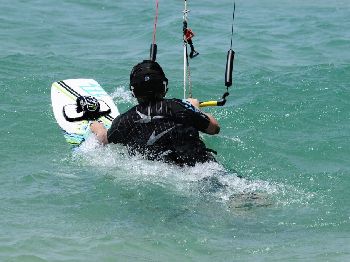
Float on your back with your shoulders low in the water and the kite parked at about 11 o'clock or 1 o'clock.
Never park it at 12, because a kite directly overhead lifts you vertically instead of pulling you forward onto the board.
Hold the board on the downwind side of your body, close enough that both knees can fold up to meet it.
If the board drifts too far downwind you will be reaching for it, and a reaching rider cannot get both feet into the straps.
Slide the front foot in first, then the back foot, and keep both feet in the straps while you are still lying down.
Front hand steadies, resting on the rail or front strap while your bar hand keeps the kite sitting patiently at 11 or 1.
Now point the board across the wind, not straight downwind, with the nose angled only slightly off the wind direction.
A board aimed straight downwind will shoot out from under you the instant the power arrives.
The kite does the lifting, and your only job is to keep the board across the wind with your weight on the back foot until you are already sliding.
Commitment: sheet in and let the kite do the work
With the board across the wind and both feet locked in, steer the kite down through the power zone and sheet in by pulling the bar.
The kite dives, line tension jumps, and you feel your body being dragged forward rather than hauled straight upward.
Keep your knees tucked towards your chest and your backside in the water while that pull builds.
Weight on the back foot, which keeps the nose of the board up and stops it tripping and diving.
If the pull throws you over the front, sheet out immediately by letting the bar move away from you.
Sheeting out is your brake, and using it early costs you nothing more than a restart.
Execution: slide first, then stand
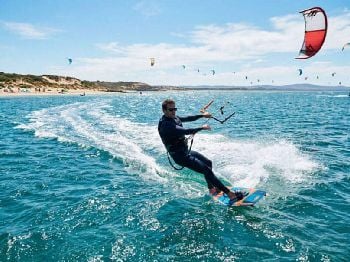
You will feel the board begin to plane and hiss under your feet, and that hiss is your only cue to move.
Once the board is sliding, straighten the front leg and push your hips up and forward over the board.
Stand tall through the back leg, keep a small bend in both knees, and look where you want to go.
Keep your eyes along the water ahead, never down at your feet, because your body quietly follows your gaze.
Ride slightly downwind for the first few seconds to build speed, then edge gently upwind once you feel steady.
Keep your downwind corridor clear, because a failed waterstart drifts you downwind quickly and other riders cannot read your intentions.
Failure diagnosis: why you are still swimming
Lifted straight up and dropped again, that is the kite sitting at 12 instead of 11 or 1.
Cannot reach the straps, the board has drifted too far downwind, so pull it back against your hip before trying again.
Board shoots out and you land on your back, you were pointing straight downwind instead of across the wind.
Nothing happens when you sheet in, the kite was already parked at the edge of the window with no power zone left to dive through.
You stand and immediately fall forward, you stood too early and your weight went over the nose before the board was sliding.
Nothing happens at all, the wind is too light for your kite and no amount of technique fixes that.
Should I learn the waterstart in flat water or small waves?
Flat water every time, because chop and shorebreak steal the board and hide the exact moment the kite begins to pull.
How long should it take to land my first ride?
Most riders who can already body-drag upwind get a few metres of riding within one or two sessions of honest attempts.
What if I keep drifting downwind between attempts?
Body-drag upwind to reset your position, then start again, and end the session while you still have beach upwind of you.
Where can I compare notes with other riders?
The forums are full of riders who have worked through the same sticking points at the same local beaches.