Harness Technique: Stop Arm-Wrestling the Rig

Quick summary
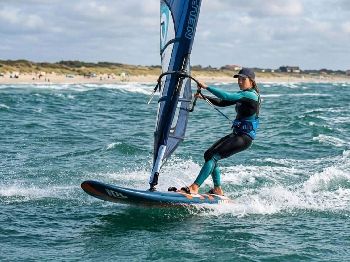
If your arms are burning after a session, you are not using the harness correctly - the harness should carry around 90% of the rig's load, leaving your arms nearly straight.
Correct harness line placement at the rig's balance point is the single most important setup step, and most tired-arm problems trace back to lines set too far forward or too far back.
The how-to
After reading, you will know how to find your rig's balance point, set lines correctly, and hook in with a technique that moves the load from your arms to your body.
Your arms should not be tired after a windsurfing session.
If they are, you are not hooked in correctly - or not hooked in at all for the portions of the session when you should be.
The harness is not an accessory for when conditions get rough - it is the primary load-bearing system for any wind above roughly 10 knots, and getting it right is the biggest single skill step between beginner and intermediate windsurfing.
The balance point: why setup matters before you even launch
Harness lines must sit at the balance point of the rig - the spot where the rig hangs level if you support it from the boom with one finger.
Finding it takes two minutes.
Stand the rig with the mast foot on the ground, hold the boom with both hands shoulder-width apart, and slide your hands together until you feel the rig balance without pulling forward or back.
Mark that point, then attach your harness line so its midpoint sits there, with the two attachment loops shoulder-width apart on either side of the balance point.
If the lines are set too far forward, your back hand takes constant strain; too far back, and your front hand works overtime against the pull.
Both problems show up as arm fatigue within the first ten minutes on the water.
Line length: getting the distance right
Harness lines for most adult windsurfers run between 60 and 80 centimetres (24 to 32 inches), with shorter lines giving a more upright, active stance and longer lines allowing a laid-back, high-wind posture.
If you are learning to hook in, start at the longer end of that range - around 75 centimetres.
Long lines keep the rig at a distance that lets your arms straighten almost fully, which is the correct position once you are hooked in.
A line that is too short bends your arms and transfers the load back to your biceps instead of the harness.
This is also why cheap or worn lines that have shrunk create exactly the same tired-arm symptoms as lines set at the wrong position on the boom.
Ninety percent of the rig's load goes through the harness. Your arms steer - they do not hold.
Peter Hart, a technique coach contributing to Windsurf Magazine, describes the correct hooked-in state as one where the arms are used purely for steering and minor adjustments - any sustained grip strength means something in the setup is wrong.
Hooking in: the actual technique
Hooking in is a three-part move: sink, pull, push.
Sink slightly by bending your knees, which brings your harness hook closer to the line and takes some tension out of the rig for a moment.
Pull the boom sharply toward you with a short flick - not a sustained pull - to swing the harness line outward and toward the hook.
Push your hips forward as the line reaches the hook, and the hook catches it.
Once hooked in, push back and down through your harness rather than pulling with your arms - your arms should immediately feel lighter, and if they do not, the lines need repositioning.
Your weight distribution at this point should be roughly 90% through the harness and 5% on each hand.
Maintaining the stance once hooked in
The correct hooked-in stance looks like you are leaning back against an invisible chair, with hips forward and shoulders sitting back over your heels.
In lighter winds, your legs stay relatively straight.
As the wind builds, bend your knees more and sink your hips further - but keep the gap between your harness hook and the boom consistent, which maintains the load angle regardless of wind strength.
The common error when a gust hits is to straighten up, which moves the load back onto the arms and creates the sensation of suddenly being overpowered on a sail you were comfortable on moments before.
Instead, sink into the gust - drop your hips, keep your shoulders back, and the harness absorbs the increase.
Unhooking: when and how
Unhook before any manoeuvre that requires significant steering input - tacks, gybes, and recovery from major gusts or lulls.
The unhook technique mirrors the hook-in: pull the boom toward you, push your hips forward and keep your shoulders back, and the line falls out of the hook without any need to reach down.
Many riders unhook by bending forward at the waist - this drops the boom, stalls the sail, and usually results in a catapult or a fall to windward.
Keeping your shoulders back during the unhook keeps the sail powered and the board tracking while your hands take over the load.
Seat harness vs waist harness
The seat harness has a lower hook point, which promotes a naturally better high-wind stance by pushing your hips forward and your centre of gravity low - this is why most instructors recommend it for riders still developing their harness technique.
The waist harness gives more mobility and a higher hook point, which suits freestyle and lighter-wind sessions where you need to move quickly around the board.
If you are still building your harness skill, a seat harness will actively shape your stance in a way a waist harness does not - it functions as a training tool as much as a piece of safety gear.
Your next session: one thing to focus on
Go out on a day with a steady 10-15 knot wind - enough to use the harness continuously without being overpowered - and set a single goal: hook in, let your arms straighten, and hold for ten seconds.
If you can hold that without the line popping out or your arms creeping back into a bent position, your technique and line setup are working together.
If not, move the line position toward the back of the boom by 5 centimetres at a time and repeat the test until the load transfers cleanly through the harness.
Check the Perth wind forecast or the Sydney wind forecast for the next steady sea-breeze window to put this into practice.
Questions
What if the harness line keeps popping out?
The line pops out when you bend your arms or pull the boom in - both moves close the gap between your harness hook and the boom and allow the line to fall off.
Can I use the harness in light winds?
You can, but the harness becomes useful only when the rig has enough load to hold tension in the line - below about 8-10 knots, the sail often does not carry enough load to keep the line taut.
My lower back hurts after harness sessions - is that normal?
Lower back soreness early on is common - it means your core and lower back are doing work they have not done before, and it fades as they adapt over a few sessions.
Should I use shorter or longer lines in stronger winds?
Stronger winds generally suit shorter lines, which allow a more compact and powerful stance - experienced riders often drop from 75cm to 65cm lines when the wind builds past 20 knots.