The Carve Gybe: Commit the Rail

Quick summary
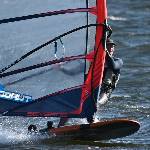
The carve gybe is a planing turn where the board stays on its rail through a smooth arc downwind, onto the new tack, and only then does the sail flip.
Most gybes fail because the sail swap happens before the board has carved through the turn, which unloads the rail and dumps you off the plane.
The how-to
Work through the five stages below in order, because the sequence matters far more than the effort you put into any single part of the turn.
Preparation
Get properly planing before you even think about turning, because a carve gybe is a planing manoeuvre and there is nothing to carve if the board is sinking.
Pick your wind, because 14 to 22 knots of steady onshore or cross-onshore sea breeze gives you enough drive to hold speed all the way through the arc.
Slightly overpowered is easier than underpowered, since a loaded sail keeps the board moving as you head downwind and the apparent wind falls away.
Both feet in the straps, harness lines at a length you can reach quickly, and the boom set so your back hand has room to sheet hard.
Learn on flat water inside a reef or in a sheltered bay, where chop will not knock the rail out from under you halfway through.
Check a sea breeze forecast such as the Perth wind forecast and pick a steady afternoon rather than a gusty, patchy morning.
Initiation
Bear away slightly to build maximum speed, because the faster you enter the turn, the less the apparent wind collapses as you swing downwind.
Look where you are going, turning your head through the arc so your shoulders and hips follow the line you want the board to take.
Unhooking is optional and best left late, since staying hooked in for the first part of the turn keeps the sail loaded and the rail pressed.
Take your back foot out of the strap and place it on the leeward rail between the two straps, with your heel over the edge.
Sink that leeward rail with steady pressure through your toes and the ball of your foot, and feel the board begin to bank.
Sheet in with your back hand as you bank, which loads the fin and stops the tail sliding out from under you.
Commitment
This is where gybes are won or lost, because the board needs to travel a long way downwind on its rail before anything else changes.
Stay low, dropping your hips and bending your knees so your weight goes into the rail rather than up into your shoulders.
Keep carving as the board swings from a reach towards dead downwind, with the sail still sheeted in and still pulling.
The board changes direction on the rail first. The sail swap is the last thing that happens, not the thing that makes the turn happen.
Your front hand slides along the boom towards the mast while your back hand keeps sheeting, which keeps the rig quiet and the power steady.
The arc should feel long and smooth rather than a sharp hook, so give yourself ten metres or more of turning radius.
If you can hear the fin working and feel the board pressing up into your feet, the rail is loaded and doing its job.
Execution
Only once the board has passed dead downwind and is swinging onto the new reach do you deal with the sail.
Flip the rig, releasing the boom with your back hand and letting the sail rotate around the mast as the clew swings forward.
Your old front hand stays on the boom near the mast, giving you something solid to hold while the rig comes around.
New front hand finds the boom first, then the new back hand, and only then do you sheet in on the new tack.
Keep your knees bent and the board flat as the sail refills, because standing tall now will bounce you straight off the plane.
Hook in last, slide your feet into the straps, and bear away a touch to rebuild speed before you head back upwind.
Failure diagnosis
Nearly every failed carve gybe traces back to one of five things, and four of them have nothing to do with sail handling.
You stood up, which lifts your weight off the leeward rail so the board flattens and the turn simply stops happening.
You sheeted out too early, the sail stopped pulling, the fin lost its bite and the tail washed out sideways.
You flipped the sail too soon, before the board had come through the wind, so you ended up parked head to wind with no drive.
Your back foot was too far forward, up near the mast foot, which leaves you unable to steer the tail and the carve washes out.
You tried it in too little wind, so the board dropped off the plane in the middle of the arc and the gybe was over before the flip.
Fix the carve first and the sail flip becomes almost incidental, which is why so many sailors blame the rig for a problem in their feet.
Should you unhook early or late?
Late, because staying hooked in through the first half of the arc keeps the sail loaded and your weight driving down into the rail.
Why does your gybe work in 20 knots and fail in 12?
In lighter wind the apparent wind disappears as you turn downwind, so the board falls off the plane before you reach the sail flip.
How wide should the arc be?
Wide enough that the turn takes several seconds, since a tight hook scrubs all your speed and leaves nothing to carry you onto the new tack.
What if you keep swimming at the sail flip?
Carve ten gybes without flipping at all, just to feel the rail hold, then add the rig work back in and compare notes in the forums .