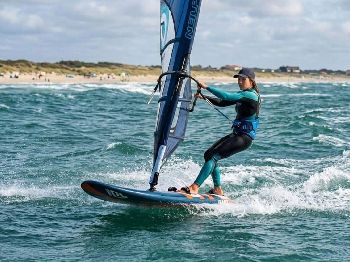
The Beach Start: Get On Without the Stumble

Quick summary
The beach start replaces the uphaul in knee-deep water, letting the sail lift you onto the board while your feet find the deck one at a time.
The stumble that sends most riders over the front is a sequencing fault rather than a strength problem, and the fix is in which order you point and power.
The how-to
Float the board just off the wind, back foot on the deck, front foot across, then sheet in smoothly and ride out before you think about the straps.
You can already uphaul and sail across the wind, which means the rig is no longer a mystery and the main cost of a fall is the energy spent getting back up.
The beach start removes that cost, taking you from standing beside the board to sailing away without lifting the rig by hand at all.
Most riders blame their legs when the board surges forward and they pitch over the nose in front of everyone on the sand.
The legs are almost never the problem, because the sail pulls you over the front when you sheet in before the board is pointed off the wind.
Preparation: read the wind and set the board
Around 12 to 18 knots of onshore or cross-onshore breeze is the usual teaching window on Australian beaches, and it is the range where this sequence works first time.
Offshore wind turns every failed attempt into a drift away from the beach, so leave the beach start for a day when the breeze is pushing you home.
Watch the afternoon build before you commit, and the Perth wind forecast is a good example of a sea breeze that arrives on a predictable schedule.
Stand in knee-deep water with the board floating free, the daggerboard retracted or removed, and the fin well clear of the sand.
Point the nose just off the wind, which means slightly downwind of a beam reach rather than anywhere near head to wind.
Swing the rig so the mast sits across the wind with the clew out of the water and the sail angled slightly back towards the tail.
Front hand goes on the mast or the front of the boom, back hand sits on the boom roughly where you hold it while sailing.
Leave the harness lines unhooked for now, since you want the freedom to sheet out instantly if the gust arrives early.
Initiation: back foot, front foot, then sheet
Place the back foot on the deck near the rear strap with the heel close to the centre line, keeping your body weight in the water.
Let the board carry that foot rather than pushing down on it, because a sunken tail makes the nose swing straight back into the wind.
Check the angle of the nose again before you load anything, since the board will have drifted while you were sorting out your feet.
Extend the front arm to reset, pushing the mast forward so the nose bears away and sits downwind of the beam once more.
Only then bring the front foot across and onto the deck between the mast base and the front strap.
Sheet in smoothly with the back hand and the sail becomes a handrail that lifts your hips up and over the board.
Commitment: look where you are going
Your eyes should be out on the water along the line you intend to sail, not down at the boom or your feet.
Staring at the boom rolls your shoulders inwards, which over-sheets the sail at the exact moment the board needs to be running free.
Point it, then power it. The board chooses the direction and the sail only chooses when you leave.
Half-committing is worse than not starting, because a hesitant sheet-in leaves you hanging off the rig with no drive to stand up on.
Execution: ride out before you change anything
As the rig lifts you, straighten the front leg, bring your hips over the centre line and stand tall with both feet in line.
Sail out on a broad reach for twenty or thirty metres and get the board tracking properly before you adjust your stance.
Straps come later, and the front foot only slides in once you have enough speed to keep the board flat and level.
On a 120 to 140 litre freeride board that usually means waiting until the hull feels light and the rig has settled forward.
Failure diagnosis: what actually went wrong
You went over the nose, which happens because you sheeted in while the board was still aiming into the wind and the rig dragged you forward.
The board kept rounding up, usually from standing too far forward or from pressing down hard on that back foot.
Nothing lifted you at all, meaning there was not enough breeze to carry your weight and not enough to plane away from the shore either.
You finished a long way out, which is the offshore trap where each failed start puts more water between you and the beach.
If you cannot uphaul comfortably in the wind you have in front of you, you are not ready to beach start in it.
That is about having a recovery option when the start fails in chest-deep water, rather than about nerve or fitness.
Run ten attempts in a row on the same stretch of shallow water and the pointing habit will build itself into the sequence.
Plenty of riders share their local shallow-water spots and timing tips in the forums if you want somewhere flat to practise.