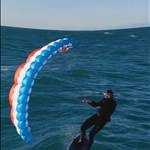
In this video, Tucker from MACkite shares a valuable tip for anyone struggling to get up on foil while using a parawing—whether they’re still learning or just riding underpowered gear in light wind conditions. He calls it the “Parawing S-Start Method,” a technique he developed through trial and error while testing smaller wings, like 3m models, in marginal wind conditions that wouldn’t typically generate enough lift for a straightforward water start. Tucker explains that the usual takeoff technique—involving pointing slightly downwind and relying on steady wind to generate enough apparent wind and board speed—often doesn’t cut it when you’re underpowered. Instead, he recommends a more dynamic approach that utilizes wave energy, precise wing handling, and thoughtful board direction changes to maximize every bit of available power. Starting in a kneeling position, Tucker raises the wing, stands, and begins heading slightly downwind, about 10 to 15 degrees off the wind. If there’s not enough power to get going, this is when the “S” concept kicks in. Rather than maintaining a straight line, he looks upwind to anticipate approaching swells. As a wave rolls toward him, he accelerates slightly and bears off just a bit more downwind to use the swell’s energy. This slingshot-like moment helps push him forward while also allowing the wing to stall slightly backward in the wind window. At this point, he gives the wing a few quick, smooth pumps—not aggressive jerks—to generate airflow and re-engage the wing’s drive. This controlled motion moves the wing forward, helping to build board speed. Simultaneously, Tucker starts pumping the board with his legs—not huge front-to-back motions, but subtle weight shifts to unweight the board and mimic a downhill run, especially if the swell’s giving him some push. Once he starts to feel lift, he transitions into a gentle carve back toward the wind—not straight upwind, but more perpendicular to it—while pumping both the wing and board in unison. This directional change, combined with exiting off the back of the swell, helps generate that last burst of speed needed to lift onto foil. He refers to this whole process as making an “S” shape—beginning with a slight downwind push, then carving back up toward the wind in an S-pattern. The key is using everything available: swell energy, smart board angles, wing positioning, and strategic pumping. Though it may sound complex, Tucker assures viewers that with repetition, it becomes intuitive, especially when that timing and feel start to click. Thank you for sharing the kiteboarding and wing foiling stoke with us! 🤙🏽 Please join us in the comments section and get a conversation started. We’re always happy to help! 🔥 LIKES and SUBS are like online BRO-HUGS! 🔥 https://www.mackiteboarding.com P | 800.622.4655 E | mailto:[email protected] Live Chat: https://messenger.providesupport.com/messenger/mackite.html MACkite Blog and Knowledge Center: https://www.mackiteboarding.com/news/ https://www.mackiteboarding.com/kiteboarding-information.htm