quote:
Originally posted by fver
2. tremendous increase of power with speed... resulting in more speed... thus more power... thus more speed... and so on! Adrenaline rush garanteed!!!
Some food for thoughts based on my experience in going fast with a Speed...
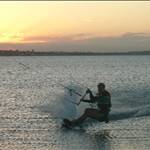
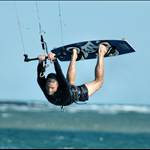
The Ocean I ride on the ocean. So riding fast is better on a not-too-bumpy ocean surface, or more commonly, heading roughly in the same direction than the swell (that generally means heading back to shore for Perth conditions). I reserve the other tack (riding against the swell) for jumping using the swell as take off ramps!
The BoardMy experience suggests that the board is very important to enjoy the possibilities of a fast kite. I have an old Airush Switch Pro board 147 x 33 and a 2007 Nobile 666 132x44. I find the Airush board much better to go fast than the Nobile one (which is great for other purposes).
The 147x33 Airush board conveys the following advantages:
- long board: more stable at high speed, smoother ride by decreasing the effect of the small bumps on the ocean. The board also does not dive into the swell;
- relatively narrow board: minimise board surface area and thus allow to hold an edge under power and speed;
- round edges: this results in a board that is not too responsive, thus more forgiving at high speed;
- stiff board (no flex): the board does not loose speed by absorbing the energy of impacts against the water surface. The board bounces against the water and keeps its speed.
I think a shorter and wider board, such as the Nobile 132X44, is not ideal for speed because:
- definitely a slower board than a long narrow one;
- harder to keep the edge at high speed;
- more prone to dive into the swell;
- the board reacts at smaller bumps on the water surface.
(compared to the Airush Switch Pro board, the Nobile 666 is shorter, wider, more flex, sharp egdes and lighter)
The WindI like the 18-22 knots range to be able to put the kite very deep into the power zone. I am approx 80 kg.
TechnicOnce planning, kite at 45degres above the horizon and 2 o'clock, the aim is to progressively bring the kite lower above the horizon (2 to 4 m above the water), and deeper into the power zone (1 o'clock). The transition should be progressive and takes approximately 100 m to 200 m of riding. The general idea of the manoevre is, that after 200m, the kite should be as close to 12o'clock as possible, as low above the horizon as possible, and as sheeted in as possible without backstalling. This relies on:
1- getting progressively some speed;
2- the speed creates more power to the kite;
3- the kite can be slightly more powered up without stalling and brought closer to the power zone;
4- bringing the kite closer to the power zone creates more power, consequently more speed;
5- back to 2;
Once the kite is deep into the power zone, working the kite in a tight sinuosidal motion will provide the extra apparent wind and give the extra power and speed that brings euphoria!!!!
The maximum power/speed is reached when:
- you are riding as fast as the kite (cannot bring extra power by riding faster); and
- the kite is deep into the power zone (cannot add power from suitable placement of the kite in the wind window); and
- you are working the kite in the power zone (cannot create extra apparent wind); and
- the kite is powered up close as close as possible from backstalling (cannot add power by sheeting in).
A long story...

Fred



 ) here is my opinion why Flysurfer makes the ONLY truly light wind option that works.
 ).
).