cisco said..Datawiz said..
So, I'm entering Port Phillip Heads with a gusty following wind and steep waves (maybe 3m) against a strong ebb (had a senior moment & misread slack water time).
<div>
<div>I'm my fin keel, wheel steered, Catalina 34, under engine with no sails up.
Catalina 34 should track very well and if it was tiller steered rather than wheel I don't think you would have had as much drama. My personal belief is that wheel steering has no place on yachts less than 40 ft in length. A Peterson 42 I previously owned had tiller steering which was perfect. The machismo fool that bought it from me HAD to put wheel steer on her.
"Directly downwind and following seas can be a hairy situation, particularly in restricted waters like the Pinchgut".
You're right there Cisco
"If you run in at 90 degrees to the swell, you run the risk of a pitch pole if the seas are big and steep. "
Thankfully the waves were not steep enough for this to be a problem - not breaking eitherIf you can hold her under power alone at a slight angle off 90 degrees to one side or the other she should surf in well.
I think in this case that would be dangerous - I felt the best tactic was to motor slowly keeping the stern at 90 deg to the waves and immediately counter the forces causing the stern to slew into a broaching situation.
This required significant effort on the wheel, the forces on the rudder were large enough for me to think about what I needed to do if I lost steering due to something breaking. The wheel to rudder gear ratio is about 2.5 to 1, so the rudder forces were quite significant.
I needed two hands on the wheel, well braced with a short tether to the pedestal.
My tactic worked but if anything broke, I think it would have been all over.If the wind is say slightly on the stbd quarter and you have a moderate amount of jib poled out to port, you should be able to ride in heaving the rudder to port just to keep her out of the broach which will be assisted by the head sail tending to drag the bow to port.
Sounds OK, but I think a poled out jib would gybe when in the trough of the wave. The mechanics were as follows - after the last correction, the stern is 90deg to the waves.
When the next wave arrives, it lifts the stern and the associated current at the top of the wave forces the stern to port. The boat surges starboard a little way down the wave as I forcefully try to correct a possible broach by turning the wheel to port. As the wave passes under me, I am now in the trough and slowing. The associated trough current (opposite to the peak current) is now aiding the port rudder attempting to slew the stern to starboard to which I am correcting by turning the wheel to starboard. The overall effect is I end up with the stern 90deg to the waves awaiting the next wave.
You got it right anyway as you are here to tell the tale.

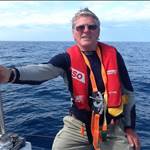
Glad to see in your avatar that you are wearing your life jacket!!!!
 Combo life jacket and harness - I don't take chances.
What Ramona says about auto pilot rings true as long as it is directly to steering quadrant or tiller. Raymarine auto pilots that are belted to wheel steering get wet and will slip. That confuses the auto pilot no end.
Yeah, I can't trust the Raymarine in testing conditions.