Thanks Kato for pointing me at this forum and good on ya Hardie for the topic.
A very interesting read for the last hour or so......
I kept thinking "I must reply to that post" and then I would get a bit further down and find that someone else had said pretty much just what I was thinking. Definately some very cluey people here

A few thoughts to add:
Sail floppy at the top? Mega downhaul fast?
Slowboat put it best I think. There is definitly an optimum for every sail and combination of conditions. Too much is just as bad as too little. My total range of downhaul tuning for the 4.4m Koncept up the the 6.6m is about 2.5 cm from one extreme to the other. Maybe less...
The more interesting question is why is the floppy top fast. I think the biggest factor is getting the centre of effort down lower to where you can get the most effient use of it (leverage). For racing and upwind in variable conditions a long boom is better but to keep that power low and under control you want the excess area up top not lifting, just smoothing the flow. In broad conditions on smooth water the apparent wind is very high. The optimum sail will be smaller and fuller at the boom but must still keep the C of E low where you can make best use of it. The choppier it gets, the more advantage you get from more sail area and power as you speed will generally be lower (less apparent wind) and you must plough through the chop with max power.
Another way to look at it. There is a limit to how much power your body weight and stance can hold. Any more sail (power) than that is just useless drag. Optimum effeciency is the aim.
Sail size is also relative to your body size. For me at 74 Kilos a 4.4m sail is pretty much the same as a 5.8m sail for Tony Wynhoven at 107K. We both seem about right with those sizes in 30-35 knots of wind. Someone who is good at 'rithmatic may be able to confirm this. I won't be holding a 5m sail in 50+ knots just 'cause Finian does!

I recon Hardie got it right about sheeting out to go faster. On a very broad course when you get a gust and you are already holding all the power you can use, sheeting out a little bit takes the load off the fin and allows for less drag. It also, very importantly, puts the direction of the lift closer to the direction of travel = go faster. Also, to sheet in in that situation often just results in a short flight followed by an abrupt halt!
"what are the main differences in fins and what makes a speed fin a speed fin as opposed to another?"
This is simple: A speed fin is faster!
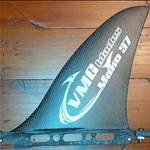
Oh, ok. I guess I could elaborate. Slalom fins are often optimised for speeds in the low to mid 30's and a relitively tight angle (compared with speed sailing). Even though some good ones are capable of 40 knots, they are often past their optimum effeciency range. Too much lift and drag and running close to cavitation. Speed fins are optimised for 35-45 knots speeds and designed to resist cavitiation (and hence a huge drag wall) until well past those speeds. Of course a 'speed' fin will not go as well as a slalom fin in most slalom racing conditions, but they kick arse on a speed course.
Mal Wright has done a huge amount of development in the last couple of years and his latest TM45v7 is very versatile for speed sailing (as long as you have a Starboard Tack course). Compared with the v6 it has a much broader range. The v6 is a bit of a trick to get into top gear in some conditions, but is unbelievibly fast when it is 'switched on'. The aim of the v7 was to get it to 'drop in' or 'switch on' very easily even if it ment a slight loss of top end speed. As it turns out, the difference is astounding! The v7 seems to be almost permanently 'switched on' and the top end does not seem to suffer at all. This fin will work just as well at 35 knots as at 45 knots and will still keep accellerating under high loads.
Assy's are a big advantage on the speed course. The feeling of stability and security is not to be dismissed lightly and the smaller size gives a big lift to drag gain. The latest versions are quite ok upwind in their sweet spot at around 20 knots. Sure, they crab a bit and they must be kept in their best speed range, but this is a small price for the huge benefit downwind.
GPS's: The Foretrex is very well designed for ease of use but suffers from a disappointing lack of precision and limited memory space. The Navi GT-11 is slightly larger and not quite as easy to use when sailing (firmware updates are rapidly overcoming that) but is far more accurate and holds a massive amount more trackpoints in its SD card memory. It is also much easier and faster to download with a simple card reader and best of all it records NMEA data which includes much more information on the number of satellites seen and the actual precision at any given moment.It also records the 'Doppler' speed (basically what you see on the GPS screen) which has the potential to be even more accurate. In short, the speeds are more accurate and can be verified with more confidence.
Phew! I better give my fat thumbs a rest. Just my slant on a few things. Hope it stirs some thoughts.
Andrew D