Crabbing Australia: Gear, Tides and Two Species

Quick summary
Mud crabs dominate northern Australia's mangrove estuaries; blue swimmer crabs are the target from southern NSW to WA's south coast and into SA and Victoria.
Drop nets and collapsible pots are the standard gear - success comes down to tidal timing, bait placement, and knowing which species you're chasing.
The how-to
This guide covers both species: gear selection, reading tides, bait, safe handling, and current size and bag limits by state.
Australia has two recreational crabbing species worth knowing: the mud crab (Scylla serrata), a heavyweight of northern estuaries from the Kimberley to northern NSW, and the blue swimmer crab (Portunus pelagicus), which ranges from southern Queensland through NSW, Victoria, South Australia and coastal WA.
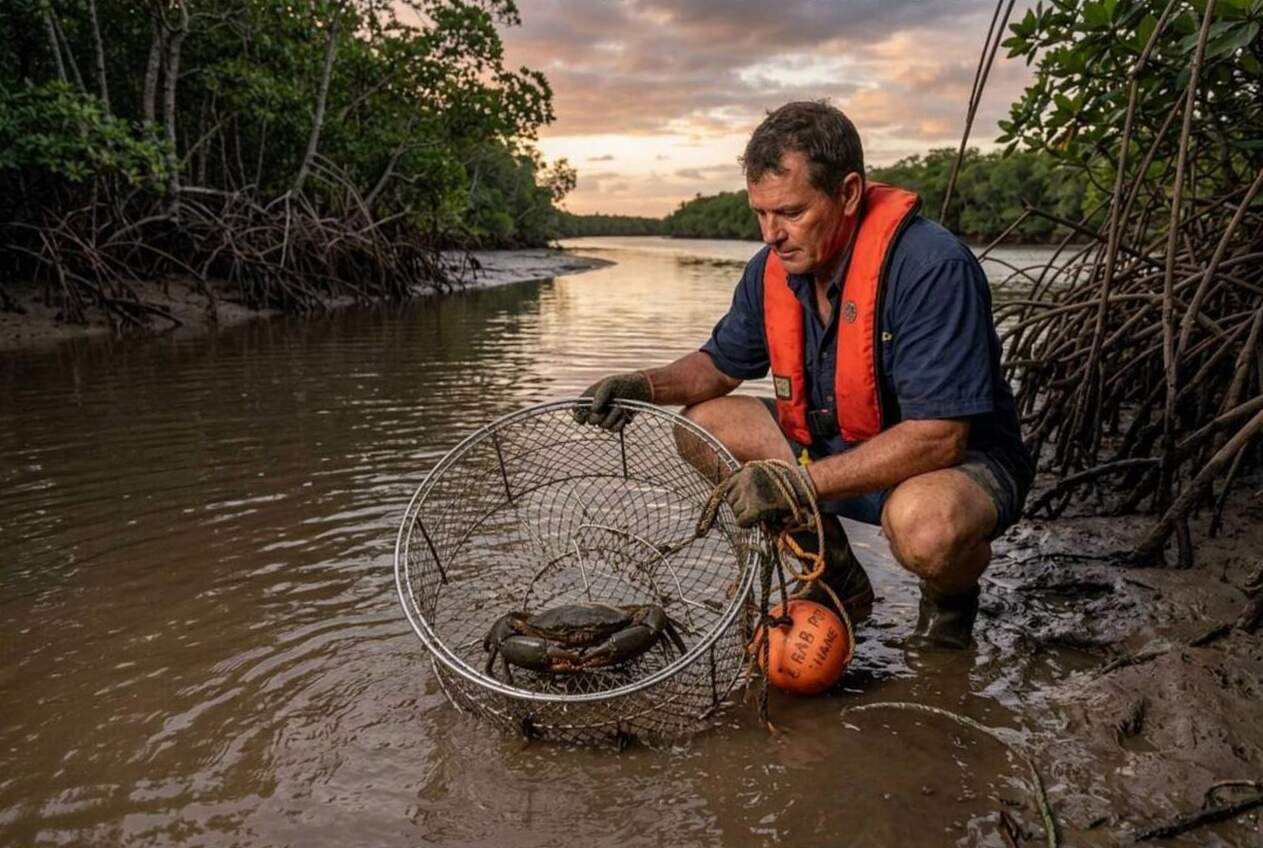
They live in different environments, respond to tidal movement in different ways, and need to be handled very differently once you've got them.
Two species, two regions
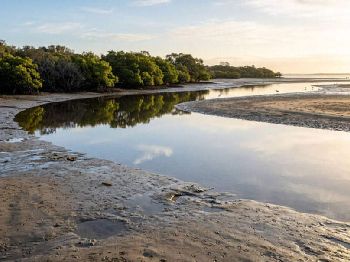
Mud crabs prefer dense mangrove estuaries with soft muddy or sandy substrate - calm, sheltered systems with enough current to carry scent trails but not enough to flush their pots clean.
They're largely nocturnal and most active when water temperature exceeds 25°C, which is why the best mud crabbing runs from late spring through autumn across most of their range.
Blue swimmer crabs prefer open sandy and seagrass-bed habitat - the margins of estuaries, shallow bay flats, and tidal channels - and are active in daylight, particularly on the flood tide when they push into the shallows to feed.
The non-obvious difference: blue swimmers don't actively swim against the current to find food - they travel with the flood tide and feed on what they encounter.
Position your drop net or pot so it intercepts crabs moving with the incoming tide, not sitting in slack water waiting for them to hunt it out.
Gear
Three types of gear account for almost all recreational crabbing: drop nets (also called hoop nets or dilly nets), collapsible crab traps, and lift nets - the method varies by state regulations, target species, and habitat.
Drop nets are the go-to for blue swimmers - a flat ring net that lies on the seafloor with bait in the centre, raised quickly when you see or feel a crab working the bait.
They need supervision because the net is open - any crab not actively feeding when you lift will escape as the net rises.
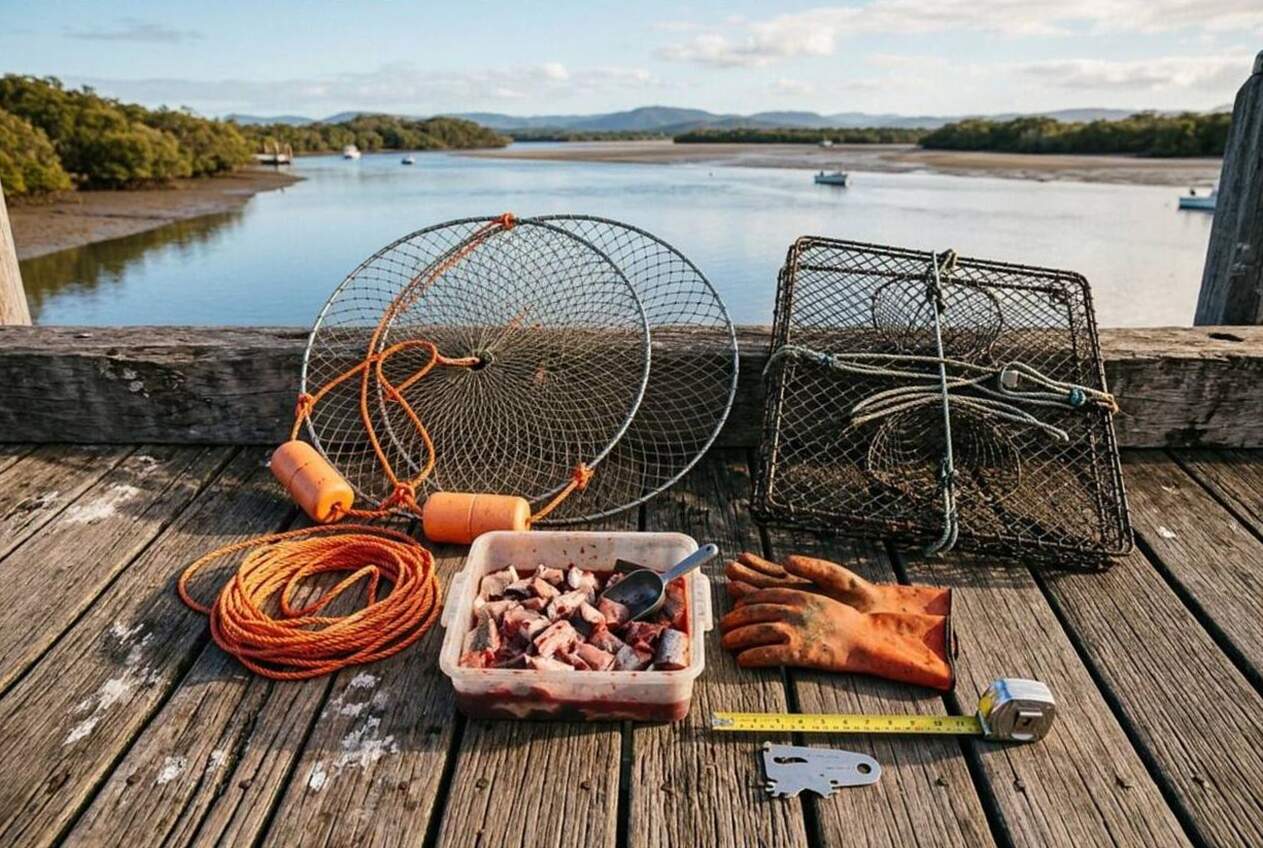 In NSW, you can use up to 4 hoop nets with a maximum diameter of 1.25m (4ft) and minimum mesh size of 13mm diagonal.
In Queensland, up to 4 traps total are permitted, covering any combination of collapsible traps, dilly nets, and funnel or pyramid traps.
In the Northern Territory, 5 pots or dillies per person is the maximum.
Collapsible crab pots suit mud crabbing well - they can be baited and left for hours, or overnight, and the funnel entry makes escape difficult once a crab is inside.
Pots work in flowing current because the scent trail from the bait disperses continuously, drawing crabs from a wider area than a passive net in still water.
Space pots at least 200m apart in large estuary systems - mud crabs travel with the tide and multiple pots set close together in the same tidal corridor compete with each other, not with other crabbers.
Tidal timing
For mud crabs, the critical principle is current - crabs go dormant at slack tide and move actively when the current runs.
Set or check your pots during a running tide: the last two hours of the run-in or the first two hours of the run-out consistently produce more crabs than working the slack.
New and full moon phases amplify tidal current strength, which is why these periods have a strong reputation among experienced crabbers - more current means more crab movement, not magic.
For blue swimmers, the flood tide is the trigger - they move inshore on the incoming water and retreat to deeper channels as the tide ebbs.
The most productive window for blue swimmers is typically the two hours either side of high water, when they're spread across shallow flats and feeding actively.
Use Seabreeze tide charts to plan your session around the tide - knowing exactly when the run builds and when it slackens lets you time pot checks to coincide with peak movement.
"Set your pots during the run, not the slack - mud crabs travel with current, and a dormant crab at slack water has no reason to move toward your bait."
Bait
Fresh, oily fish is the most reliable bait for both species - mullet is the benchmark because it's cheap, available at most bait shops, stays on the hook well, and produces a strong scent trail.
Chicken frames or chicken legs are the budget alternative for mud crabs specifically: easy to source, tough enough to resist being quickly cleaned out, and effective enough that they're standard bait across Queensland's crabbing community.
Blue swimmers are less selective - tuna, pilchard, and other oily fish all work, but fresh bait consistently outperforms frozen or degraded bait regardless of species.
For pot fishing, secure the bait at the centre of the pot floor - loose bait shifts with current and can be picked clean by small fish or discarded pieces of shell before a crab arrives.
Safe handling - mud crabs
Mud crabs will hurt you if you give them the chance.
Their crusher claw can exert enough force to fracture a finger, and - critically - a detached claw will stay clamped shut after separation from the animal.
The correct approach is to pin the crab to the ground with a metal rod or long-handled tool before attempting to pick it up.
Then grip firmly from behind the rear of the carapace - the widest part of the shell at the back - keeping all fingers clear of the claws and legs.
Thick rubber gloves provide useful protection but are not a substitute for proper grip technique - a glove won't stop a crusher claw.
For transport, mud crabs must be restrained - tie the claws and legs with rope, rubber bands, or twine before placing in a container.
Safe handling - blue swimmer crabs
Blue swimmers have fragile legs and a softer carapace than mud crabs, but their claws and edge spines will still draw blood on an unprotected hand.
Hold them by the rear swimming legs (the paddle-shaped hind legs) - grab from behind and grip the two rear legs on each side simultaneously.
This keeps the crab's claws out of reach and gives you a secure, two-point hold.
Welding gloves or thick rubber gloves are worth carrying - they're not always necessary for experienced handlers but make the learning phase much less painful.
Legal requirements - size and bag limits
Regulations vary by state and are updated periodically - always check with your state fisheries authority before you go out.
Current limits as at April 2026:
Queensland: Mud crabs - minimum carapace width 15cm, possession limit 7 per person or 14 per boat (with 2+ on board), females are no-take.
Blue swimmers - minimum 11.5cm notch-to-notch, possession limit 20 per person, females are no-take.
New South Wales: Mud crabs - minimum 8.5cm, daily bag limit 5.
Blue swimmers - minimum carapace width 6.5cm.
Some NSW waterways carry additional estuary-specific restrictions - check current DPI guidance for your location before going out.
Western Australia: Swan River and Cockburn Sound - 5 blue swimmers per day, 20 per boat.
Outside those designated waters, 10 per day applies; season opens 1 December.
South Australia: Blue swimmers - minimum 11cm carapace width; females with external eggs are totally protected and must be returned immediately.
Victoria: General crab limit is 30 crabs or 1 litre of whole crabs or crab parts per day.
All states prohibit taking berried (egg-carrying) females - learn to recognise the broader, rounder abdominal flap that identifies female crabs before you start handling your catch.
Measuring correctly
For mud crabs, carapace width is measured across the widest point of the shell, not including the spines on the lateral edges.
For blue swimmers, the common convention in Queensland and most states is notch-to-notch (the two points of the carapace that notch inward), not the full shell width including spines - the difference is a few millimetres but matters near the size limit.
Questions worth asking
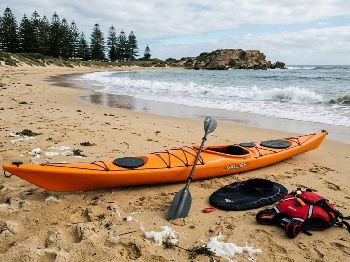
Can I crab from a kayak or small boat? Yes - both species are accessible from small craft. Blue swimmer grounds on shallow tidal flats are particularly well-suited to kayak crabbing, and the low profile of a kayak avoids spooking crabs on very shallow flats.
Do I need a fishing licence to go crabbing? In most states, recreational crabbing counts as fishing and requires the standard recreational fishing licence. Some states exempt adults over 65 or under 18 - check with your state authority.
What's the difference between a dilly net and a hoop net? They're the same thing in most Australian usage - a flat ring net raised from beneath, as opposed to a fyke net or drop net with a vertical side wall. Terminology varies by region but the mechanics are identical.
What bait works at night for mud crabs? The same bait works day and night - fresh mullet or chicken frames remain effective. If anything, scent-based bait is more efficient at night since crabs are relying on chemical rather than visual cues, so a particularly fresh or strongly scented piece of fish can improve results.
Before your next session, open the Seabreeze tide charts and identify the two-hour running-tide window you'll be working - that single adjustment to your timing will make more difference to your catch rate than any gear upgrade.