Punching Out: Launch Through the Dump

Quick summary
The dump is a short, steep wave that breaks straight onto the sand, and your launch window sits in the leftover foam behind the last wave of a set.
Timing beats fitness, so you watch two full sets, pick the hole, keep the bow square and never let the paddle stop.
The how-to
After reading this you can time a small shorebreak, punch out through whitewater in a sea kayak or ski, and abort cleanly when the window closes.
Before you leave the flat water
Entry level. You can already hold a straight line in a sea kayak or ski, wet exit under control, and fit your spraydeck without looking down.
If any of those three still feel shaky, keep them on the estuary for a few more sessions, because a dump punishes fumbling far more than it punishes weakness.
The dump defined. Shorebreak is a short, steep wave that breaks almost on dry sand, so there is no gentle green shoulder to sneak around.
That narrow break zone is actually good news, because you only need eight to fifteen committed strokes to be completely clear of it.
Gear that suits a beach launch
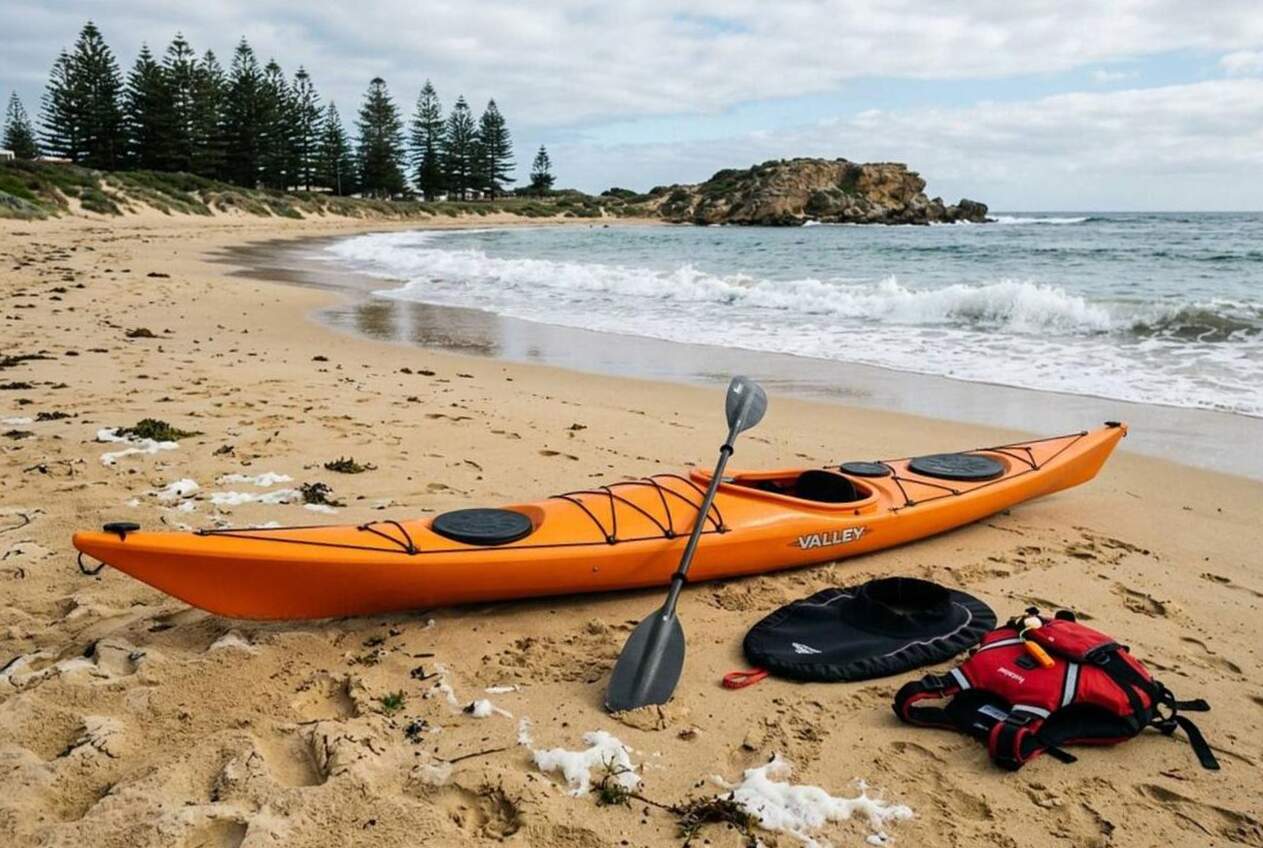
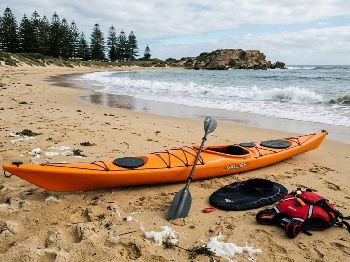
Boat. A sea kayak between 4.5 and 6 m with front and rear bulkheads, deck lines and grab handles will stay recoverable if you come out of it.
PFD. Wear it, tell someone your plan and your return time, and know exactly how you will get back to the boat after a swim.
Pick a forgiving day
Size. Choose a small dumping beach with waves under 1 m (3.3 ft) for your first attempts, and be honest about what a metre really looks like.
Wind. Fifteen to twenty knots is already a lot for a first beach launch, especially cross shore, where it turns your bow before the foam does.
Check the wind forecast or your local equivalent the night before, then confirm it with your own eyes on the sand.
Phase 1: Preparation
Choose your slot. Walk the beach and look for a rip or slightly deeper channel, where waves break later, smaller and less often.
Set the boat down pointing straight out to sea in ankle deep water, with the rudder or fin clear of the sand.
Get everything on and closed before you sit down, because adjusting a deck, leash or hat in the impact zone is how launches fail.
Phase 2: Initiation
Watch two full sets. Stand and count the waves in two complete sets, then note the lull that follows the last one.
You are not hunting a glassy window, you are hunting the hole: the churning, brown, spent foam that sits there right after the set finishes.
That foam has already broken, so it can shove you and soak you, but it has almost no power left to pick your bow up and throw it.
The launch is won in the ten seconds after the last wave of the set, in leftover brown foam, not in the pretty green face.
Phase 3: Commitment
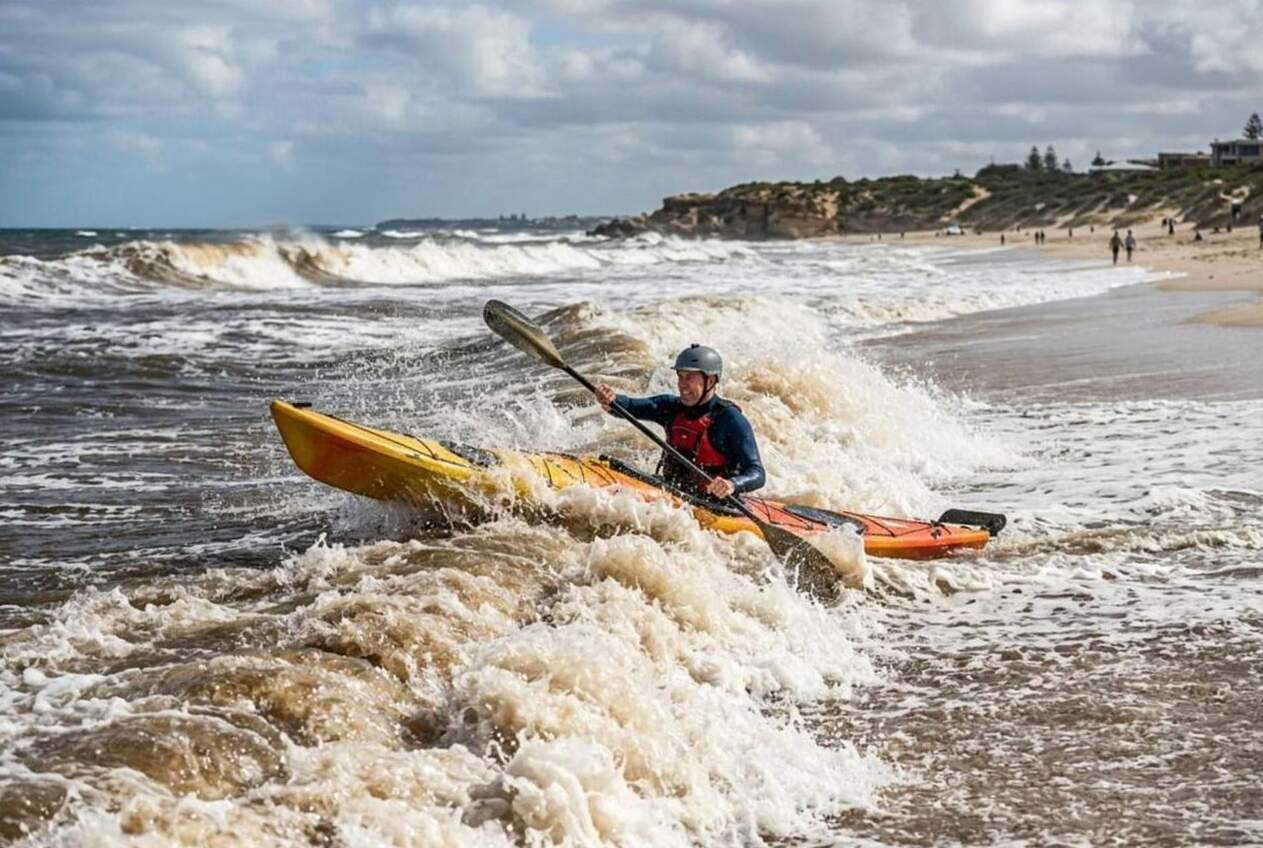
Go on the last wash. As the final wave of the set collapses and drains back, sit in, close the deck and start paddling.
Keep the bow square to the oncoming water, because a hull sitting even twenty degrees off square will be turned side on and broached.
As the first lump of foam meets your bow, unweight it slightly by sitting tall and easing your weight back a few centimetres.
The instant the bow punches through and drops again, bring your weight forward and drive the next stroke long and hard.
Phase 4: Execution
Never stop the blade. The most common failure is a defensive freeze at the moment of impact, which stalls the boat and hands the wave control.
Do not brace on a dumping wave, because a flat blade on the surface gives you nothing while the foam pushes you backwards.
Short, quick, positive strokes beat long, pretty ones here, and a stroke that finishes half buried in whitewater still counts.
Look out to sea. Your eyes drag your bow, so stare at the horizon rather than down at the mess hitting your chest.
Phase 5: Recovery
Get properly clear. Paddle a couple of wave lengths past the outside line of white water before you even think about relaxing.
Then sit, breathe, and check your deck, your leash and your hatch covers while you are still pointing out to sea.
Only after that do you turn and set your course, because a boat that turns too early gets caught by the next set.
What right and wrong feel like
Right. You feel a firm shove of foam against your chest and deck, a moment of noise, then sudden quiet as you slide beyond the break line.
Wrong. The bow lifts sharply and keeps lifting, and you either go over backwards or get spun side on and washed back to the sand.
Five mistakes that end launches
1. Waiting for glass. The perfect flat window is not coming, and while you wait on the sand the next set is already forming behind it.
2. Going in side on. Any angle invites a broach, so square the bow before you sit down and hold that line under power.
3. Freezing the paddle. Stopping to brace at impact stalls the hull, and a stalled hull gets picked up and sent straight back to the beach.
4. Too much weight forward. Leaning in to attack the foam buries the bow, and a pearled bow either stops dead or trips the boat sideways.
5. No abort plan. If you miss the window and a closeout stands up in front of you, get out, hold the boat and reset.
Where this sits in the rules
Paddle Australia treats any surf, of any size, as water that is not classified as flatwater, which changes the skills and supervision expected of you.
The Paddle Australia Qualification Scheme includes Sea awards built for exactly this environment, so a session with an accredited coach is a shortcut worth taking.
Paddle Smart basics still apply to a five minute launch: tell someone, wear your PFD, leash your ski and be certain of your wet exit.