Tahiti by sextant and seat of your pants? No way

 |
| 'John Jourdane navigating the good old way to Tahiti in 1978 (Photo credit Unknown)' Rich Roberts © Click Here to view large photo |
A lot has changed since the last race in 1994 when Fred Kirschner's Kathmandu set the elapsed time record of 14 days 21 hours 15 minutes 26 seconds, and even more since the one 16 years before that.
John Jourdane of Long Beach, author of the popular ocean racing books 'Icebergs, Port and Starboard' and 'Sailing with Scoundrels and Kings,' raced on Bob and Nancy Gosnell's S&S 49, Tuia, in 1978.
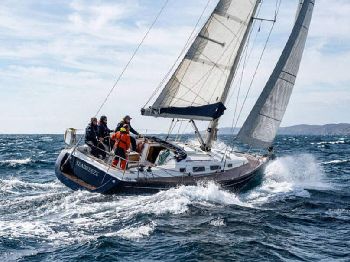
'When I did it we were sailing on older boats pretty much dead downwind with bloopers, and now it's completely different with asymmetricals,' he said. 'They're more like catamarans where you just beam-reach all the time.'
Ernie Richau, navigator on Doug Baker's record-seeking Magnitude 80 from Long Beach, said, 'When you ran [downwind] in an older boat you sailed a true wind angle of 170 or 180---dead downwind. Nowadays, on Magnitude, if it's blowing 20 [knots], our true wind angle is about 150. We do sail much closer to the wind nowadays.'
Jourdane: 'And with the technology now they'll be able to see where the Doldrums are and the spots to get through. I used a sextant the last time I did the race [in '78]. We didn't even have Loran, [let alone] GPS.'
Richau: 'In those days, they were really big on tracking speed and course and they had to dead-reckon really well.'
Jourdane: 'It was all sightings. I was praying I would see an atoll when we got there. I was within about five miles.'
Richau: 'Now we have the routing programs. We download satellite images where we can actually look at where the clouds are. I don't ever worry about where we are. I worry about where we're going to be, strategically and tactically, with the forecasted weather.'
As in '78, this race---half-again as long as Transpac and through more isolated waters---also has four boats, an exclusive group committed to a once-in-a-lifetime experience.
This time Jourdane had planned to sail as navigator on Bob Lane's Andrews 63, Medicine Man, but he had to drop out to help the private school where he teaches build a sister school in China this summer. Last month's catastrophic earthquake shelved that plan, and by then Lane had enlisted another navigator.
That left no skipper and perhaps only one crew member---Mark Olson, navigator on Chris Welsh's Ragtime---on any of the boats who has sailed a previous Tahiti Race, in '78, although some have sailed through there on boat deliveries and private cruises. Mag 80 bowman Hogan Beattie's father and grandfather did the race.
It would have been the 50th Pacific crossing for Jourdane, 64, whose r?sum? lists several Transpacific Yacht Races to Hawaii, countless races to Mexico and many boat deliveries---all told, about 300,000 miles of ocean sailing.
Jourdane will follow the race but expects no surprises, just some variations in tactics. While former Tahiti races were largely downwind and Transpac is about 80 percent off the wind, a wind matrix Richau developed for this race based on historical data and current projections suggests that winds will blow from 14 to 20 knots for two-thirds of the race, most of which will be sailed---by choice---on a beam reach with far less downwind work.
'That's how we decide what sails to take,' Richau said.
 |
Tahiti Race 2008 outlook Black line: rhumb (direct) line Red line: optimum route for projected conditions Blue lines: equal barometric pressure H: center of high-pressure area L: area of low pressure L group: Doldrums, a.k.a. Intertropical Convergence Zone along the equator - Rich Roberts© Click Here to view large photo |
The sail inventories will include asymmetricals generally replacing conventional spinnakers, so the boats will sail less direct but more efficient courses than the 200-degree rhumb line (just right of due south) but will sail significantly faster than before.
'But it's still a marathon,' Jourdane said. 'My feeling is where Transpac is kind of a half-marathon, with this you have to conserve yourself and not try to change sails with every [wind] shift. It's kind of a Mexican race out of here, and then you start getting lifted out into the Pacific, and then you have to jibe [to port] and it's pretty much that jibe all the way to the Doldrums. The real tricky point is when you do that jibe.'
Once through the Doldrums (i.e., the Intertropical Convergence Zone), the racers will settle into more of a routine.
'I'd love to be going,' Jourdane said, 'but I have raced or delivered or sailed across an ocean for the last 34 years, so it's going to be kind of nice to have a break this summer.'
Something he won't miss is man's wasting of the Pacific and the evidence of global warming. Jourdane has a love for the sea inherited from his grandfather Albert, one of 14,000 sailors in Teddy Roosevelt's Great White Fleet of U.S. Navy ships that circled the earth in 1907-09.
'Every year when I'm doing deliveries back from Transpac I see more and more [trash],' he said. 'It's getting worse. There are fewer fish and wildlife. We're really got to do something.'
But he still has friends out there, like the magnificent, ever-airborne albatross with the largest wingspan---10 feet or more---of any bird on earth.
'There's always one that stays with us awhile,' Jourdane said. 'I called him Albert. Albert Ross. Every trip I see Albert when he comes by and visits.'
A skippers' meeting and buffet sendoff dinner is scheduled Friday, June 20, 5:30 p.m. at Los Angeles Yacht Club in San Pedro.
Oceanus ( www.oceanus-us).com is official timekeeper of Tahiti Race 2008. The Transpacific Yacht Club has maintained a sponsorship agreement with Casio Computer Co., Ltd ( world.casio.com)., to make the company's Oceanus watch the official timekeeper of the 13th Tahiti race. The Oceanus is a solar-powered chronograph watch with a time signal-calibration function developed by making full use of Casio's advanced electronic technologies.
Official Tahiti Race 2008 entries
Fortaleza (Santa Cruz 50), Jim Morgan, Long Beach
Magnitude 80 (Andrews 80), Doug Baker, Long Beach
Medicine Man (Andrews 63), Bob Lane, Long Beach
Ragtime (Spencer 65), Chris Welsh, Newport Beach
Sailing Instructions and more Tahiti Race information is available from www.transpacificyc.organd www.transpacificyc.org
by Rich Roberts
 |
Click on thumbnails to enlarge and find more photos:

Newsfeed supplied by