Heave-To: Sailing's Emergency Pause Button

Quick summary
Heaving-to is the technique of balancing a sailboat's backed headsail, eased mainsail, and rudder held to windward so the boat sits nearly stationary - drifting slowly to leeward but requiring no active steering.
It works reliably in moderate conditions on most monohulls, and with modification in heavy weather - but boat design determines how well it works, so you need to practise on your own vessel.
The how-to
After reading this, you can execute a heave-to in moderate conditions, understand the storm modifications, and know which boats handle it best and why.
The heave-to is the manoeuvre experienced offshore sailors reach for when conditions make forward progress pointless, dangerous, or simply exhausting.
It lets you park the boat at sea.
Not anchor - park.
The boat holds a rough angle to the wind without anyone on the helm, drifting slowly to leeward, stable enough to cook a meal below or wait out a squall without thrashing through the conditions.
Every sailor doing coastal or offshore work needs this in their repertoire - and the only way to know whether your boat heaves-to well is to practise it before you need it.
The mechanics
The technique works by creating opposing forces that cancel each other out.
The backed headsail - sheeted to the windward side so the wind pushes the bow away from the wind - wants to drive the boat downwind and off to leeward.
The rudder, locked to windward, constantly tries to steer the bow back up into the wind.
The mainsail, eased until it is barely drawing, acts as a damper.
The result is a slow, rhythmic scalloping: the boat edges up toward the wind, the backed jib pushes it off again, and the cycle repeats.
Forward speed drops to near zero.
Sideways drift continues - typically one to two knots to leeward, depending on conditions and hull design.
"So long as the vessel ends up 20 to 40 degrees off the wind and with minimal forward motion, you are well hove to."
The procedure - moderate conditions
Start close-hauled or on a close reach with the sails properly trimmed.
Step 1: Begin a normal tack - bring the bow through the wind.
Step 2: Do not release the jib sheet.
Let the jib back on the new tack while it remains cleated on the old side.
Step 3: Ease the mainsheet until the mainsail is just drawing or lightly luffing.
You are not trying to power the boat - just balance it.
Step 4: Lock the helm to windward.
On a tiller, push it to leeward - which turns the rudder to windward and tries to steer the bow into the wind.
On a wheel, pull it to windward for the same effect.
Step 5: Lash the helm in position and step back.
The boat should settle into the scalloping motion within a minute or two.
If it keeps trying to tack, sheet the jib in slightly tighter on the backed side, or ease the main a little more.
If it keeps bearing away to leeward, move the helm further to windward or trim the main in slightly.
Boat design and how well it works
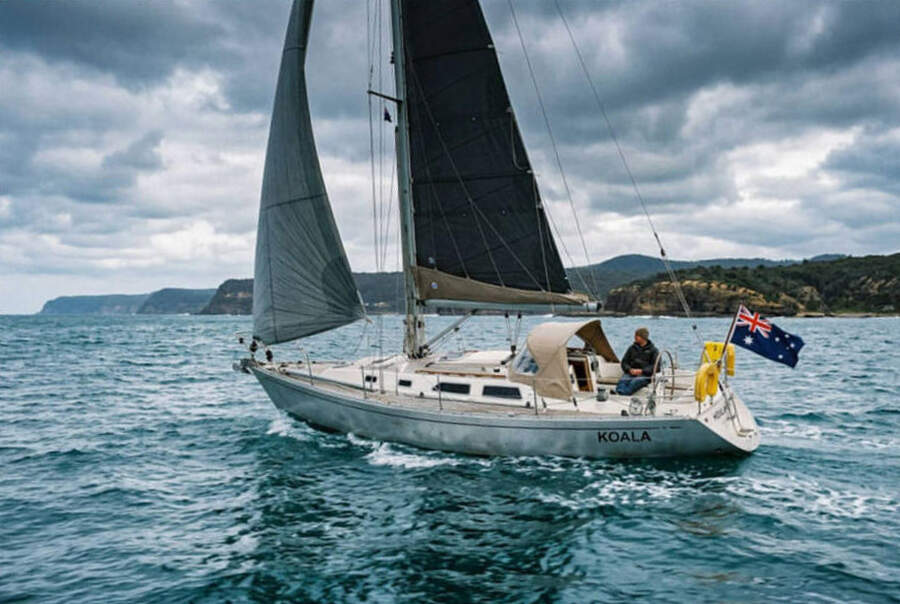
Heave-to works reliably on most traditional monohulls with moderate to full-length keels.
The longer keel surface gives the hull more grip on the water and resists the leeway drift while the forces balance.
Modern fin-keel performance designs are much harder to heave-to effectively.
They have less lateral resistance, tend to make more leeway, and in some cases cannot achieve a stable balance at all - they simply continue to bear away despite all adjustments.
Skip Novak - four-time Whitbread Round the World competitor and holder of the Cruising Club of America's Blue Water Medal - warns that high-aspect spade rudders face an additional risk in heavy weather.
When the boat "back pedals" in a large wave while hove-to, the rudder takes a load it was not designed to handle from the reversed direction.
If your boat has a modern spade rudder, practise heaving-to in moderate conditions to understand the limits before you need the technique in a blow.
Catamarans generally do not heave-to.
The wide beam resists the sail forces needed to create the balance, and most catamaran designs in heavy weather are better served by reducing sail and keeping the boat moving to maintain steerage.
Storm modifications
Heavy-weather heaving-to uses the same principle but requires a more conservative approach throughout.
You will already be sailing under reduced canvas - put a reef or two in the main and use the smallest jib or staysail before conditions deteriorate.
Do not gybe into the heave-to in storm conditions.
Gybing in heavy weather with a large wave behind you risks the boat accelerating wildly downwind - tack instead.
If you are carrying a large staysail, reduce it to a fraction of its area before backing it - Novak describes rolling it to "handkerchief size" so the forces remain manageable.
Aim to settle the boat at around 45 degrees to the wind and sea in storm conditions - slightly further off the wind than the moderate-weather angle of 20 to 40 degrees, to reduce the impact of wave faces.
Watch for chafe on the backed jib sheet where it presses against the windward shrouds.
In sustained heavy weather, check the sheet regularly and rig chafe protection from the start.
The leeway problem
The one thing heave-to will not do is hold your position.
You will drift to leeward at one to several knots, depending on conditions and hull type.
In open ocean this is irrelevant - you ride out the weather and lose a few miles of ground.
Near a lee shore it can be fatal.
Before heaving-to, always confirm you have significant sea room to leeward - at minimum several hours of drift time before reaching any hazard, and preferably open water beyond.
If you are off a rocky coast with the wind onshore, heaving-to is not the answer.
Keep sailing, or look for an anchorage or port of refuge.
When to use it
Waiting out a squall: A sharp squall in Bass Strait or off NSW typically passes within 30 to 90 minutes.
Heaving-to in open water while a squall line moves through is far more comfortable than bashing to windward in steep, short-period seas.
Crew welfare: On a shorthanded boat, heaving-to allows the off-watch crew to sleep in a stable boat rather than a pitching hull trying to claw upwind.
Repairs and emergencies: Seasickness, a medical situation, a gear failure - any scenario where you need to stop and deal with a problem before continuing.
Navigation time: Heaving-to while you properly plot your position, consult the chart, or reassess the weather is far safer than trying to navigate in a hurry.
Meals and morale: A hot meal makes a difference on a long passage.
Heaving-to for 30 minutes to cook and eat is a legitimate tactic on a multi-day sail.
Diagnosing failure
The boat keeps tacking: The mainsail has too much power relative to the backed jib.
Ease the main further, or tighten the backed jib sheet slightly.
The boat keeps bearing away: The jib is not generating enough backwind, or the helm is not far enough to windward.
Sheet the jib tighter on the backed side, or adjust the rudder angle.
The boat makes too much leeway: Usually a fin-keel design without enough lateral resistance.
Try a slightly higher angle to the wind, or accept the limitation and choose a different tactic - lying ahull with bare poles, or running off under a storm jib.
The boat feels unstable and won't settle: In very steep or breaking seas, heaving-to may not produce a stable result.
This is the sea state, not a technique failure - re-evaluate whether you have sufficient sea room and consider running off instead.
Practising safely
The AS/ISAF Offshore Safety and Sea Survival course - a mandatory requirement for AMSA's Sailing Master Offshore qualification - covers heaving-to as part of its heavy-weather management curriculum.
But the classroom is not the boat.
Practise heaving-to on a day with 10 to 15 knots of breeze and a manageable sea state - conditions comfortable enough to experiment but enough wind to see the technique working.
Check the angle your boat settles at.
Measure your leeway rate over five to ten minutes using GPS.
Try adjusting the jib sheet trim and helm angle to find the most stable configuration for your particular hull.
Then do it again in 20 knots.
Then in 25.
You are building a set of mental notes specific to your boat - what sail configuration, what helm angle, what sea state produces a reliable heave-to.
By the time you need it in a pre-frontal blow off Port Stephens or rounding Wilson's Promontory into Bass Strait, you will execute it without hesitation.
Check the Seabreeze wind forecast before you head out to practise - pick a day with steady conditions in the 10-20 knot range, not a day where a squall line is developing offshore.
What works on a Beneteau 40 may not work on a S&S 34.
What works in 15 knots may not work in 35.
Know your boat.