Neutral Buoyancy: The Skill Behind Good Diving

Quick summary
Over-weighting is the single most common buoyancy mistake - and the easiest to fix.
Your lungs are more precise than your BCD: use breathing for fine adjustments, BCD only for larger depth changes.
The how-to
After reading this, you can run a proper weight check, dial in your breathing pattern and get into horizontal trim on any Australian reef dive.
If your dives feel like a workout - kicking constantly to avoid the bottom, puffing your BCD every 30 seconds, surfacing exhausted - the fix is almost always the same: sort out your buoyancy fundamentals.
Neutral buoyancy is not a gift some divers have. It is a set of three learnable things: correct weighting, disciplined breathing, and horizontal body position.
Get all three working together and the water column stops being something you fight.
The weight check: where everything starts
Before you do anything else, you need to know whether you are carrying the right amount of lead.
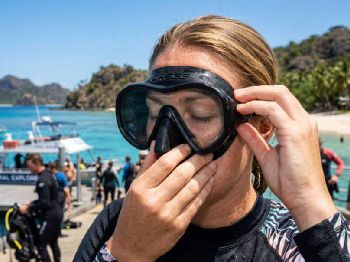
The surface weight check is the only reliable starting point: empty your BCD completely, hold a normal breath, and float in calm water.
At the correct weight, you float with the water line at eye level.
When you exhale fully, you should begin a slow, gentle sink.
If you bob up to your shoulders with an empty BCD, you are under-weighted for that combination of wetsuit, tank and salt content.
If you sink with air still in your BCD, you are over-weighted - the most common situation for divers who trained in one wetsuit and are now diving in thicker neoprene.
Saltwater lifts more than freshwater, and a 7mm winter wetsuit over a 3mm summer suit can need an extra 4-6kg of lead to compensate - always re-run the weight check when your configuration changes.
A second check matters at the end of the dive: at 5 metres with a near-empty tank, you should hover neutrally on a half-breath with minimal BCD air.
If you need a full BCD at the safety stop, your weights are set for a full tank and you will be fighting buoyancy for the last third of every dive.
"Most divers who think they have a breathing problem actually have a weighting problem - fix the lead first, and the breathing sorts itself out."
Breathing: your most precise buoyancy tool
Your lungs hold around 4 to 6 litres of air.
That volume creates roughly 4 to 6kg of lift - more than enough to control your position in the water column without touching the BCD inflator.
For fine adjustments of less than 1 metre, use breathing exclusively: slow inhale to rise, slow exhale to sink.
Reserve the BCD inflator for position changes of 2 metres or more, or at the start of a dive when you are working through the transition zone.
The most common breathing mistake is over-relying on quick BCD blasts: you add a burst, overshoot neutral, vent too much, sink, add another burst - and so on for the whole dive.
The fix is to slow down: breathe in a relaxed, full cycle of around 4 seconds in and 4 seconds out, and let position changes follow the breathing rather than trying to force them with the BCD.
Divers who unconsciously hold their breath when concentrating on a subject often find themselves drifting upward mid-dive - the air stays in the lungs and provides constant positive lift until they realise what's happening and exhale.
Build the habit of conscious breathing cycles before you descend, and the reflex will carry through to the dive.

Trim: how your body sits in the water
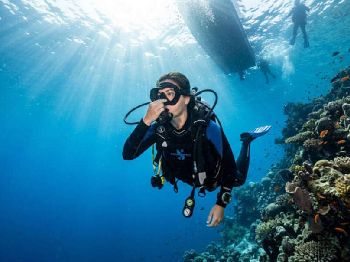
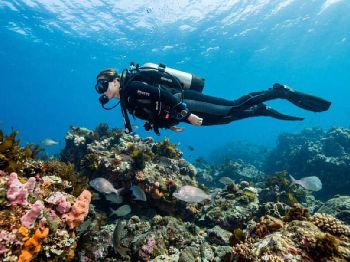
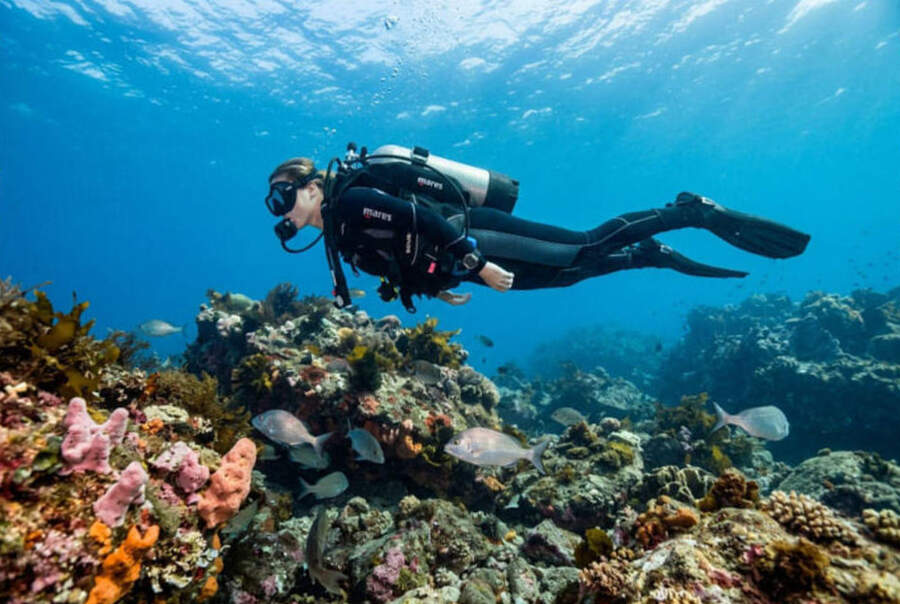
Correct trim means horizontal: your body parallel to the seabed, not head-up and feet-down.
A head-up position creates drag, forces you to kick upward rather than forward to maintain depth, and exhausts leg muscles that should be doing almost nothing on a well-trimmed dive.
The first fix is tank depth: slide your tank lower in the BCD backplate and the weight shifts aft, tipping your hips up and levelling your body.
If your legs still sink, move some lead from your weight belt to integrated BCD pockets at the back - shifting lead toward the hips counteracts the pull of heavy legs.
Fin angle matters too: kick with your fins flat behind you, not flicking up and down with your feet, which drives you toward the surface on every stroke.
A bent-knee frog kick keeps the fins horizontal and the thrust purely rearward, which is why technical and cave divers use it as their standard kick pattern.
Neutral trim has a practical conservation benefit on shallow reef dives: a horizontal diver with good fin control never contacts the bottom or coral, reducing the physical damage caused by divers who compensate for poor buoyancy with constant touch-downs.
The descent: the hardest part to get right
The first 5 metres of descent is where most buoyancy problems start.
Wetsuits compress as you go deeper, losing buoyancy quickly in the 0-10 metre range - that is the zone where most divers kick furiously to break through the surface layer.
Then they add too much BCD air to compensate, setting up an unstable cycle that runs for the rest of the dive.
At the surface, take a final full exhale and let your body begin to sink naturally before kicking downward.
Add air to the BCD in short bursts - 1 second at a time - as the wetsuit compresses below 5 metres, aiming for the state where you stop neither sinking nor rising at your target depth.
On a well-weighted dive, you will add very little BCD air between 5 and 20 metres: the air in the BCD left over from the ascent on the previous dive is usually enough.
The ascent: venting slowly and staying in control
Ascending too fast is as dangerous as descending too fast, and poor buoyancy control is a common contributor to rushed ascents.
Begin venting your BCD well before you want to stop: a slow ascent from 20 metres takes around 2 minutes, and the BCD will be expanding as the pressure drops.
Vent continuously on the way up, one hand on the dump valve, maintaining a rate of around 9 metres per minute - roughly the speed of your smallest bubbles.
If you overshoot and find yourself rising faster than planned, a full exhale and a frog kick pointing slightly down will bring you back without a panicked BCD dump that overshoots neutral in the other direction.
Common buoyancy problems and how to fix them
Yo-yoing through the water column. Cause: using BCD blasts instead of breathing for fine control. Fix: empty BCD to 60 percent of what feels right and use breathing only for a full dive. The BCD becomes the backup, not the primary tool.
Slow, continuous sinking mid-dive. Cause: wetsuit compression not compensated for with BCD air, or tank gas being consumed - a near-empty aluminium tank becomes positively buoyant and needs less BCD air than a full one.
Fix: add small BCD top-ups every 10 minutes rather than waiting until you are dragging along the bottom.
Legs hanging down, head up. Cause: tank too high, lead on belt not in trim pockets. Fix: lower the tank 5cm on the backplate and move belt weight to BCD rear pockets or ankle weights.
Shooting to the surface at the safety stop. Cause: over-weighted for a full tank but correctly weighted for a near-empty one. Fix: reduce total lead by 1-2kg and run the end-of-dive check at 5 metres.
Burning through air quickly. Cause: over-exertion from poor buoyancy, increased breathing rate, or holding breath. Fix: slower breathing cycles, check you are not unconsciously holding breath when focused on marine life.
Practice dives that accelerate improvement
A dedicated buoyancy dive - shallow, calm site, no photography or fish-watching - is worth three normal dives for improving your control.
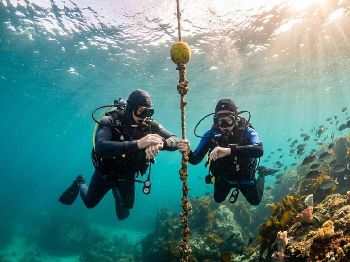
Set up a hovering station at 5 metres: mark a reference point on the mooring line or anchor chain and attempt to hold your depth within 30cm for 5 minutes using breathing only, no BCD adjustments.
PADI's Peak Performance Buoyancy specialty, offered at dive centres including Abyss Dive Centre in Ramsgate, NSW, structures exactly this kind of practice and typically halves air consumption over two specialty dives, per the centre's reported outcomes.
Fin kick practice in open water: spend 10 minutes in hover, alternating between flutter kick, frog kick and modified flutter - observing which kick pattern disturbs your depth least is one of the most direct ways to understand your trim.
What good buoyancy feels like
When all three elements are working - correct weight, breathing control and horizontal trim - the sensation changes noticeably.
You stop thinking about depth and start thinking about what you are looking at.
A well-trimmed diver at correct weight uses the BCD inflator perhaps three or four times on a 45-minute dive: once on descent, once or twice during the dive as the tank lightens, and once on the safety stop.
Everything in between is breathing.
On your next dive, before touching the BCD, give the breath three full cycles to do the work - you will be surprised how much of the water column you can control before reaching for the inflator.
Check tidal windows for your next reef or wreck dive using the Australian tide times page - incoming tides typically bring cleaner, higher-visibility water to inshore sites.
Questions divers ask about buoyancy
Do I need a weight belt or integrated weights? Either works, but integrated trim pockets in the BCD allow you to distribute weight between front and rear, which is useful for adjusting horizontal trim in a way a single belt cannot.
How often should I redo the weight check? Any time you change your wetsuit thickness, switch from a steel to aluminium tank, go from freshwater to saltwater, or change your BCD. The weight profile of your kit changes meaningfully with any of these.
Why does my buoyancy feel different in Australia compared to overseas? Saltwater density varies by location - warmer, saltier tropical water like the Coral Sea lifts more than cooler temperate water like the Tasman or Bass Strait.
Expect to adjust weights by 1-2kg when moving between tropical and temperate Australian sites.
Is a Peak Performance Buoyancy course worth it? For anyone diving more than six times a year, yes. The structured practice format and shore-based debrief accelerates improvement that would otherwise take dozens of casual dives to develop.