cisco said...
It is with the attitudes that make insurance necessary in instances where people should assume their own risk and take responsibility for their own actions instead of looking to blame somebody else for their own mistakes.
Insurance is, unfortunately, necessary, although the need for it is not entirely due to 'ambulance chasing' lawyers. Sure, there are way too many of them, but if a club, manufacturer, or individual does something genuinely negligent and an innocent bystander gets hurt, that bystander has every right to be compensated. It is unlikely that a club would have sufficient funds to pay for even one claim, which means that the club members would be exposed. I love my sport, but I'm not prepared to bet my house on it.
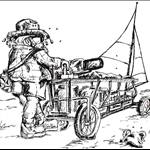
In close consultation with the designer I would be prepared to build [a Lake Lefroy Mini Explorer Yacht] and submit it for stress testing as is done to the blokarts. If this was done satisfactorily and a set of rigid construction guidelines drawn up for that design, it could be repeated for other designs (Pacific Magic, Promo 5 etc) intended for amateur construction.
By this method amatuer built yachts of an approved design can be insured as comprehensibly as mass produced yachts.
I can see where you are going, but I think you will find that the issue is not just the design, but the quality of construction.
You are probably highly skilled with a welder and may be able to produce a safe land yacht assuming the underlying design is okay. I am not so skilled with a welder and may produce one that looks identical to yours, but has explosive tendencies in more than 15kts of wind. This is what I was refering to when I wrote about the consistency of quality. With different builders constructing the same home-built, there would be no consistency in the build quality.
There is plenty of recorded history of incidents or the lack of, pertaining to amateur built land yachts in Australia, so assessing risk is not a difficult process.
Actually, the one-off nature of the construction process is why it would be hard to assess the risk. No two land yachts are alike. The design may be the same, but the materials and construction quality is not.
Is this the best way to go for competitive events or using liability disclaimer agreements as is practised even at blokart events??
Actually, you need both.
The disclaimer basically ensure that participants are aware that if they wipe themselves out through no one elses fault but their own, that is their own problem. I am not aware of any clubs that have a form of Personal Injury cover. to put it simply, the clubs and their members are insured against getting sued, not injured. If you enter the race and have an accident that is not the result of a product defect or poor safety standards by the hosting club, you are accepting that you are doing so at your own risk. It is not a 'get out of jail free' card for the manufacturer or club.
On a different but related topic is the Duty of Care and Duty of Disclosure. At the 2009 Australian blokart Championships at Yeppoon, there was a kid who was dropped off by his father and left to fend for himself. On the second day in 15kt+ winds, he put up his big 5.5m sail. This was an accident waiting to happen, so the race officials did what they were required to do and pulled him back. Sure, the kid's dad should have stayed and it could have been argued that he was negligent in not doing so. But if the kid had been allowed to sail with an oversized sail for the kid's size and wind conditions with the full knowledge of the officials and there was an incident, CQBC as the host club could not have escaped responsibility. The same thing would happen if they knowingly let someone sail drunk, without a seat belt, or without a helmet and there was an accident. Sadly, the "But you knew I was pissed and let me sail anyway, so it's your fault" line probably would stand up.
At the same event, there was a cyclone warning issued for Yeppoon. Under the Duty of Disclosure obligation, if there is something that adversely affects the exposure of the insurance company, you have to tell them. A phone call was placed to the insurer telling them that a cyclone warning had been issued. The winds had not sprung up to dangerous levels, but because of the existence of the warning, the insurance was pulled. Had that call not been made and an incident occurred, the insurance company would have their own 'get out of jail free' card, leaving the club open to be sued with no cover. Some people went off and had a sail on their own, but it was made crystal clear that there was a cyclone warning and no insurance.
You will find these duties are common across the insurance industry. They apply to your home insurance, car insurance, and pretty much any other insurance you buy. Basically, they stop the "I've got insurance, so I can behave like a reckless idiot" mentality.
I think you will find that the waiver is only effective when the manufacturer and club has done everything else right.
Sorry for the long post.



 I'm ecstatic!