Burley: What Most Boat Anglers Get Wrong

Quick summary
Effective burley is about creating a consistent scent trail - a little dropped often beats a big dump every 10 minutes, every time.
Tides and current control your trail: too little flow and the burley stalls under the boat; too much and fish can't work back to your hook before the scent dissipates.
The how-to
After reading this, you'll be able to mix a basic burley blend, position it correctly for the tide, set the right release rate, and adjust by species - from surface bream to mid-water snapper.
Burley works on a simple principle: create a scent trail that leads fish upstream to your bait.
Where most anglers go wrong is treating it like an on/off switch - drop a big handful, wait, drop another big handful - instead of thinking of it as a slow-burning fuse that needs to stay lit continuously from rod to rail.
Why the "little and often" rule is not optional
A consistent trickle of burley keeps fish locked into your trail and moving toward your bait.
When you dump a large amount at irregular intervals, two things happen: the sudden pulse can startle cautious fish near the boat, and fish further back in the trail get a full stomach before reaching your hook.
The target rate is roughly one handful every two to three minutes for a standard mid-tide drift - enough to keep the trail fresh without overloading it.
Charter skipper experience from Southeast Queensland operations consistently shows that anglers who are told to trickle burley from a small cup, rather than throw handfuls from a bucket, catch more fish in the first hour than those left to self-manage.
"A little often, rather than a lot at once - that single rule separates a berley trail that brings fish to the boat from one that fills them up 40 metres behind you."
Reading the current: the make-or-break factor
Your burley trail is only as good as the current carrying it.
You need some water movement to disperse the scent and particles in a consistent downstream direction - without it, the burley clouds up around your hull and fish have no trail to follow.
Neap tides - where the tidal range is smaller and flow is gentler - are better burley conditions than spring tides for most scenarios.
On a spring tide with strong current, your burley trail covers distance faster than fish can follow it, and your bait presentation ends up well behind the fish rather than in the zone they're working toward.
If you're fishing a strong run, position up-current of your target structure and let the trail work downstream to the reef or hole - don't sit directly over the fish and expect them to swim against current to reach you.
On a rising tide in an estuary, fish often move with the flow toward drains, mangrove edges and weed beds - position your boat with the current behind you and let the trail lead into those areas.
Mixing a basic blend: what to include and why
A working burley blend needs three components: something with scent, something with oil, and something to control release rate.
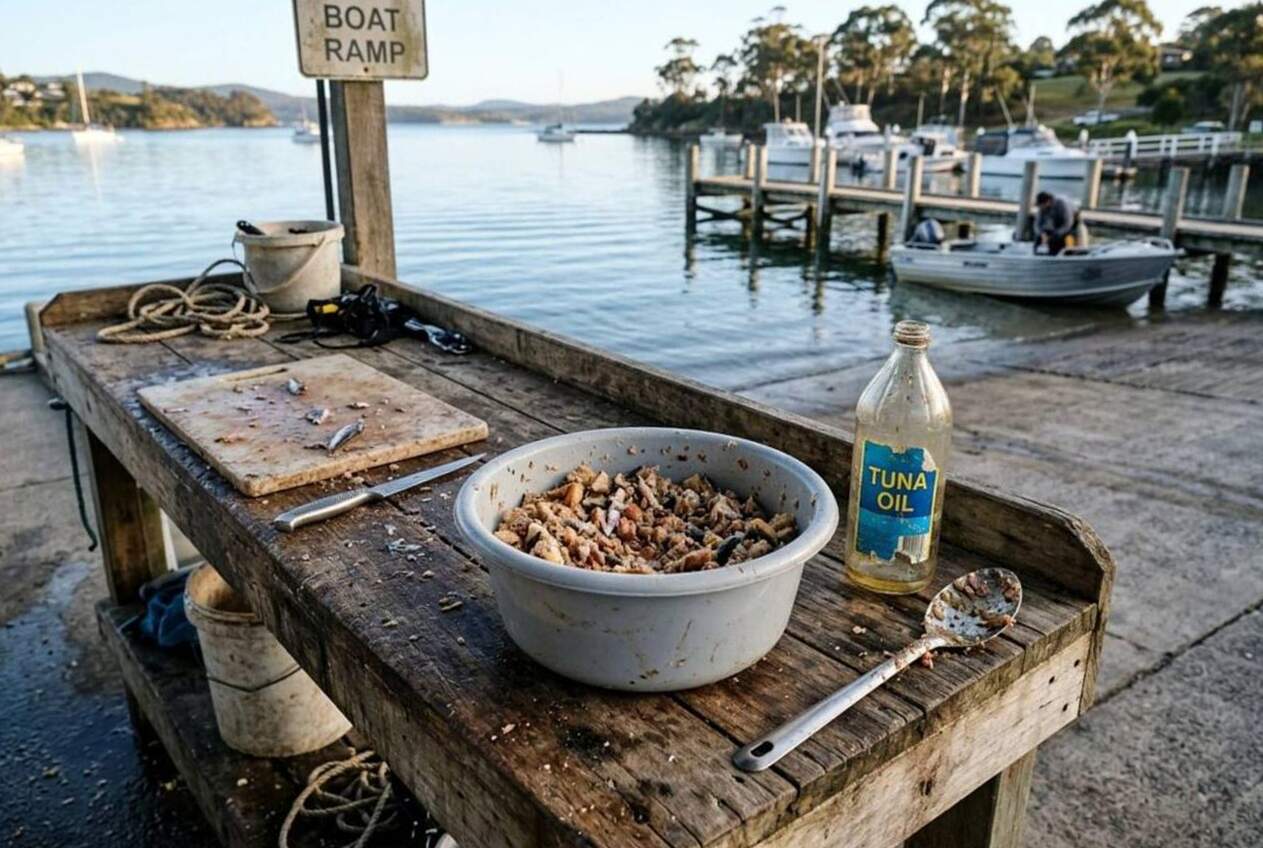
The scent component is typically fish-based - chopped pilchards, tuna frames, old prawn heads, or mixed fish mince from the bait fridge.
The oil component is the part most people skip. Tuna oil or pilchard oil soaks into your dry binders and then releases slowly when the mix hits the water, extending your scent trail far beyond where the solid particles reach.
Dry binders - breadcrumbs, pollard, or chicken feed pellets - serve two purposes: they absorb oil to slow-release it, and they create a visible particle trail that fish key into visually as well as by scent.
A rough ratio that works in most conditions is two parts fish material, one part dry binder, with oil added to the point where the mix holds together but still crumbles when squeezed.
Match the blend to the species
Snapper respond well to oily, fishy blends - pilchard and tuna oil mixes pulled them up from structure in Gold Coast charter operations throughout the summer months, according to True Blue Fishing Charters, a licensed charter operation running offshore trips from the Broadwater.
Bream are more cautious and often respond better to a lighter blend with less oil - heavy, pungent burley can push bream away from the boat in clear shallow water.
Tailor and Australian salmon are aggressive feeders that will follow a strong oily trail - surface trickles of chopped pilchards and tuna oil on a run-out tide bring tailor to the boat quickly.
Yellowtail kingfish require a different approach - live bait scraps (slimy mackerel, yellowtail, or small bonito pieces) create a more excited response than pilchard-based mixes, and releasing a live or lightly stunned fish into a burley trail often triggers the most aggressive competition bites.
Delivery methods: pot, hand, or block
How you deploy burley matters as much as what's in it.
A berley pot - a mesh or perforated cage hung off the transom at around 1 metre depth - gives you the most consistent slow-release rate and is ideal when you're anchored over structure fishing for snapper or bream.
Hand-tossing small amounts gives you real-time control over rate and lets you adjust to fish behaviour - if bream are hanging 5 metres back, toss slightly less to pull them closer before presenting the bait.
Block berley - frozen compressed mixes that thaw and release over 20-40 minutes - work well when you want to set and forget while focusing on other rigs, but they're harder to adjust if conditions change.
In the Victorian Fisheries Authority's recreational fishing guide, a maximum of 10 litres of berley applies when fishing Port Phillip Bay, Western Port, the Gippsland Lakes, and any inlet in Victoria - a rule worth checking if you're fishing the bay with a large pot.
Positioning the burley relative to your rig
The most common positioning mistake is presenting your bait directly under the boat while the burley cloud disperses 15 metres downstream.
Your bait needs to be inside the trail - either drifting with it at the same rate, or sitting at the end of it where fish are congregating.
On anchor, a long trace fished unweighted or lightly weighted on a running sinker lets your bait drift back with the burley naturally - 5 to 15 metres behind the transom is the typical productive zone for snapper and bream on a moderate run.
Fishing directly under the boat into the berley cloud is one of the most consistent ways to miss fish that are sitting just behind your stern.
When burley doesn't work
Flat calm, zero-current days are the hardest conditions for berley - without flow, the mix stacks up under the boat and creates an unnatural pool rather than a trail.
On those days, switch to slow hand-tossing of individual pieces cast slightly upwind of the boat, and fish back through them at various depths to find where fish are holding.
Cold water suppresses fish metabolism and reduces their willingness to chase - in winter estuary fishing, slow down your burley rate and fish the tide change, when even cold-water fish commit to feeding windows.
If you're getting short strikes or fish are visible in the trail but not taking the hook bait, step down your hook size and reduce bait bulk - fish are selective, not disinterested.
Questions for your next session
Are you running a heavy sinker that's pulling your bait out of the burley trail and into the bottom where fish aren't following it?
If you're fishing an estuary rather than offshore, is your burley blend too heavy and oily for the shallow, clear conditions where bream and flathead are the target?
Have you tried a hand-toss rather than a pot on your next snapper trip to see if you can pull fish closer to the transom before they commit?
The difference between a dead spot and a hot bite is often just the release rate - track your tides, set your wind forecast on the Seabreeze wind page before leaving the ramp, and build the trail from the moment you drop anchor.