Docking when wind and current fight

Quick summary
- Wind pushes the parts of the boat above the water and current pushes the parts below, so the bow and the hull can move in different directions.
- Watch how your boat actually drifts in open water before you commit to a tight berth.
- Maritime Safety Queensland applies a 6 knot limit in Queensland boat harbours, marinas and canals, and within 30 metres of a jetty, wharf, boat ramp or pontoon, or of an anchored, moored, shore-fastened or aground boat, or a person in the water.
- Rig lines and fenders early, brief the crew, keep limbs inboard and never jump ashore.
- Abort while room remains if speed, angle or position is wrong.
The how-to
- Check tide and wind before departure.
- Drift test in clear water.
- Decide which force dominates for your hull.
- Prepare gear and brief crew.
- Approach with short engine inputs.
- Go around rather than force it.
Why opposing wind and current are unpredictable
Wind acts on the topsides, cabin, canopy and flybridge, while current acts on the submerged hull, so the two forces together often pivot a boat instead of simply sliding it sideways.
A high-sided cruiser with deep running gear behaves nothing like a shallow runabout carrying a large bimini, and the same berth can feel straightforward one morning and unmanageable the next.
For that reason no single manoeuvre can be offered as the correct answer for every boat, every berth and every combination of breeze and tidal stream.
Read the drift before you enter confined water
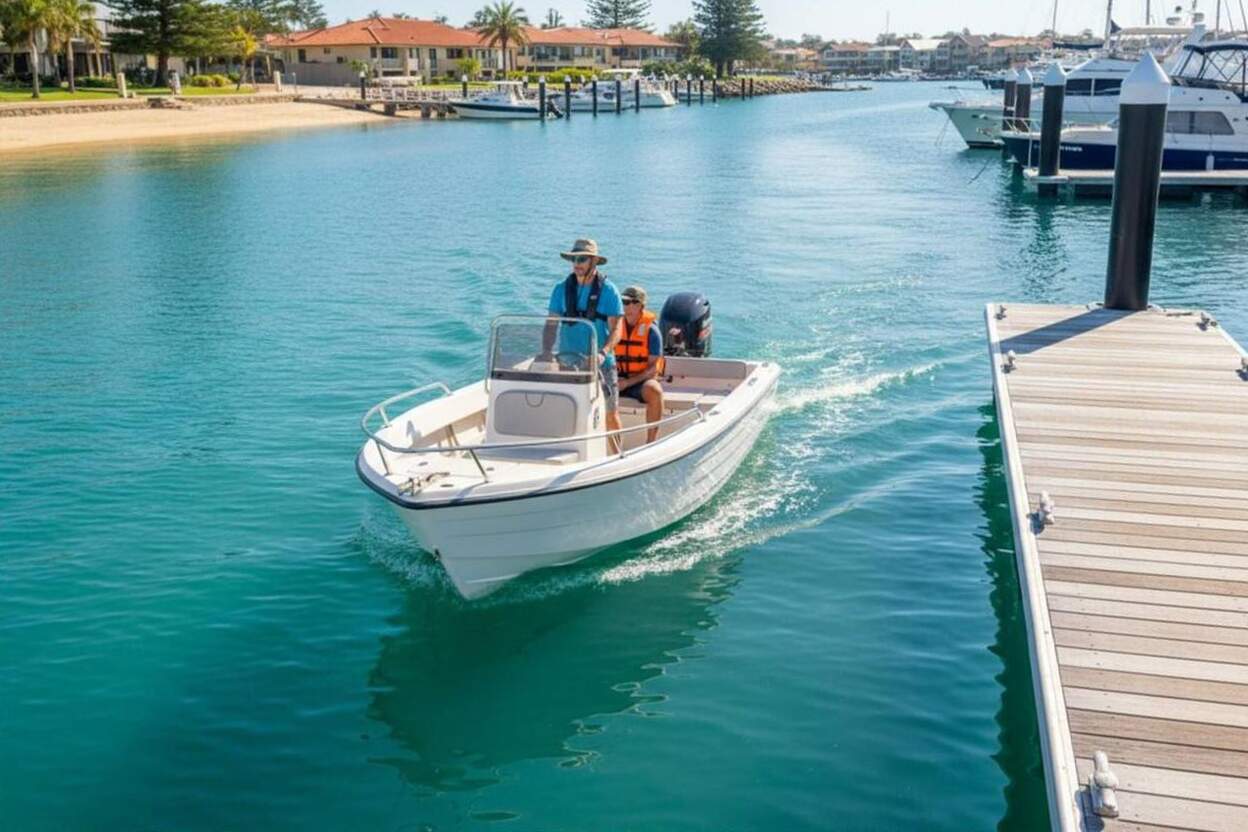
Tristian Mooney, founder and trainer at BoatWise, advises skippers to observe the boat's natural drift before entering confined water, which means letting the vessel settle and watching what the conditions actually do to it.
Hold the boat in neutral in clear water near the berth, with a good lookout maintained, for long enough to see a consistent pattern rather than a single gust.
Note whether the bow falls away, whether the stern walks to one side, and whether the whole hull is setting up or down the fairway.
Looking at tide times and the stage of the tide on tides before you leave the ramp helps you anticipate whether the stream will be running with or against the breeze on your return.
Know how your own boat responds
A single outboard, twin outboards, a shaft drive with a rudder and a sterndrive all answer differently to a short burst of thrust, especially at the slow speeds used around a wharf.
Weight, windage, draft, propeller walk and whether you have a bow thruster all change what is realistic, so judge the approach on your boat rather than on what the vessel ahead of you managed.
Speed limits in Queensland waters
Maritime Safety Queensland sets a 6 knot limit in Queensland boat harbours, marinas and canals, and within 30 metres of a jetty, wharf, boat ramp or pontoon, or of an anchored, moored, shore-fastened or aground boat, or a person in the water.
Those limits are upper bounds rather than target speeds, and a crowded fairway, poor visibility or a strong cross-set can call for far slower progress than the posted figure.
These are Queensland rules and other states and territories set their own requirements, while different rules again apply to personal watercraft.
Prepare lines, fenders and crew
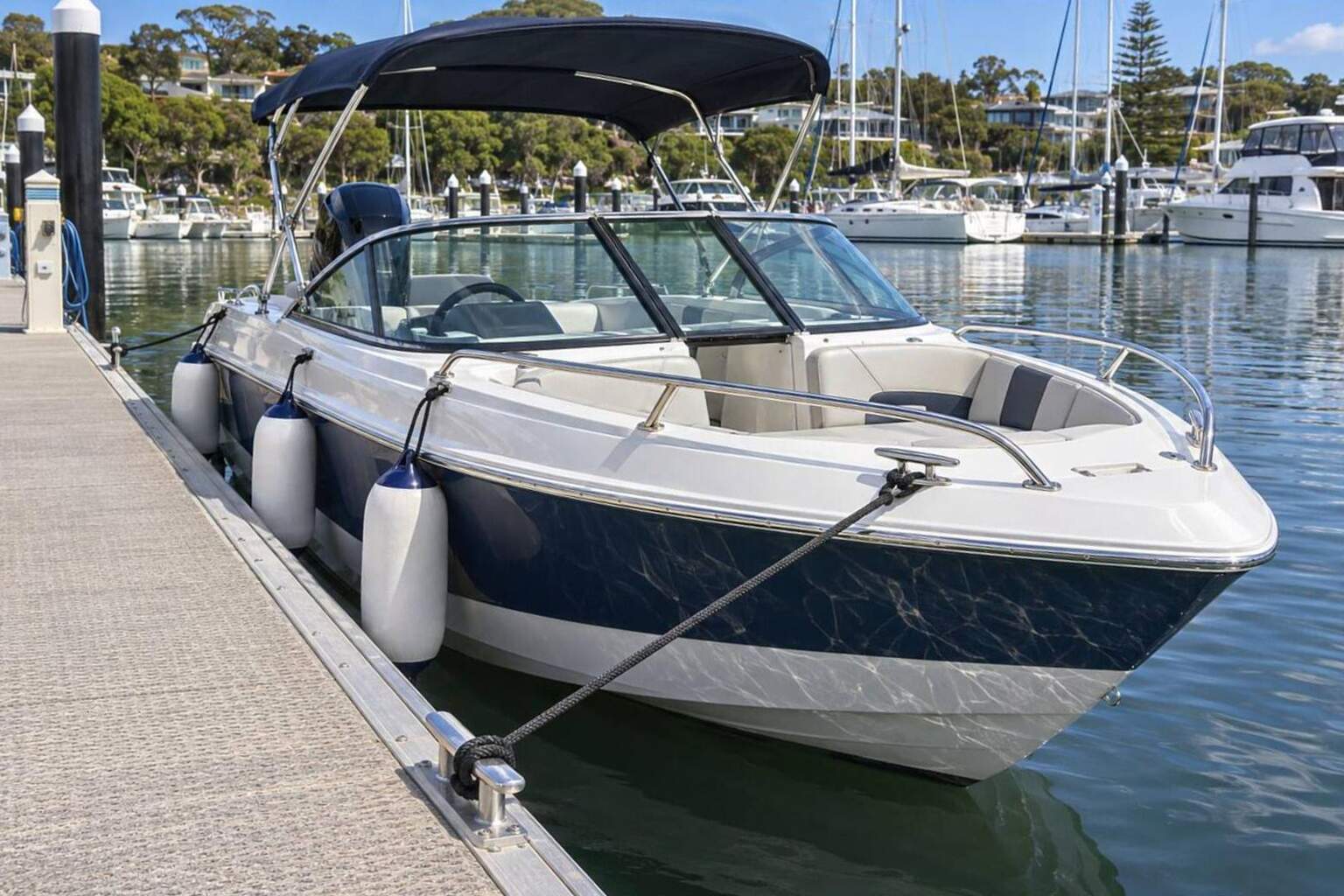
Rig bow, stern and spring lines on the side you intend to berth, and hang fenders at the height of the wharf or pontoon rather than wherever they happen to hang from the rail.
Brief the crew on which line goes ashore first, where they will stand, who takes the helm's instructions, and what happens if you call off the approach.
Make it plain that nobody places a hand, foot, leg or boathook between the hull and the structure, and that nobody steps or jumps ashore while the boat is still moving.
A fender can be replaced and gelcoat can be repaired, but a crushed hand or a fall between the hull and the wharf cannot be undone.
Wind onto the berth versus wind off it
With the wind pressing onto the berth, many skippers stop the boat parallel and a little off, then let it set down onto the fenders, accepting that gusts can make that landing heavier than planned.
With the wind off the berth, a steeper approach and a forward spring secured early often helps, although a current running the other way can stall the bow before any line is ashore.
When the two forces oppose, work out which one dominates for your hull on the day, and expect the balance to shift as you move into the lee of sheds, breakwaters or larger vessels.
Alongside berths and finger pontoons
An open alongside berth usually gives room to adjust late and to drive away, which makes it the sensible place to try an unfamiliar combination of wind and tide.
A finger pontoon between two boats offers less room, often disturbed and gusty air, and far fewer options once you are committed between the fingers.
Making the approach
Use short, controlled engine inputs with pauses between them, so you can see the result of each input before adding another.
Carry only enough way to keep steerage and to hold your angle against the set, since excess speed removes the time you need to read what is happening.
Go around if the approach is wrong
Mooney's guidance is to leave while room still remains if speed, angle or position is not right, and that judgement is made early rather than at the last metre.
A go-around costs a few minutes and some pride, while a forced approach can cost fibreglass, fingers or worse, and no technique can promise a good outcome in any wind or current.
What to practise
In open water, practise holding station, pivoting in your own length, stopping cleanly and approaching a mooring buoy from upwind, downwind and across the stream.
Repeat those drills in a range of conditions, and consider time with a qualified instructor on your own boat if berthing still feels like guesswork.
Frequently asked questions
Should I always approach into the wind?
No, because the current may be the stronger influence on your hull, so the drift test tells you more than any rule of thumb.
What if my crew cannot reach the cleat?
Call off the approach, move clear and set up again rather than letting anyone lean or step across the gap.
Does staying under 6 knots make docking safe?
No, it is a legal maximum in the Queensland areas described, and conditions frequently require much slower speeds.
Compare berthing approaches with other skippers in the Seabreeze forums .