Live Baiting Kingfish: The Rig That Works

Quick summary
Bridle-rigged yakkas and slimy mackerel are the most effective live baits for yellowtail kingfish along NSW and SE Queensland reefs - rigging correctly keeps baits alive longer and puts the hook where it needs to be.
Circle hooks have replaced J-hooks for good reason: they hook in the corner of the jaw, reduce gut-hooking, and you don't need to strike.
The how-to
After reading this you'll be able to rig a live bait correctly, position your boat on structure, and understand why kingfish hit some baits and ignore others.
Lure fishing for kingfish is fun until you meet a crew of anglers who consistently clean up on live baits.
In heavily fished areas, live baiting is the better option for targeting bigger fish, according to Al McGlashan, a Sydney-based offshore fishing writer and television presenter with more than 30 years targeting the species.
The mechanics are straightforward: a kingfish's evolutionary advantage is speed and ambush, and it's wired to intercept the weakest, most erratic target in a school.
A yakka swimming in tight circles at the end of your trace is doing that job for you.
Your bait options
Slimy mackerel, yellowtail scad (yakkas), garfish, squid, and small tuna are the main options along the NSW and SE Queensland coast.
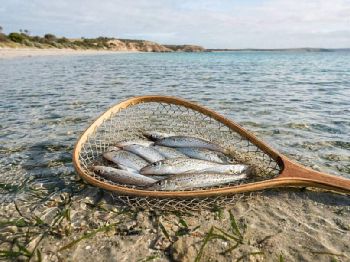
Slimies are the preference for most NSW offshore anglers - they're easy to catch on sabiki rigs at the same reef structure where kingfish hunt, and unlike yakkas, they don't have dorsal spines that force a kingfish to turn the bait before swallowing head-first.
Yakkas are excellent when slimies aren't available and work particularly well at anchor.
Garfish are strictly a drift bait - they can't be slow-trolled alive.
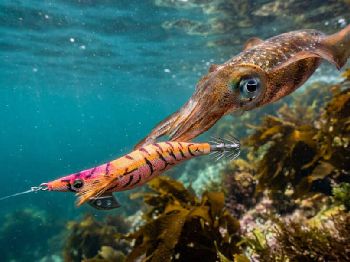
Squid are the exception to most rigging rules: use a double circle hook setup, one hook through the mantle and one near the head, so the squid trails naturally behind the swivel.
The bridle rig versus other options
"For slimies and yakkas, I always bridle them, which helps to keep them alive for a lot longer, especially when slow trolling," Al McGlashan wrote in Club Marine Magazine.
Bridling uses a small loop of heavy braid or dacron threaded through the bait's eye sockets with a baiting needle, then attached to the hook bend or shank.
This method works because no metal penetrates the bait's body - a hook through flesh stresses the bait, causes bleeding, and shortens the time it stays active.
At anchor or drifting slowly, a shoulder hook is a good alternative - the hook goes just above the lateral line below the dorsal fin, where the muscle is firm enough to hold without stressing the bait's central functions.
Nose rigging (hook through the nasal cartilage) keeps the bait swimming head-first and works well at pace when slow trolling at 2-3 knots, but the hook hold is fragile and can tear if the bait makes a sudden run.
The rule: bridle for slow trolling, shoulder for anchor work, nose for drifting past headlands in light current.
"In heavily fished areas live baiting is the best option to beat the bigger fish." - Al McGlashan, Club Marine Magazine
Hook selection
Use in-line circle hooks.
Owner, Gamakatsu, and BKK all produce quality circle hooks in sizes 4/0-7/0, which covers most yakka and slimy sizes used on NSW and SE Queensland reefs.
Circle hooks hook in the corner of the jaw - not in the gut - which produces far fewer lost fish and a much better survival rate for releases.
The counter-intuitive part: don't strike.
When a kingfish takes the bait, lower the rod tip and let the fish run for 5-10 seconds before slowly building pressure.
The circle hook slides forward out of the throat and snags in the corner of the jaw as line tension builds.
Strike too early or too hard and the hook comes straight out.
Your trace setup
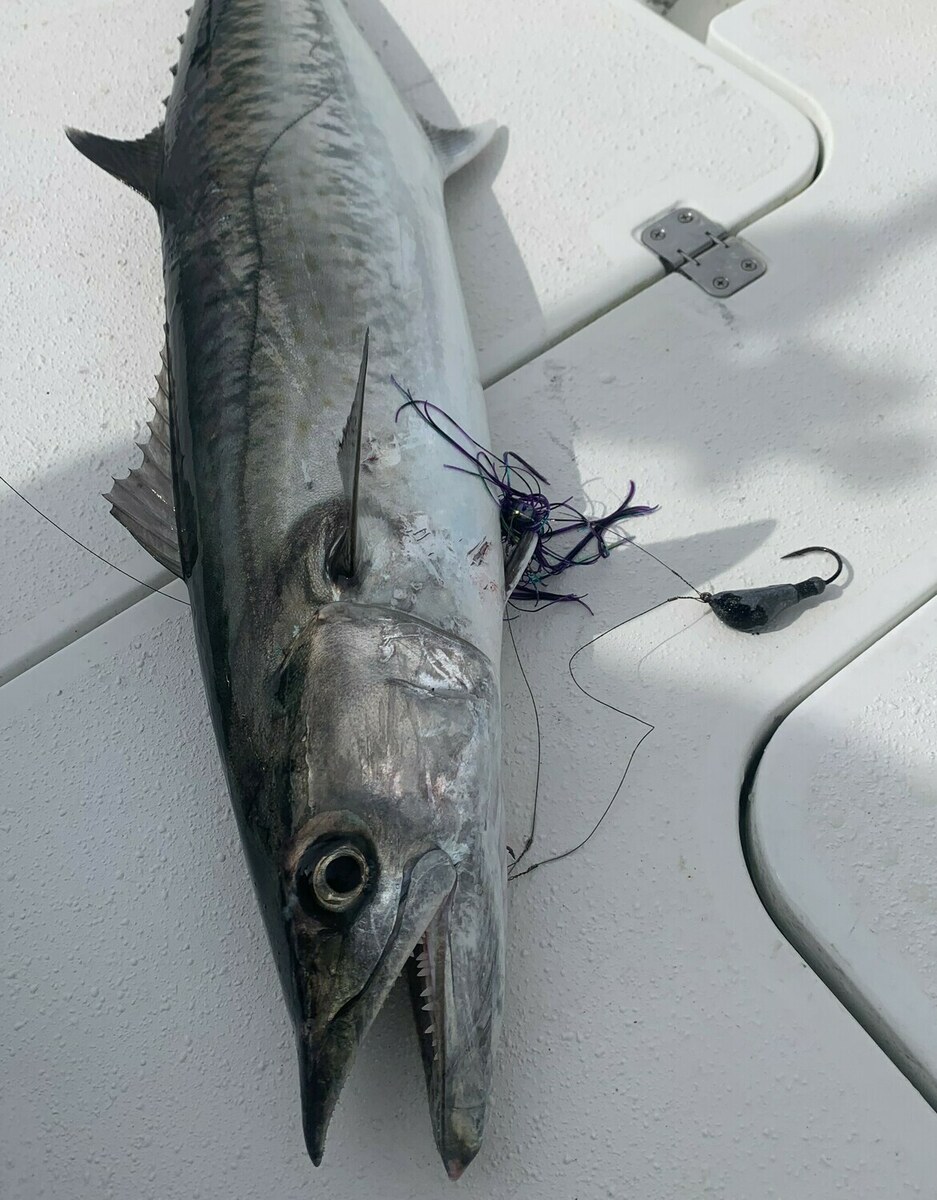
For most NSW and SE Queensland reef situations, 80-100lb fluorocarbon trace in 1-metre lengths covers the range from school fish to large specimens.
Fluorocarbon has two advantages over monofilament at equivalent breaking strain: lower visibility underwater and significantly better abrasion resistance when a kingfish pulls into reef structure or a pylon.
Connect to the mainline with a solid barrel swivel, Uni-to-Uni knot, or an FG knot if running thin braid main line.
Avoid snap swivels - the gate can open under load from a heavy fish.
If targeting fish over 15 kg around sharp reef edges, bump trace to 120-130lb and keep the trace under 80 cm so the bait stays close to the hook during the drop.
Reading the current
Current is the non-negotiable ingredient when live baiting kingfish.
"The old story 'no run, no fun' couldn't be truer when it comes to kings," McGlashan wrote. "On the east coast, the ideal situation is around a knot of current."
Current does two things: it concentrates bait against structure, and it positions kingfish in predictable locations relative to that structure.
Kingfish are ambush predators and they stack on the downcurrent side of hard structure - reef edges, headlands, offshore pinnacles, marker beacons - where the current deflects and creates a pressure shadow.
A bait dropped on the upcurrent side of structure, drifting naturally through that pressure shadow, is in the strike zone.
A bait positioned on the upcurrent face of structure, where fish have to fight the current to reach it, produces far fewer takes.
How to position your boat: anchor or drift set upcurrent of the structure with enough scope to put the boat directly over or slightly upcurrent of the reef edge.
Your bait should be drifting naturally toward and over the drop-off, not fighting back against the current.
If current is raging - over 1.5-2 knots - the bait can be pushed down to the bottom where it's less visible, and schooling fish may move off the top of the reef.
In this case, either add a small running ball sinker (15-30g) to get the bait into the strike zone faster, or wait for the current to ease - usually during the tidal transition.
Finding fish in winter
Yellowtail kingfish move to deeper offshore water as water temperatures drop through May and June.
In 2026, above-average Tasman Sea surface temperatures - running up to 2 degrees above average, according to Bureau of Meteorology autumn SST data - are keeping kingfish active in shallower inshore structure into late autumn that would normally push them offshore by mid-May.
This means the same near-shore headlands, marker beacons, and reef outcrops that hold fish in summer are still producing in late May 2026.
The practical check: find the bait.
According to McGlashan, kingfish follow concentrations of bait, not temperature readings.
"Find the bait and the kings won't be far away," he wrote.
Use your sounder to check mid-water bait schools before dropping a live bait - if the water column is clear, move to the next piece of structure.
Kingfish are creatures of habit, returning to the same structure repeatedly.
A spot that produced fish 3 weeks ago in autumn will usually still be holding fish now - the same schools work the same reef system until the bait moves.
The fight: keeping fish out of structure
A kingfish that reaches reef structure or a pylon wins the fight.
Their first run is the most important - the fish will immediately turn toward the nearest hard object and the window to stop them is 2-4 seconds.
Use high-drag settings from the moment of hook-up: for a 10-15 kg fish on 65lb braid, set strike drag to 7-9 kg.
Pump quickly and keep the rod tip up on the initial run to put maximum sideways pressure on the fish rather than pulling straight back.
Straight-back pressure on a running kingfish is the fastest way to break the trace - lateral pressure turns the fish and is far more effective per kilogram of force applied.
NSW and SE Queensland regulations
In NSW, the minimum legal length for yellowtail kingfish is 65 cm (total length) and the bag limit is 5 per person per day, according to NSW Department of Primary Industries.
Victoria's bag limit was revised to 2 per person following changes announced by the Victorian Fisheries Authority in late 2025.
Queensland does not have a specific minimum size or bag limit for yellowtail kingfish as of May 2026, but possession limits and general fisheries requirements apply - check with the Queensland Department of Agriculture and Fisheries before heading out.
Regardless of what the regulations allow, take only what you'll use - schools are not limitless and kingfish pressure along the Sydney and SE Qld coast has increased significantly as the species has become more popular with lighter-tackle anglers.
Questions for next session
What if the current is running the wrong direction? Move to structure on the other side of the headland - kingfish stack on the sheltered face regardless of tide direction. Different face of the same reef, different school of fish holding there.
Can I use frozen yakkas instead of live? Dead bait works but produces fewer strikes from big fish in clear water. If live bait supply is limited, rig a fresh-dead slimy under a small float and let it drift - it'll look more natural than a sinker-pinned dead bait on the bottom.
What tackle weight is appropriate? A 4000-6000 size spinning reel or equivalent overhead loaded with 40-65lb braid and 1m of 80-100lb fluorocarbon trace covers most situations. Go heavier if targeting structure under 20 metres depth where a fish can reach the bottom quickly.
The fish is taking line but I can't stop it - what am I doing wrong? Check two things: drag setting and rod angle. Most anglers run drag too light to turn a running kingfish. A 10 kg fish needs at least 5-6 kg of strike drag to stall the first run. If drag is correct, lower the rod tip and apply side pressure rather than holding the rod at 90 degrees to the fish.
Check the Seabreeze tides page before your session - tide transitions are when current eases and bait schools reposition, which is typically when kingfish move and feed most actively.