The Pivot Turn: Spin Your SUP in One Move
Quick summary
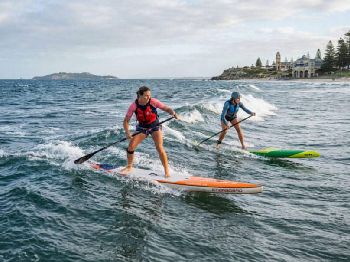
The pivot turn spins a paddle board almost on the spot by stepping back to sink the tail and lift the nose clear of the water.
Get the footwork and the sweep stroke working together and you will turn in a fraction of the space a flat board needs.
The how-to
After this you will be able to step back, sweep, and bring the nose around in one smooth, balanced move.
If you can already paddle in a straight line and swap your paddle side without wobbling, the pivot turn is the skill that transforms your control.
A flat board turns in a slow, wide arc, but sink the tail and it will spin in barely its own length.
The move works because lifting the nose shortens the board in the water, so there is far less hull for the water to resist.
Done well it looks like a dance step, and it is the foundation for catching waves, dodging obstacles and turning in tight water.
Set up before you step
Start on flat, sheltered water with no wind, because a pivot turn is hard enough without chop or a breeze fighting your balance.
Paddle up to a comfortable glide, then bring your feet to a parallel stance roughly over the centre of the board.
Soften your knees and drop your weight low, since a low centre of gravity is what keeps you upright once the tail sinks.
Pick a target to turn toward and keep your eyes up on it, because looking down at your feet pulls your balance forward.
Stepping back to sink the tail
Slide one foot back toward the tail into a surfing stance, staying light on your feet rather than stamping down.
Shift your weight onto that back foot and watch the nose lift clear of the water as the tail settles in.
The further back you step, the deeper the tail sinks and the faster and tighter the board will spin.
Start with a small step while you learn the balance point, then step further back as your confidence grows.
"The pivot turn is not about muscling the board around; it is about sinking the tail and letting the water do the turning for you."
The sweep stroke that spins you
Reach the paddle out wide and plant the blade in the water forward, near where your front foot sits.
Draw the blade through a big arcing sweep, from the nose out and around toward the tail, well away from the rail.
Turn from your hips and shoulders rather than pulling with your arms alone, so your whole body drives the rotation.
The wider the arc of your sweep, the more it turns the board, so make the stroke long and deliberate.
Finishing and levelling off
As the sweep finishes and the board comes around, step back toward the nose to lower it and level the board off.
Keep your feet either side of the centre line as you move, so the board stays balanced under you throughout.
Take a normal forward stroke to settle your glide, and you are pointed at your target and moving again.
Fixing the usual mistakes
Locking your knees straight turns every small wobble into a fall, so keep them bent and springy the whole way through.
Pulling with your arms only gives a weak, tippy turn, so rotate your core and let the big muscles do the work.
Stepping too far back too soon buries the tail before you are ready, so build up the step size as your balance improves.
Sweeping too close to the rail can trip the board and tip you in, so keep the blade out wide through the arc.
Adapting to the conditions
On a longer touring board, expect to step further back and sweep harder, because there is more hull to lift and swing around.
A shorter, wider board pivots more easily, so a smaller step and a lighter sweep will bring it around quickly.
Once you own it on flat water, practise in a gentle breeze, since the pivot turn is how you spin the board to head back in.
Stay safe learning it
Wear a leash and a lifejacket, because you will fall in often while you find the balance point, and winter water is cold.
Learn in shallow, sheltered water close to shore, so a swim to recover the board is short and safe.
Dress for the water temperature rather than the air, since repeated falls in cold water chill you faster than you expect.
Taking it further
What if I keep falling backward off the tail?
You are stepping back too far or too fast, so make a smaller step and keep more weight over your front foot until it settles.
Do I need a special board?
No, but a board with some tail rocker and a bit of width pivots more forgivingly than a long, flat race board.
Which way should I turn first?
Start turning away from your paddle side, since the sweep stroke naturally pushes the nose across in that direction.
Next session, spend ten minutes just stepping back and feeling the nose lift before you add the sweep, then check the wind forecast and pick a still morning to nail it.
Swap tips and local flat-water spots with other paddlers on the Seabreeze forums to speed up your progress.


A New Star for Starboard
Top Female National/International joimns the Starboard SUP AU Tea