The Kneel-Up: Stand Without the Swim
Quick summary
The move: standing on a SUP is not a balance trick, it is a three-point stance made from two feet and one paddle blade buried in the water.
The sequence: kneel over the handle, plant the blade forward, then swap each knee for the foot that was already sitting on top of it.
The conditions: pick a glassy morning under 10 knots, clip your leash on, and launch from ankle-deep water on an all-rounder.
The bailout: if it goes wrong, fall flat and away from the board, then climb back aboard over the tail where the rocker sits lowest.

The how-to
On your knees the board already feels planted, and that feeling is not luck: your weight is low, centred on the stringer and spread across a wide part of the hull.
Standing does not change the board, it only changes where your mass sits, so the whole job is keeping that mass over the stringer while your legs straighten.
Most paddlers treat the stand-up as a balance test they either pass or fail, which is why they wobble, snatch at the air and end up swimming beside the board.
Once you bury the blade beside you, the paddle becomes a load-bearing point of contact, and a tripod does not need balance in the way that two feet do.
Bury the blade and lean a little weight on the shaft: the paddle is your brake and your outrigger, not a walking stick you carry along for the ride.
Phase one: prep
Choose the water first. Work in the lee of a bank, a breakwater or a headland where the surface is oily and the fetch is too short for anything to build.
Ten to 15 knots is already a lot of wind for this drill, so check the numbers the night before on the Perth wind forecast or your local equivalent and aim for under 10 knots, roughly 19 km/h.
Set your gear. Clip the leash to your ankle or calf every single time, and set the paddle 15 to 20 cm above your head so you are not reaching down to load the blade.
Start shallow. Wade out to ankle depth, deep enough that the fin clears the sand but shallow enough that a swim is just a stand-up and a laugh.
Phase two: initiation
Kneel with your knees hip width apart, one either side of the carry handle, because that handle marks the balance point of nearly every all-rounder.
Take three or four solid strokes before you think about your feet, since a board with glide on it tracks straight and resists roll far better than a stationary one.
Plant the blade. Reach forward and sink the blade fully on one side, top hand on the handle and bottom hand low on the shaft, then let a little weight travel down that shaft.
Phase three: commitment
Bring one foot up to the exact patch of deck your knee just left, keeping your shin close to the board rather than swinging the leg out wide.
Now push through the paddle and that front foot, and bring the second foot up beside it so both feet land either side of the handle.
Do it in one breath. Hesitating in the half-crouch is what tips people in, because a bent, frozen body is heavy and high at the same time.
Phase four: execution
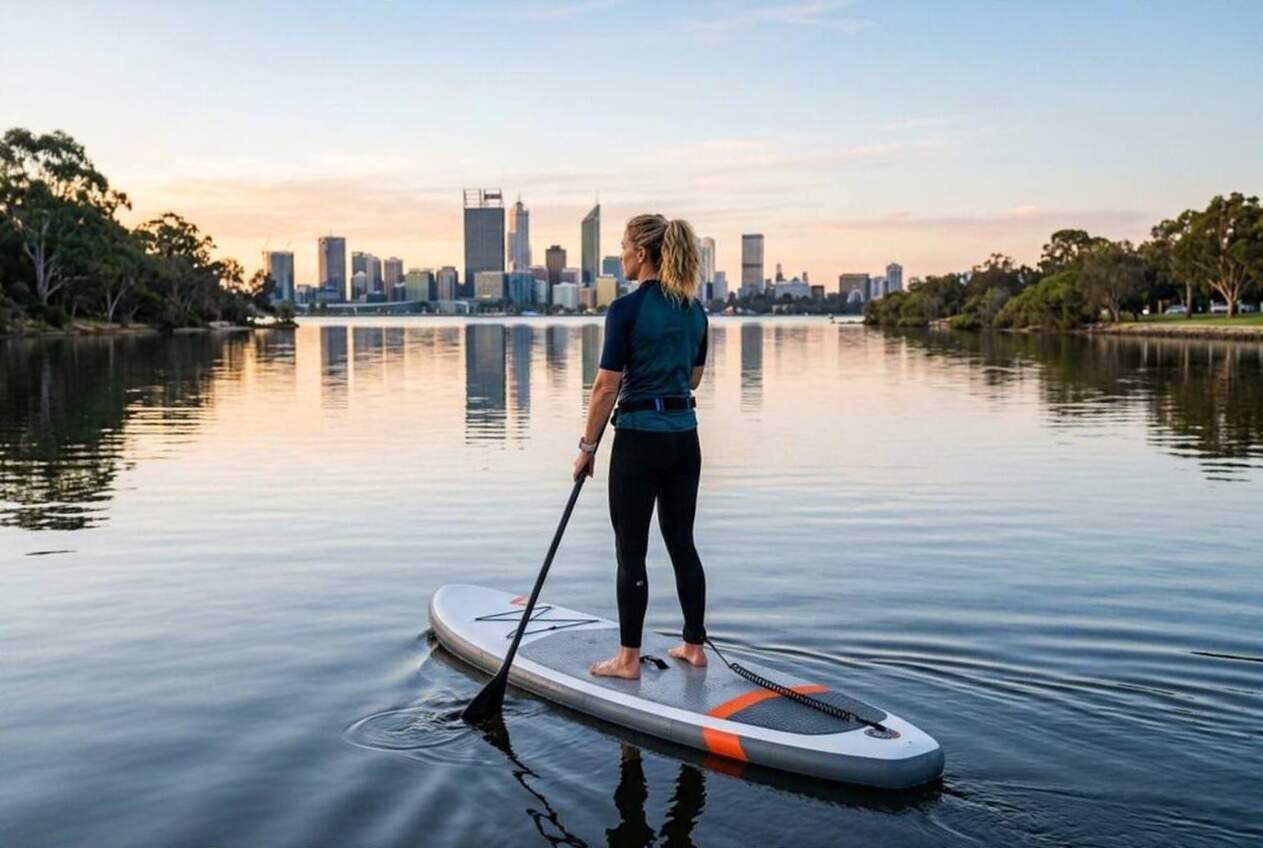
Stack your hips directly over the handle, soften your knees, and let your ankles make the small corrections instead of throwing your arms around for balance.
Eyes on the horizon. Look at the far bank, a moored boat or the beacon ahead, because your feet go where your eyes send them and the deck tells you nothing useful.
Take your first stroke within a second or two of standing, since a paddling board is a stable board and stroking gives your body a job to do.
Phase five: recovery
When you do go in, and you will, fall flat and away from the board so the rail does not catch a knee and the fin misses your legs.
Climb on over the tail. The tail sits lowest in the water, so slide your chest up the deck there, kick your legs level, and settle back onto your knees before standing again.
Four mistakes worth fixing
Looking at your feet. Dropping your chin pitches your shoulders forward, shifts your weight off the stringer and cuts your reaction time down to almost nothing.
Standing too far back. If the nose lifts and the tail squats, the waterline shortens, the board turns twitchy and every small wobble becomes a big one.
Pulling the paddle out. Lifting the blade at the moment you rise removes your third point of contact and hands you two feet and a very short deck.
Rushing it on a small board. A 2.9 m board rewards paddlers who already stand comfortably, so learn the move on 3.0 to 3.4 m of hull and size down later.
Safety
Wear a PFD any time you paddle in wind, current or water you could not comfortably swim back across, and treat that as the rule rather than the exception.
The Australian Stand Up Paddle Association counts a leash and a Type A flotation device among the basics once you leave sheltered, protected water.
How much wind is too much?
Anything over 10 knots makes the board hunt and the blade catch, so keep your first sessions under that number and build up gradually.
Where exactly should my feet sit?
Either side of the carry handle, hip width apart and square across the board, which puts your hips right over the balance point.
Is it easier to stand while moving?
Yes, a board with glide resists roll, so take three or four strokes on your knees before you commit to standing up.
Do I need a wider board?
Width always helps. As does length and volume. You can keep increasing until you're essentially standing on a barge, but whats the point of that. Learn to lean on the paddle. Persist with what you have, and if too frustrating, beg or borrow for an easier board. You'll get it if you keep at it.


How to Stand Up Paddle
Awesome tutorial on the basic of standup paddle, and a segment from the TV show "Totally Wild", an introduction to Standup Paddle