The Reverse: Turn Without the Sweep
Quick summary
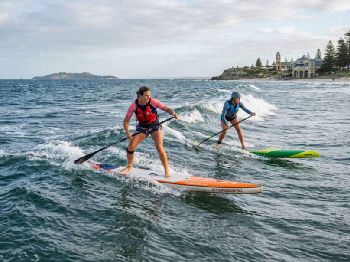
The reverse turn spins your board around its tail instead of dragging it around the middle, which is why it finishes in two strokes rather than ten.
Most paddlers who already track straight reach for a harder sweep first, then wonder why the board yaws sideways, the nose stays planted and they end up swimming.
The how-to
Step back until the nose lifts clear, plant the blade beside your hip, let the board rotate underneath you, then step forward and paddle out on the new line.
The insight first, the reverse is a weight shift onto the tail so the nose unweights and the board pivots under you.
Sweeping harder with the blade while you stand in the middle of the board only yaws the hull, scrubs your speed and sets you up to step off.
Move your feet and the board turns itself. Move only the paddle and you are just pushing water sideways.
Everything below assumes flat Australian water, a lake or a sheltered estuary on a light morning, with your leash on and nobody within swinging distance of the blade.
Preparation
Board choice matters, you want enough tail rocker and enough tail width to stand on without the back sinking straight under you.
A flat, thin tail will submerge the moment you shift your weight back, so a touring or all-round shape is friendlier than a low-volume race tail.
Check your paddle length by standing the blade flat on the deck beside your feet and seeing where the T-grip finishes.
For turning work the grip should sit at about wrist height, which keeps the shaft low enough for you to drive a deep, stable plant.
Leash on, fin bolt tight, and start in knee-deep water where you can step off and remount without a long swim back to shore.
Wind under about 10 knots stops the nose being pushed around while you learn, so check the Perth wind forecast or your nearest equivalent before you load the car.
Initiation
Build speed first, two or three firm strokes give the board glide, and a moving board rotates far more willingly than a parked one.
Take one reverse step with your back foot, feel for the carry handle or the edge of the deck pad with your heel, then bring the front foot back.
One or two steps is enough at the start, and plenty of paddlers never need a third.
Step, do not shuffle, because dragging your feet keeps your weight in the middle while your head moves, and that combination tips you every time.
Lift your eyes to the exit, the patch of water you want to be facing when the turn finishes, rather than watching the nose.
Looking down at the nose drops your chin, rounds your back and pulls weight forward at the exact moment you need it over the tail.
Commitment
This is the step people skip, the weight has to settle onto the back foot before the blade does anything useful.
Bend your knees, drop your hips and press through the back foot until you feel the tail sink and the nose lift clear of the surface.
With the nose unweighted the board sits on a short section of tail, and the fin and rails have almost nothing left to hold a straight line.
Plant the blade in the water beside you, not out in front, and keep the shaft close to vertical so you pull the board around rather than shove it sideways.
A reverse sweep on the side you want to turn towards is the simplest version, arcing from the tail out and away in a wide half circle.
Keep the blade buried the whole time, because a blade in the water is also a brace, and a brace is what stops a wobble becoming a swim.
Execution
The board will rotate under you in a single stroke once the nose is genuinely clear, and in two or three strokes if you have only half committed.
Resist the urge to pull harder, and if the board is slow to come around, step back another few centimetres instead of adding force.
As the exit point swings into view, let the blade finish, step forward one foot at a time and bring the nose back down gently.
Stepping forward in a rush drops the nose with a slap, kills the rotation and wastes the speed you just earned.
Take your first forward stroke before you are fully back in your normal stance, so the board keeps moving while you settle over it.
Practise both sides from the first session, because almost everyone builds a strong side within a week and then spends a season trying to balance it out.
Failure diagnosis
The board yaws but will not spin, you are still standing mid-board and turning with your arms alone.
You step off backwards, the blade was out of the water when your weight arrived over the tail.
The tail sinks and everything stops, you have gone back too far, or the board lacks the tail volume to carry you there.
The nose never lifts, your head is down, your hips are high and your weight is sitting forward of your back foot.
It works on glass and nowhere else, you are trying it in chop or breeze, where the nose gets pushed before the turn finishes.
Short boards with a cut-away tail give you nothing to stand on, so borrow something longer for the learning sessions if you can.
Falling is part of this one, which is another reason knee-deep water and a leash beat deep water and good intentions.
Paddlers trade board and step-back notes on the forums if you want to compare what works under other people's feet.
How far back should you step?
Far enough that the nose clears the water and no further, which for most all-round boards means one or two steps and your back heel near the tail pad.
Why does your nose stay down?
Almost always because your eyes are on it, since a dropped head sends your hips forward and cancels the weight you thought you had moved back.
Should you learn this on flat water first?
Yes, because the footwork needs to be automatic before wind or chop starts moving the nose while you are mid-step and balanced on one leg.
How long does it take?
Expect a few sessions to land it cleanly on your strong side, and a few more before the weak side stops feeling like a different skill entirely.


The Kneel-Up: Stand Without the Swim
Three points of contact beat balance every time