Installing an AIS - One Cruiser's Experience

 |
| 'Crystal Blues in Borneo' . |
My father taught me to sail when I was about 8 years old. With great and delightful understatement, he always said that 'a collison at sea can ruin your whole day'. He is right of course, though AIS technology is now available to help avoid those 'ruined days'. This is the first of three posts regarding the system, and basically describes the technology. Future posts will cover our installation experiences and the system in operation.
 |
You really don’t want to be even CLOSE to one of these - .. . |
This is a significant primary safety system, and many in the yachting community have taken advantage by purchasing low cost AIS receivers - these display ship locations on navigation chart plotters, or on suitably equiped navigation computers. Whilst an AIS receiver system is a good thing to have, I always believed that the best safety system required the big ships to see me as well - I wanted a proper transponder.
Nowadays we can all see and be seen, with low cost AIS transponders available to the cruising and pleasure craft community. The 'big ship' Class A systems are expensive, so the IMO has also ratified a simpler version called AIS Class B, for pleasure vessels.
 |
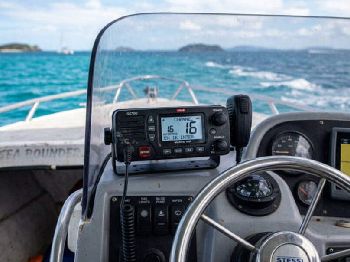
AIS System showing text display - .. . |
Class B systems also use a dedicated GPS receiver, but transmit a more restricted data set (no rate of turn, destination, ETA or cargo information) and do so less frequently, using less power (maximum 2 watts). The control protocol is CSTDMA (Carrier Sense Time Division Multiple Access). Basically the Class B systems listen for a gap in the Class A traffic, then transmit. There is no guarantee that any individual data burst will be successfull, however the system transmits a burst every 30 seconds when underway. Even in Singapore, with literally hundreds of ships transmitting close by, I've watched very solid returns from Class B equipped vessels in the Singapore Straits. The system can certainly process lots of traffic - our transponder identified over 1000 targets (!) in 48 hours on our recent passage from Singapore to Langkawi.
Most of the approved Class B systems use a common internal circuit board, made by Software Radio Technology (SRT) in the UK. SRT was part of the IMO advisory panel that set the standard, so its no surprise they have complying product on the market. Our Comar CSB200 AIS transponder (user manual here) uses the SRT circuit board.
AIS is already compulsory on pleasure craft in some parts of the world (eg South Korea), and I believe it will become mandatory in many countries. In Singapore, pleasure craft must carry either an AIS-B transponder or one of the local HARTS transponders that use cellphone technology as the data link to shore based monitoring stations (more info on HARTS is here - thanks to Terry Sargent on SV Valhalla for the document).
For more background information on the politics, technology and products behind AIS, I suggest you spend awhile reading the AIS links on the excellent PANBO blogsite.
To be continued next week...
To read more about the activities of Crystal Blues, go to their WEBSITE
by Neil Langford
 |
Click on thumbnails to enlarge and find more photos:


Newsfeed supplied by