Reefing: Read the Signs, Act Early

Quick summary
The right moment to reef is when you first think you might need one - not when the boat is already on its ear and you're fighting the helm.
Slab reefing takes less than three minutes with a practiced crew, and the technique is the same whether you're motorsailing off the heads or caught in a building southerly passage.
The how-to
After reading this, you can put in a reef cleanly under way, diagnose the three most common mistakes, and build the habit of reefing early into every coastal passage.
The standard advice every racing instructor gives beginning cruisers - reef when you first think about it - is correct, but it doesn't tell you what to think about or how to act on it.
Here's the complete picture for coastal Australian sailing.
Who this is for
You're comfortable sailing to windward, confident tacking and gybing in moderate conditions, and you understand how to trim a mainsail for point of sail.
You've probably reefed a few times but you're not completely happy with how it goes - the boat feels chaotic, something gets stuck, or it takes longer than it should.
What reefing actually does
A reef raises the effective foot of your mainsail to a set of reef points higher up the cloth, cutting the sail's working area.
On most coastal cruisers, a first reef reduces driving area by roughly 25-40 percent.
Less area means less heeling force, less weather helm, and a more balanced boat in conditions where the rig is working harder than it should be.
The tradeoff is forward drive, but an overpowered sail costs you more speed than a properly reefed one: a boat heeling past 20 degrees is pushing sideways through the water, not forward through it.
Reading the signs - before you look at the wind gauge
Wind speed alone is a rough guide; boat response is the real indicator.
The first sign is weather helm - the tiller or wheel is pulling hard to weather and you're working to hold course, rather than sailing hands-off with light helm.
The second sign is heel: if your leeward deck is approaching the water, the boat is generating more heeling moment than it can efficiently use.
On a typical coastal cruiser, these signs appear around 15-18 knots apparent wind - though boat type, sail cut, and loading make that vary significantly.
The third sign is specific to Australian coastal passages: the 40 percent gust rule.
BOM marine forecasts give mean wind speeds, and gusts routinely run 40 percent stronger - a 20-knot forecast means gusts to 28 knots, which puts most cruising yachts firmly in second-reef territory.
If the forecast is 20 knots and building, put the first reef in before you leave the marina.
"Reef before you need to - it's far easier to shake out a reef when conditions ease than to put one in when the boat's already on its ear and the foredeck crew are holding on."
That's the standard guidance from Australian Sailing instructors, and it's been standard because it works.
The slab reef sequence, step by step
Slab reefing - also called jiffy reefing - is the system fitted to 90 percent of Australian cruising yachts.
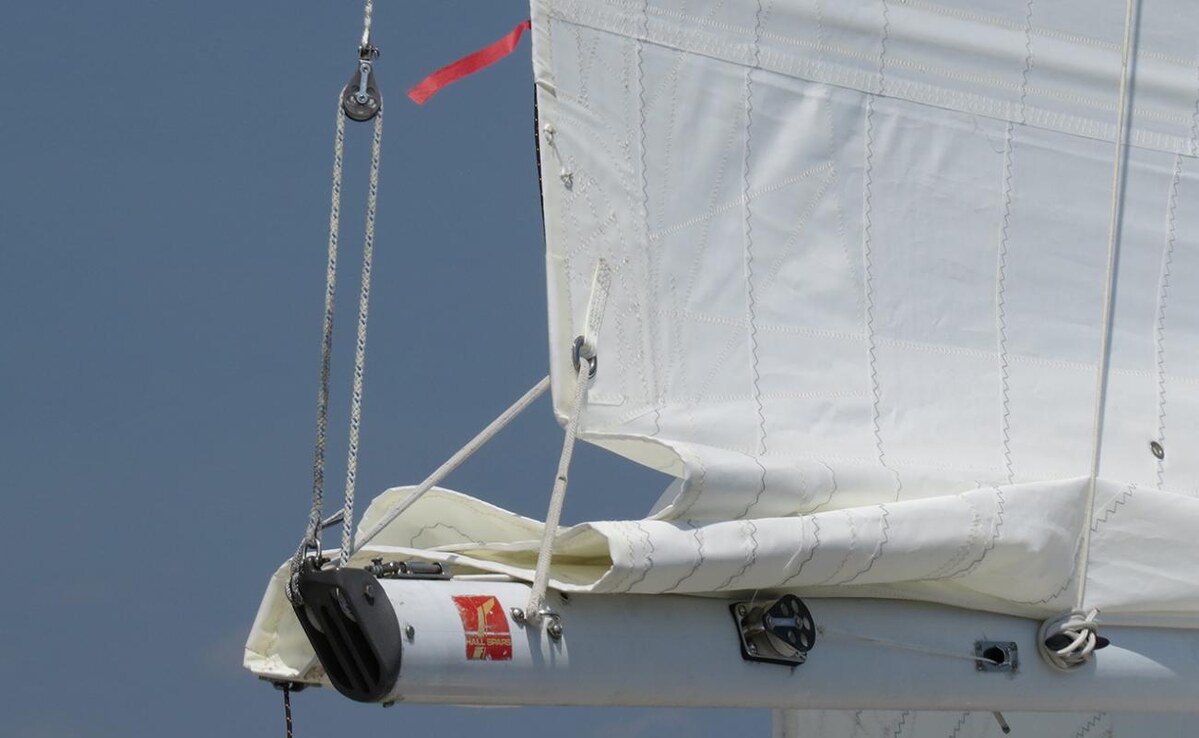
A reef line runs from the cockpit through the boom and up to a cringle in the leech of the sail.
When the halyard is eased, pulling this line tightens the foot of the sail against the boom at the reef point.
Step one: communicate. Tell the crew you're reefing, assign the halyard to one person and the reef line to another, and have the helmsperson hold a steady course.
Step two: reduce load on the sail. Head up five to ten degrees toward the wind and ease the mainsheet until the sail just stops driving - you want the cloth to flutter without being completely depowered.
Step three: ease the halyard. Lower the main halyard steadily while the reef line operator takes in the slack, pulling the clew reef cringle down toward the outboard end of the boom.
Step four: secure the tack. Before pulling on the leech, make sure the luff reef cringle - the eyelet at the front of the reef - is secured to the boom tack fitting, horn, or reef hook at the gooseneck.
Step five: tension the clew. Pull the reef line until the foot of the sail is flat and taut along the boom, with no diagonal wrinkles running from tack to clew - those wrinkles mean the clew isn't tensioned enough.
Step six: re-tension the halyard until the luff of the mainsail is firm and the cringle sits cleanly on its fitting.
Step seven: tidy the bunt. The loose sail between the reef points hangs below the boom - roll it up and tie the reef points (or use a single lacing line) around the fold and around the boom, not through the sail itself.
Trim the mainsheet, bear away to your heading, and sail on.
Done cleanly, this takes two to three minutes from decision to sailing.
Single-line versus two-line systems
Many newer yachts fit single-line reefing, where one continuous line runs from the cockpit through the boom to both the clew and tack cringles.
Pulling that single line simultaneously lowers the sail and secures both ends of the reef.
It's faster - under two minutes for practiced crews - but requires a correctly set-up and led system and can be harder to diagnose when something jams mid-reef.
If you have a single-line system, always confirm both the tack and clew cringles are seated before sheeting on - a loose tack cringle puts enormous load on the reefing line and will strip the cringle out of older sails.
Reefing downwind
If you're running downwind when conditions build and turning head-to-wind is impractical - for example, you're between headlands on a south coast passage - you can reef on a broad reach instead.
Sheet the boom to about 30 degrees off the centreline to reduce the apparent wind and give the sail some shape, then follow the same tack-before-clew sequence.
It takes longer and is messier, but it avoids the risk of an accidental gybe in a building sea when turning toward the wind.
Three common mistakes and their corrections
Waiting too long - the most common mistake at every level of experience.
An overpowered boat is hard to steer, the foredeck is wet and moving violently, and everyone is stressed - exactly the conditions that make a straightforward reef turn into a drama.
The fix is a pre-defined trigger: reef at 18 knots apparent on a beat, reef before leaving port if the forecast is 20 knots or more.
Pulling the clew before the tack is set is the second common error, and it puts load directly onto the reef line rather than sharing it between the boom-end fitting and the tack horn.
Always hook or secure the luff cringle first, then tension the clew - the sequence matters.
Over-tightening the reef points is the third mistake, and it can tear the sail.
Reef points (the short ties through the sail) hold the bunt of the folded cloth against the boom - they carry almost no load when the luff and clew are properly tensioned.
Tie them firm enough to keep the bunt from flogging, not so tight that you feel resistance - if the sail feels stiff when you tie the points, the tack cringle probably isn't seated properly.
Australian conditions worth planning for
On the New South Wales south coast, southerly changes after a coastal trough can go from 12 knots to 30 in under thirty minutes - a reef already in saves the scramble.
In Queensland, afternoon sea breezes often build beyond the forecast range through spring and summer; plan to reef by early afternoon if you're heading south through inshore passages.
On the WA coast, the Fremantle Doctor arrives predictably in the early afternoon from the south-west at 20-30 knots - if you're not already anchored or in port by early afternoon, the first reef should be in before it arrives.
Use the Perth wind forecast or your relevant coastal forecast at Seabreeze to track the timing before you depart.
Making it automatic
Practice reefing in light air, moored or in calm anchorage, until the sequence is physical memory for everyone on board.
Running a dry reef drill in flat water takes fifteen minutes and makes the next offshore reef feel like a non-event rather than an emergency.
Then, when the sky darkens and the boat starts to press, the decision is already made.
Questions to consider for your next passage
What's your pre-defined reef trigger for this boat and crew? Having a specific apparent wind speed or heel angle agreed before departure removes hesitation in the moment.
Have you checked the reef lines and fittings recently? Reef lines chafe at the boom exit block and at the cringle; inspect them at the start of each season and before any passage of more than 50 nautical miles.
Can every crew member put in a reef solo? If the skipper is the only one who can reef, that's a safety gap - particularly on shorthanded overnight passages.
Does your boat have a second reef set up and led? On most south-east coast passages, a second reef means the difference between managing a surprise 35-knot squall comfortably and having a bad day on the water.