Heaving To: Park the Boat in a Blow

Quick summary
- What it does: parks a sloop at 40 to 60 degrees off the breeze with the headsail backed against a locked helm.
- Why bother: it buys time to reef, eat, navigate or fix gear without burning fuel or steering into a building sea.
- When: commonly once the wind sits in the 25 to 35 knot (46 to 65 km/h) band and keeps climbing.
- Sea room: she still forereaches at 1 to 2 knots (1.9 to 3.7 km/h), so a lee shore is the one thing that ruins it.
- Reef first: shorten sail before you try to stall the boat, never after.
The how-to
Heaving to is a controlled stall rather than a stop, and understanding that distinction is the difference between a restful hour and a very expensive afternoon.
You back the headsail so it pushes the bow down, lash the helm to leeward so the rudder pushes the bow up, and the two forces argue until the boat settles.
Settled looks like a slow, heavy hobby-horse with the wind somewhere between 40 and 60 degrees off the bow and a slick of flattened water sliding away to leeward.
Phase one: prep
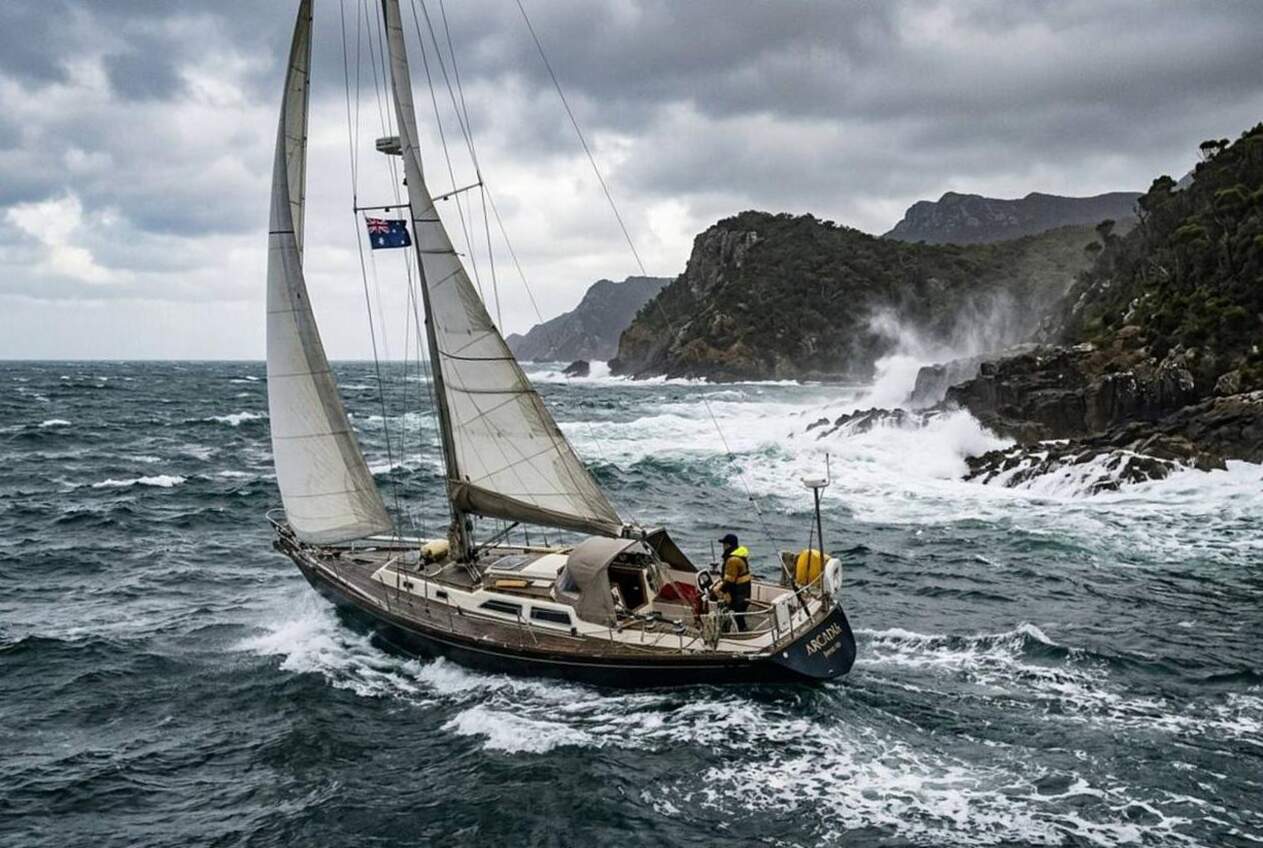
Reef before you commit. A boat carrying too much canvas will not lie quietly, because she sails forward hard, heels badly and tries to tack through the wind on every gust.
On most cruising sloops the working combination is two reefs in the main with a partly furled headsail, though a deep third reef and a storm jib suits heavier air.
Count your sea room in miles, not metres. Forereaching at 1 to 2 knots puts you roughly two nautical miles downrange every hour, and leeway adds to that total.
Work out where the drift takes you over the next three hours, and if the answer is a headland, a bombora or a beach, keep sailing until you find deeper water.
Check the traffic and the chart. Heaving to inside a shipping channel, a narrow bay or a crowded anchorage is both antisocial and dangerous, because you become an underpowered obstacle.
Get lifejackets on, clip the crew in, close the companionway hatch and stow loose gear below before the boat starts rolling in earnest.
Phase two: initiation
Come up onto a close-hauled course and get the boat moving properly, because you need real momentum to carry the bow through the wind and out the other side.
Tack as you normally would, but leave the working headsail sheet cleated so the sail crosses the foredeck and fills hard on the new windward side.
That backed headsail is the engine of the whole manoeuvre, and it should stay full, taut and quiet on the wrong side of the forestay.
Leave the mainsheet alone for now and let the main luff a little while the bow swings, then deal with it once the boat has slowed.
Phase three: commitment
Lash the helm to leeward and lock it. With a tiller that means pushing it down to the leeward side and tying it off, and with a wheel it means turning toward the wind with the brake hard on.
A helm merely held by hand will creep, and a creeping helm lets the backed jib win, which sends the boat tacking through the wind unannounced.
Use a proper lashing to a cleat or winch rather than trusting a friction brake alone, because gusts load the rudder far harder than you expect.
Phase four: execution
Now trim until she sits. Ease the mainsheet until the main stops driving and starts acting as a damper, then watch the bow for a full thirty seconds.
If she keeps trying to tack, ease more main or take another roll in the headsail, and if she falls beam-on into the trough, sheet the main in a touch.
The target is 40 to 60 degrees off the true wind, drifting slowly to leeward and easing forward at little more than walking pace.
Heaving to is a controlled stall, not a stop, and the boat still forereaches at 1 to 2 knots.
Feel the motion. Right feels like a slow, heavy hobby-horse, where the bow lifts, pauses and settles while the rig loads and unloads on a long lazy rhythm.
Wrong feels sharp and busy, because she either sails through the wind and tacks herself, or stops dead in irons with the sails slatting and the rudder useless.
Fix the first with less main and more rudder, and fix the second with more headsail drive or slightly less helm angle.
Once she is settled, log your position, note the time, set a drift alarm on the plotter and keep someone on deck watch.
Phase five: recovery
Getting sailing again is the reverse, in order. Free the helm lashing first, then release the backed headsail sheet and let the sail unwrap across the foredeck.
Bear away as the headsail fills on the correct side, sheet on hard, and build speed before you even think about pointing up into the sea.
Give yourself a wave cycle or two of clear water before hardening up, because a stalled boat has no momentum to punch a steep face.
The five mistakes that spoil it
A lee shore is the killer, because everything else on this list is merely uncomfortable, while drifting onto rocks at 1.5 knots for three hours is terminal.
Too much sail stops the boat lying quietly and turns the manoeuvre into a slow, heeling reach that nobody on board asked for.
An unlocked helm hands you a self-tacking boat with a backed jib on the wrong tack and a crew who never saw it coming.
A crowded channel makes you a hazard to shipping, and it strips away the sea room that made the manoeuvre safe in the first place.
Reefing after the fact means working the foredeck of a boat fighting itself, which is exactly the job heaving to was supposed to make easier.
Practise it before you need it
Australian Sailing's keelboat pathway treats handling under shortened sail as core competency, so heaving to belongs in the same drill session as reefing and crew recovery.
Run it on a 15 knot afternoon with clear water to leeward, and learn your own boat's settled angle and sheet positions while nothing is at stake.
Every hull differs, because a long-keeled cruiser may lie quietly at 50 degrees while a fin-keeled racer needs a scrap of headsail and constant attention.
Write the winning settings on a card at the nav station so you are not experimenting at midnight with a rising gale and a tired crew.
Swap notes with sailors who have hove to in Storm Bay and off the Tasman Peninsula on the Seabreeze forums .
Can you heave to with a furling headsail?
Yes, and a partly furled genoa backs well enough, though the shape is poor so expect to need a little more main to balance her.
Is heaving to the same as lying to a drogue?
No, a drogue or sea anchor is deployed gear that slows drift, while heaving to uses only sails and rudder and keeps you forereaching.
How long can you stay hove to?
As long as your sea room lasts, which is a navigation question rather than a sailing one, so recalculate your drift every hour.
What if she will not settle at all?
Some fin-keeled boats simply will not heave to, so fall back to running off under a scrap of headsail or towing a drogue.
Check Seabreeze wind, tides and warnings before every offshore leg this season, and plan your sea room before the breeze makes the decision for you.