Equalise Your Ears: Descend Without the Pain

Quick summary
Painful ears are the most common reason new divers cut a dive short, and almost every case comes down to equalising too late.
Clear your ears early and often on the way down, gently and before you feel any pressure, and the descent stops fighting you.
The how-to
After this you will know how to equalise on the surface, how to keep ahead of the pressure as you sink, and what to do when an ear will not clear.

Your ears hurt underwater because the water pressure rising around you squeezes your eardrum inward faster than your body can balance it from the inside.
Equalising simply pushes a little air up the Eustachian tubes into the middle ear, pressing the eardrum back to neutral and taking the pain away.
The pressure change is steepest in the first few metres, so the shallows near the surface are exactly where careless divers get caught out.
Get the habit right and equalising becomes automatic, something you barely notice on every descent for the rest of your diving.
Start before you get wet
Gently equalise on the surface before you descend, which pre-inflates the middle ear and gives you a small head start on the pressure.
Through the day, chew gum or swallow now and then, because an already-open, mobile Eustachian tube clears far more easily than a stiff, dry one.
Never dive with a heavy cold or blocked sinuses, since congestion swells the tubes shut and makes a clean equalisation almost impossible.
Descend feet-first down a line if you can, so you control your speed rather than sinking head-down and racing the pressure.
The Valsalva, the one everyone learns
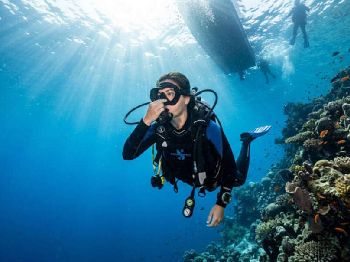
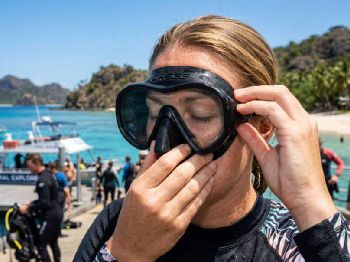
Pinch your nose closed, then gently blow against it as if clearing a stuffy nose, and you will feel the ears pop clear.
Blow softly, never hard, because a forceful blast can strain the delicate structures of the inner ear and cause real, lasting damage.
The Valsalva works well in the shallows but grows less reliable with depth, which is why divers learn to reach for other techniques too.
If one gentle attempt does not clear, stop, rise a little, and try again rather than blowing harder and harder against a stubborn ear.
"You cannot muscle your way past a blocked ear; the moment it hurts you have already gone too far, so ascend a metre and clear before you sink again."
Equalise early and often
The golden rule is to clear every metre or two on the way down, before you feel any pressure at all, not after it starts to ache.
Pain is not the signal to equalise; pain means you have left it too late and the eardrum is already stretched and inflamed.
A slow, controlled descent is your best friend, because it gives the tubes time to keep pace with the rising pressure around you.
If you fall behind, stop your descent, hold the line, and clear fully before you drop another metre.

Other techniques worth learning
The Toynbee manoeuvre is pinching your nose and swallowing at the same time, which opens the tubes using your throat muscles instead of pressure.
The Frenzel technique uses the back of the tongue to flick air up the tubes, and it stays reliable at depth where the Valsalva fades.
Wiggling your jaw side to side, or pushing it forward, can help coax a sticky tube open between attempts.
Most experienced divers blend a couple of these methods without thinking, switching to whatever clears the ear most easily on the day.
Fixing the usual mistakes
Waiting until it hurts means the eardrum is already stressed, so start clearing at the surface and repeat every metre or two.
Blowing too hard risks injuring the inner ear, so keep every Valsalva gentle and stop the instant an ear refuses to clear.
Descending too fast outpaces your ears, so slow right down and use a line to control your rate of drop.
Diving with congestion loads the deck against you, so postpone the dive rather than forcing sealed, swollen tubes to open.
When an ear will not clear
If an ear stays blocked or painful, stop your descent at once and rise a metre or two until the discomfort eases off.
Try again gently from there, and if it still will not clear after a few calm attempts, end the dive rather than pushing on.
Forcing a descent through a blocked ear can rupture the eardrum or cause a painful barotrauma that will keep you out of the water for weeks.
A reverse block, where trapped air cannot escape on the way up, is handled by ascending slowly and swallowing, never by a hard Valsalva.

Common questions
Why does only one ear hurt?
One Eustachian tube is often slightly narrower or more congested than the other, so it lags behind and needs a little extra attention on descent.
Should I feel a pop each time?
A gentle click or pop is the sign the tube has opened and the middle ear has equalised, and it should feel comfortable, never sharp.
Can I keep diving with a mild cold?
It is far safer to wait, because congestion makes equalising unreliable and a decongestant can wear off at depth and leave you blocked coming up.
How slow should I descend?
Slow enough that you always stay ahead of the pressure, using a line or the reef so you clear comfortably every metre without rushing.
Plan your next dive around a calm, clean window using the Seabreeze Sydney wind forecast , and check the local NSW tides before you gear up.