After Dark: Your First Night Dive

Quick summary
Your first night dive belongs on a site you have already dived in daylight, with two working torches and a planned exit.
Night dives are often calmer and easier on air than day dives, but only if you slow right down instead of bolting a torch onto your usual pace.
The how-to
After reading this you can plan, brief and run a controlled first night dive on familiar ground without losing your buddy or your bearings.
You already dive by day, you equalise cleanly and you can hold a stop without sculling with your hands.
That is the entry ticket for night diving, because nothing about the skill set changes after sunset.
What changes is your reference points, and that is the whole job of preparation.
Pick a site your hands already know
Choose somewhere you have dived at least a few times in daylight, so you know the sand line, the depth curve and where the exit actually is.
A familiar shore reef, a jetty you have swum a hundred times, a NSW south-coast bombora or a Moreton Bay wreck you have done in the sun all work well.
Never a new site, because your first night dive should have zero navigation surprises in it.
Late winter and early spring evenings are popular because dark comes early and you are back on the beach at a civilised hour.
Water is still cold through August, so add exposure protection beyond what you would wear at midday, since you will be moving slower and generating less heat.
Gear that earns its place
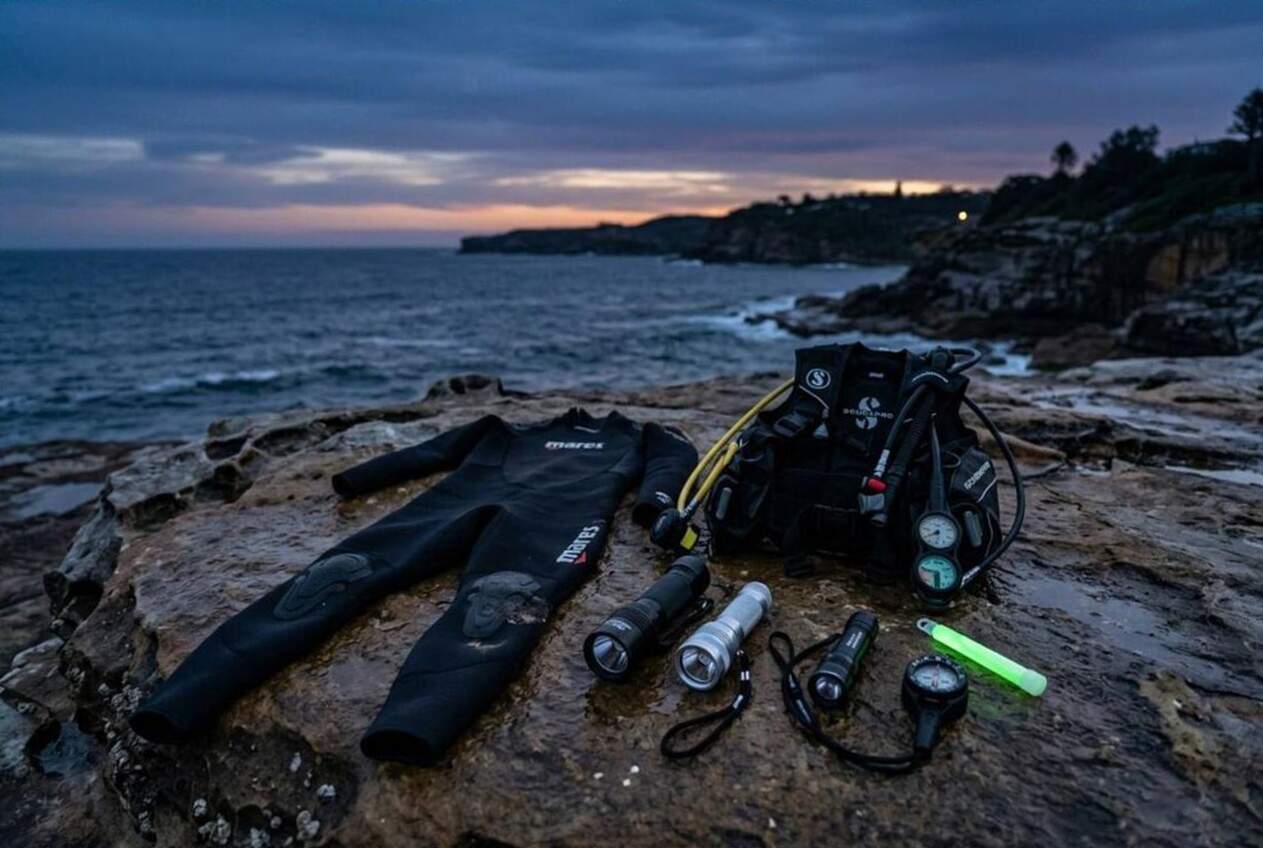
Primary torch, backup torch, and that is not a suggestion, it is the standard.
Ross McLaren, a PADI writer and long-time diver, carries two lights for a blunt reason: a fully charged primary has still died on him mid-dive.
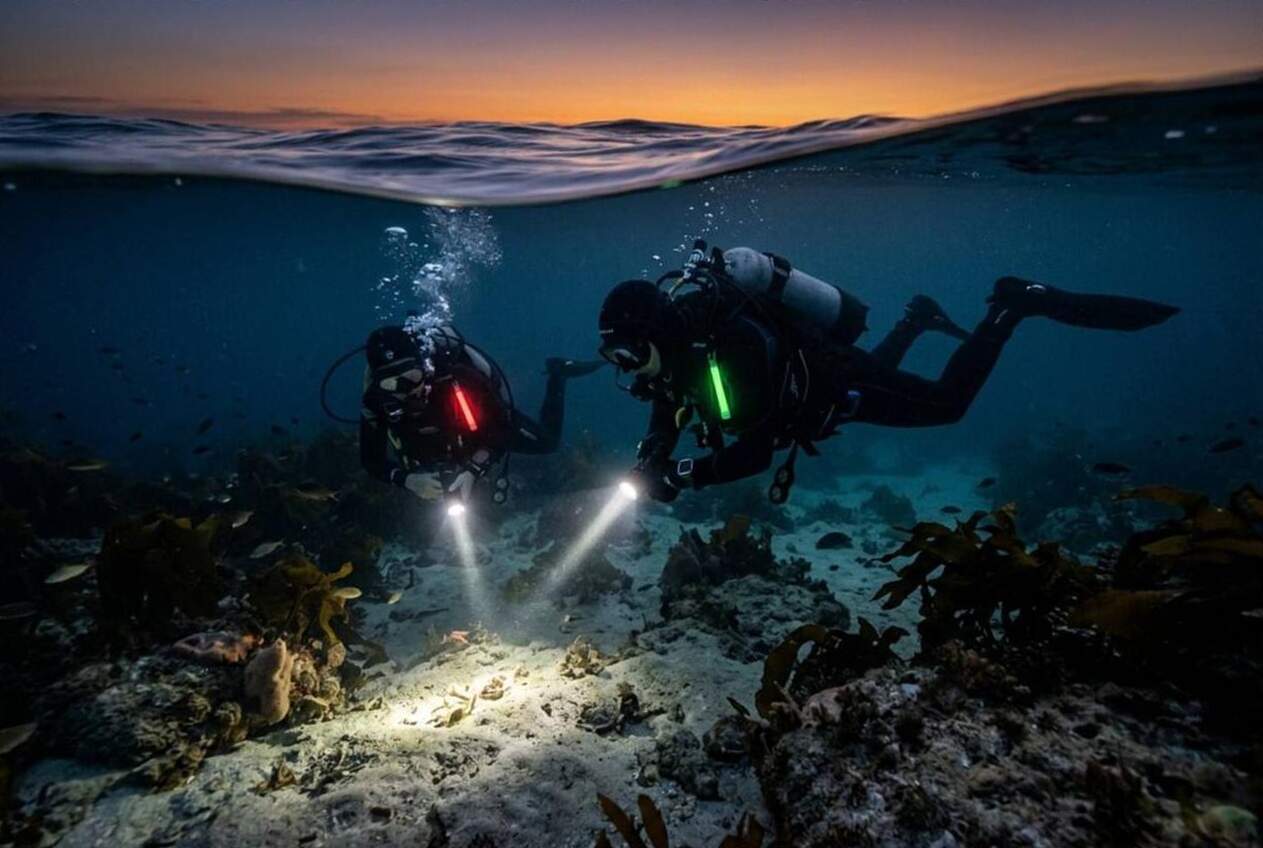
Clip a small strobe or a cyalume stick to your BCD so your buddy can find you when their beam is pointed elsewhere.
Take a compass and actually look at it on the surface before you descend, so you know which way home is without thinking.
Tell someone on shore, giving them your entry time, your planned exit time and what to do if you are late.
Why it feels calmer than you expect
Night diving works because you shrink the world down to your beam.
You stop scanning the middle distance, you stop chasing the next bit of reef, and your breathing settles into something slower than your usual daytime rhythm.
That is why a lot of divers come up with more gas left than they would after the same site in sunlight.
The hazard on a night dive is not the darkness. It is treating a night dive like a day dive with a torch bolted on.
Losing the beam or losing the buddy are the two real problems, and both are pace problems more than light problems.
What right feels like
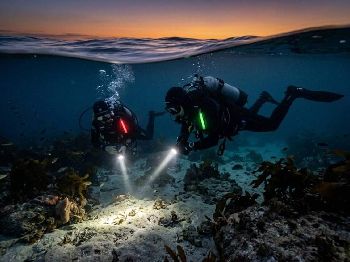
Right feels like a slow kick with fins clear of the bottom, and your beam angled onto the sand a couple of metres ahead.
Your buddy's glow stick or strobe sits in your peripheral vision the entire dive, so you never have to go looking for it.
Wrong feels like tunnel vision, fast fin strokes, silt boiling up, and a beam that swings across your buddy's mask every time you turn.
Torch range underwater is short, far shorter than the same beam looked on the beach, so stay closer to your buddy than instinct tells you.
Running the dive in phases
Preparation happens dry: charge both lights, agree your signals, plan the exit, set a turn pressure and check the tides so you are not swimming home against a run.
Initiation is best at last light, entering while there is still a little colour in the sky so your eyes adapt gradually rather than slamming into full dark.
Switch your primary on before you leave the surface, every time, so you are never fumbling with a switch while sinking.
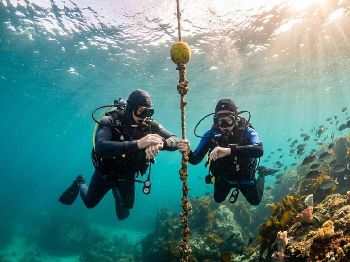
Commitment means descending on a reference you can touch or see, a shot line, a mooring, a pylon or the sloping sand itself.
Stay shallower than your usual daytime profile on this site, because a conservative depth removes one variable while you learn the rest.
Execution is slow and low: beam on the bottom, buddy in your peripheral vision, regular gas checks, and a turn at the pressure you agreed.
Recovery means ascending on the same reference you came down, then switching your strobe on the moment you break the surface.
Light signals that actually work
A large slow circle traced on the bottom or a nearby wall means OK.
Quick horizontal wags side to side mean there is a problem and your buddy needs to come to you now.
For anything more detailed, shine your beam onto your own hand and give the normal hand signal.
Never into the face, because a beam in the mask wipes out night adaptation for a minute or more and your buddy is effectively blind while it recovers.
When it goes wrong
Primary light dies mid-dive: this happens even to charged units, so deploy the backup, signal your buddy and end the dive rather than pressing on with your reserve.
Lost buddy: stop, do a slow 360 degree sweep with your beam held high, then hold position for one minute before surfacing to look for their strobe.
Silt-out: the cause is fin wash or a hand on the bottom, and the correction is to stop finning, hold still and let the cloud drift off you before moving on your compass heading.
Disoriented on the surface: strobe on, mask on, look for the shore lights or boat lights you identified before you got in, which is why the pre-dive look around matters.
Blinded buddy, caused by a careless head turn, is fixed by dropping your beam to the sand immediately and giving them time before you signal again.
Common questions
Do you need a course? The PADI Night Diver Specialty is built for certified divers and includes three night dives, which is a tidy way to get supervised repetition.
Are two torches genuinely necessary, or is that gear-shop talk? Two is the accepted minimum, and the reason is simply that primaries fail without warning.
Will you use more gas? Usually less, provided you slow down, because there is far less visual noise pulling you around the site.
Shore or boat for a first one? Shore on a site you know, since you control the timing, the exit and how far out you go.
Should you dive deeper than usual because the dark hides the shallows? No, go shallower, and keep the profile inside what you have already done there in daylight.
Your next session
Pick the site you dive most often, do a daylight dive there this weekend and note the exit bearing, the depth curve and one obvious descent reference.
Then go back the following evening, enter at last light, and swim half the distance you normally would.
Share how it went and compare notes with divers who know your local site in the Seabreeze forums .