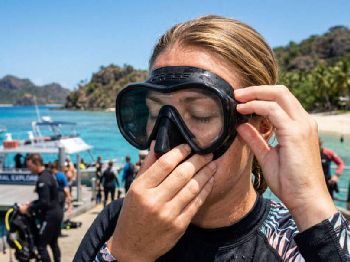
The Mask Clear: Stay Down After the Flood

Quick summary
A flooded mask is routine, not an emergency, and the fix is one steady exhale through your nose while you stay exactly where you are.
Most failed clears happen because the diver looks down or lifts the whole skirt, breaks more seal, then kicks for the surface.
The how-to
After reading this you can flood and clear your mask at 3 to 6 m without changing depth or losing your breathing rhythm.
The flood is not the emergency

Cold water across your eyes and up your nose triggers a startle response that feels urgent, but nothing about it threatens your air supply.
You still have a regulator in your mouth, a full cylinder on your back and a buddy within a few metres.
John Lippmann and the DAN Asia-Pacific team have long argued that rapid, uncontrolled ascents remain one of the main injury pathways in recreational diving.
Carry that framing into the water and treat the mask flood as a skill you own, not a reason to leave the bottom.
Preparation: set the seal before you giant stride
Clear the skirt. Pull every strand of hair out from under the top edge, including the fine wisps at your temples that you cannot feel.
Check the seal dry. Press the mask to your face without the strap, inhale gently through your nose, and confirm it holds on suction alone.
Set the strap low and loose. An overtightened strap distorts the silicone and leaks more, which is why divers who crank the buckle often flood first.
Pick the right conditions. Practise at 3 to 6 m on a sheltered site in 18-24° water with low swell and a buddy in visual range.
Check the tide times before you go so you are not fighting run-out current while working on a slow, deliberate skill.
Initiation: stop, get neutral, look up
Stop moving. Finning while you clear changes your depth and your trim, and both of those work against you.
Get neutral or settle on sand. A stable platform means the only thing changing is the water level inside your mask.
Tilt your head back. That angle moves the air pocket to the top of the mask and puts the lowest point of the skirt under your nose.
Take one normal breath in. You need lung volume to drive the clear, so inhale through the regulator before you commit to anything.
Commitment: press the top, start the exhale
Press the top frame only. Two fingers flat on the upper edge, sealing the top so air cannot escape upward.
Leave the bottom alone. The lower skirt must stay loose, because that gap is the door the water leaves by.
Exhale a long, steady stream through your nose. Think of a slow sigh lasting three or four seconds, not a sharp snort.
The expanding air pocket pushes down from the top and forces water out under the bottom edge in one continuous flow.
PADI Open Water training treats partial flood, full flood, and mask remove-and-replace as confined-water skills for a reason: the clear is a rehearsed routine, not something you invent while your eyes sting.
Execution: hold the crack, finish the breath
Keep pressing until the window is dry. Divers often release the frame halfway through and let the water flood straight back in.
Use the whole exhale. One long breath clears more reliably than three short bursts, because each pause lets water creep back under the skirt.
Breathe in through your mouth only. The regulator stays in and your nose stays shut on the inhale, every single time.
Recovery: two calm breaths, then keep diving
Re-seat the skirt. Run a finger around the edge to confirm the silicone sits on skin, not on a hood lip or a strand of hair.
Take two slow breaths before you move. This resets your heart rate and stops the skill bleeding into the rest of the dive.
Signal your buddy. A simple okay tells them the problem is solved and keeps them from grabbing at your gear.
What right and wrong feel like
Right feels like a distinct pressure drop inside the mask, then clear vision, with your depth gauge reading exactly the same number.
Wrong feels like more water, a fogged window, or a sudden urge to stand up, surface or rip the mask off your face.
Five faults, and the fix for each
Looking down. Gravity holds the water against your nose so nothing can leave, so tilt your chin up until you see the top edge of the window.
Lifting the whole mask. Pulling the frame off breaks the bottom seal too, so air escapes everywhere and more water pours in; press only the top.
One explosive snort. A single hard blast empties your lungs and tempts you to inhale through your nose, so use a slow continuous stream instead.
Ripping the mask off. Removing it mid-skill leaves you with two problems and no vision, so keep it on and finish the exhale.
Clearing while swimming up. Ascending changes the air volume and your buoyancy at once, so clear on a stable platform and move afterwards.
The safety line you do not cross
Never make an uncontrolled ascent to get air, because you already have air and the ascent is the only genuinely dangerous part of this sequence.
If the mask will not clear, your options stay at depth: push it to your neck, use a buddy's spare, or ascend slowly under control.
Where to go next
Once the clear feels boring, flood the mask fully and swim a few metres before clearing, so vision becomes optional rather than essential.
Then work on remove-and-replace at the same depth, which is the skill that genuinely prepares you for a snapped strap or a kicked mask.
Why does water keep coming back in?
Usually hair, a hood edge or an overtightened strap is holding the skirt off your skin, so re-seat it and loosen the buckle a notch.
Should I hold my breath while clearing?
No, the clear runs on a continuous exhale, and breath-holding at depth is the exact habit that leads to lung overexpansion injuries.
What if water goes up my nose?
Keep the regulator in, keep exhaling through your nose, and restart the clear from a stable position once your breathing settles.
Does a smaller mask clear faster?
A low-volume mask needs less air to empty, so it clears quicker, but fit beats volume whenever the skirt does not match your face.
Compare mask fit notes and local practice sites with other divers in the Seabreeze
forums
.