Drift Diving: Reading and Riding Currents

Quick summary
A successful drift dive starts before you enter the water: reading tide tables, surface indicators, and the reef itself tells you what the current is doing and where it will take you.
A Delayed Surface Marker Buoy (DSMB) is not optional - it is the primary way your boat locates you when you surface away from the entry point.
The how-to
After reading this, you can plan and execute a drift dive with confidence, from tide selection through to boat pickup.
Drift diving is the difference between fighting the ocean and using it - you stop spending air on horizontal swimming and let the current do the work while you focus entirely on the reef passing beneath you.
Most divers who try it for the first time describe it as the most effortless and immersive ocean experience available once they understand how to read the site and communicate with the boat above them.
The entry point requirement is real: be comfortable holding your depth within 1 to 2 metres before attempting a drift dive.
A diver fighting for buoyancy control in moving water is spending the dive managing themselves rather than the experience, and can quickly drift away from the group without noticing.
Reading the site before you drop
The tide table is your first planning tool: slack water - the brief period at the turn of high tide and low tide when horizontal water movement slows to almost nothing - is when most drift dive operators introduce new divers to the technique.
Current runs hardest at mid-cycle, typically two to three hours either side of the tide peak, and this is when drift dives become genuinely demanding for buoyancy management and group cohesion.
At the surface, look for three current indicators before entry: surface foam lines and floating debris align with the current direction; the bow of any anchored vessel points into the current; and calm water shadows appear in the lee of headlands and exposed rocks.
Under the surface, the reef itself reads the current: soft corals and sea fans sway consistently in one direction; stationary reef fish face into the current; and sand ripples align perpendicular to the prevailing flow direction.
You can read all of these before the dive by looking over the side of the boat, and during the dive they tell you instantly when the current has shifted or accelerated.
Neutral buoyancy in moving water is not a passenger skill - it is the difference between riding the current and being dragged by it.
Gear for drift diving
A DSMB, a reel, and a cutting tool are the three additions to a standard dive kit that matter most for drift diving.
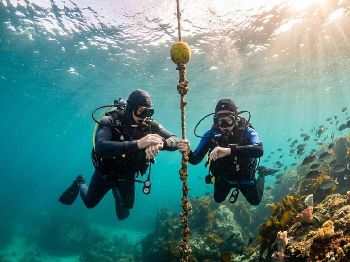
The DSMB - a brightly coloured surface marker buoy you inflate from depth and send to the surface on a reel line - is your primary communication tool with the boat above.
Deploy it when you are ready to ascend, not when you surface.
If you surface without a DSMB in moving water with any swell running, the boat driver must spot a diver's head in broken water, which is much harder than tracking an orange sausage on the surface.
PADI's Drift Diver specialty course covers DSMB deployment, reel technique, and current management as its core skills - completing it before your first drift dive in significant current is worth the half-day investment.
Wetsuit thickness matters in Australian winter conditions: a 5mm wetsuit for water temperatures below 18 degrees Celsius on the NSW coast in July, or 3mm for Queensland and tropical waters where temperatures hold above 22 degrees.
Weight yourself to be neutrally buoyant at 5 metres on a near-empty tank at the end of the dive - adjust with additional small weights until you hold that depth comfortably without finning.
Entry and the descent
Drift dive entries are typically giant strides off the stern or a backward roll into moving water - establish buoyancy immediately on surfacing, signal OK to the boat, and group up with your buddy before descending.
Descend as a unit: buddies with different descent rates in a current will drift laterally as they descend, and separation at 10 metres is far harder to resolve than at the surface where you can signal the boat and swim together.
At sites like Julian Rocks near Byron Bay or the popular Solitary Islands drift dives off Coffs Harbour, current speed varies noticeably with depth - finding the right layer quickly is part of the skill.
Do not grip the reef to slow yourself or anchor in the current, even wearing gloves: coral contact causes damage to both the reef and the diver, and the instinct to grab is a sign the dive plan needs adjusting, not the reef.
Managing the drift
Aim to hover in the mid-water column, 2 to 5 metres above the reef: the view is better, surge exposure is less, and buoyancy adjustment is more responsive than when drifting close to the bottom.
Do not swim back upstream if you drift ahead of the group - you will exhaust yourself before you close the gap and increase your air consumption dramatically.
The correct response is to ascend slightly, signal your buddy, and allow the group to converge at a shallower depth where current is typically slower and communication is easier.
Down-currents - localised water pushing you toward the bottom near walls, bommies, or reef passes - are the one scenario that requires immediate decisive action: stop finning, stay calm, and swim laterally away from the feature rather than fighting to ascend vertically against the flow.
Down-currents are almost always localised and resolve within a few metres of horizontal movement away from the generating feature.
Ascent and boat pickup
Agree on a turn pressure before you descend - 80 bar is a common standard with most dive operators in Australian waters - so ascent timing is consistent across the whole group.
At turn pressure, reel out your DSMB, inflate it slowly with your octopus second stage or BCD dump valve, and allow it to ascend while you complete a 3-minute safety stop at 5 metres.
The DSMB reaching the surface is the signal to the boat driver to move toward your position - a well-briefed skipper will be repositioning before you complete your safety stop.
Surface with your mask on and your head up, and establish the boat's position before removing your regulator.
If there is any uncertainty about the pickup, keep your regulator in and wait for the boat to come to you rather than swimming in conditions.
Common mistakes and how to fix them
Descending without grouping first: group up at the surface before any descent in a current - lateral separation on the way down is much harder to close than on the surface.
Swimming against the current to stay with the group: if you are consistently working hard to maintain position, the group is at the wrong depth - ascend together and find a slower layer.
Not deploying the DSMB early enough: the DSMB must reach the surface while you are still on your safety stop at 5 metres, not as you are surfacing - deploy at the start of every safety stop.
Weight miscalculation: if you touch the reef during the dive, you have too much weight or too little air in your BCD - note the exact conditions and adjust before your next dive, not mid-dive.
Buddy separation: agree on a maximum separation distance before you enter - 3 to 4 metres in reduced visibility, 8 to 10 metres in good visibility - and the clear agreed action if you exceed it.
Questions for your next drift dive
Is your current wetsuit the right thickness for the water temperature at your planned site in this season, and will it change how you need to weight yourself?
Has your boat driver been briefed on your DSMB colour and your agreed pickup procedure if you surface well downwind of your entry point?
Have you checked the tide table to identify the slack water window at your site, and is the dive brief structured around that window?
Check tidal windows for your dive site at NSW tides on Seabreeze before your next ocean dive.