Duck Diving: Getting Under the Wave, Not Over It

Quick summary
The duck dive works by generating forward speed, pushing the nose deep with straight arms, using a knee or foot to sink the tail, and staying submerged until the turbulence passes above you.
Timing is the most common failure point - starting too early means you surface into the wave, starting too late means the wave hits you before you are under.
The how-to
After reading, you will know how to time a duck dive correctly, what your arms and legs should do underwater, and how to diagnose which part of your technique is failing when you keep getting washed back.
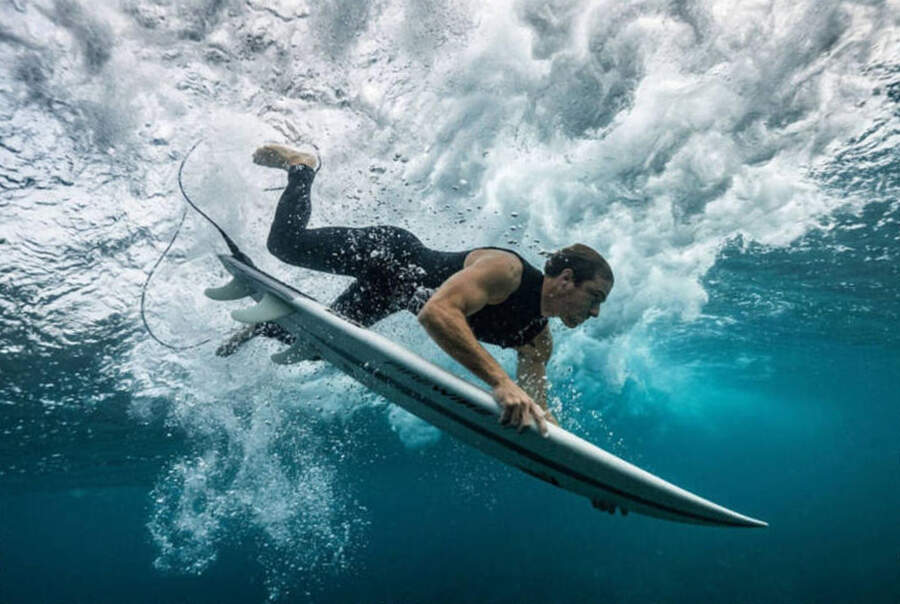
The duck dive is not a survival skill - it is a momentum skill.
Done right, you pass through the wave and emerge paddling, with most of your speed intact and no energy wasted wrestling the whitewater.
Done wrong, the wave drags you back 10 metres, you surface with your leash wrapped around your ankle, and you start the paddle-out again from scratch.
The difference is mostly timing and arm position, not strength.
Before you start: the board requirement
The duck dive only works on boards you can physically push underwater - typically shortboards, fish boards, and some mid-lengths up to around 7'0", depending on your weight and the board's volume.
If you are on anything higher-volume than that, the turtle roll is a more effective technique for getting through the break.
Many intermediate surfers waste time attempting duck dives on boards they cannot sink, and switch to the turtle roll as soon as they move to a more appropriate board volume.
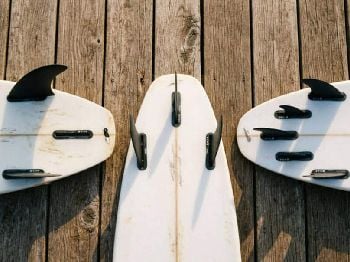
A 6'2" thruster in the 30-34 litre range is the sweet spot where most surfers first learn to duck dive reliably.
Phase 1: paddle hard and commit
The single biggest duck dive mistake is stopping paddling too early.
You need forward momentum to carry the nose down and under the wave - a duck dive with no paddle speed buries the nose and stalls, leaving you right in the breaking lip.
Paddle hard all the way to the moment you grip the rails, generating as much forward speed as you can in the final three strokes before the wave arrives.
Phase 2: grip the rails and push the nose under
Place your hands on the rails of the board roughly level with your lower chest - slightly forward of where your hands would be for a pop-up.
Lock your elbows straight and push the nose directly down and forward, using your body weight through your arms rather than muscle strength alone.
Start this movement 1-2 metres before the whitewater reaches you - if you time it correctly, the nose goes under just as the wave face arrives, and the board is angled 30-45 degrees below horizontal as it passes through.
Your head follows the nose: keep your chin tucked, not thrown back, so your body stays streamlined and does not create drag in the water column.
A good duck dive is all in the timing - keep paddling until the last possible moment, then commit fully to the push.
That principle, consistent with the coaching guidance published by Boardcave Australia and surf schools across the Gold Coast and Sunshine Coast, holds for waves from knee-high to overhead-plus.
Phase 3: sink the tail
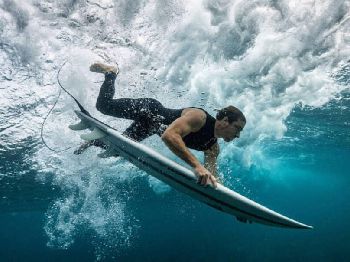
Once the nose is under and your arms are straight, use your back knee or the top of your back foot to press the tail of the board down.
Beginners use the knee because it is easier to control pressure - push down firmly on the traction pad to bring the tail below the surface and get the board horizontal or slightly nose-up underwater.
More advanced surfers use the top of the foot, which generates more downward force and allows a slightly deeper submerge - the foot press also keeps your body more compact and harder to move by the passing wave.
The board should end up roughly parallel to the bottom at the deepest point, not angled steeply down, which would send you too deep and waste the exit energy you need to resurface.
Phase 4: stay deep and let it pass
The most common mistake at this point is to start angling back up too early, before the turbulence has passed over you.
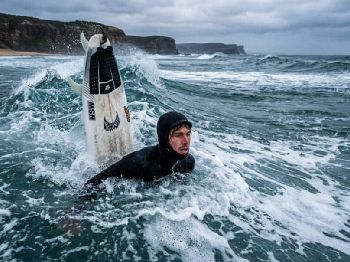
Resist the urge to surface for the first second after the wave hits - stay deep, with your arms still extended and your body streamlined, until the churning water above you settles.
Whitewater that has broken travels in a tumbling, forward-moving mass - if you surface into it, you get rolled and pushed back toward the beach.
If you stay a metre or more below it, the turbulence passes over you and the water at your depth is relatively undisturbed.
Phase 5: resurface with momentum
Once the turbulence has passed, tilt the nose of the board slightly upward and let the board's buoyancy do the work - you will rise toward the surface without much effort.
As you surface, transfer directly into paddling strokes without pausing - the exit from a good duck dive should flow straight into forward momentum so you are moving toward the next wave before it reaches you.
If you surface and find yourself stationary or moving backward, you either came up too early or the board did not go deep enough - check which phase failed in the next set.
Common mistakes and how to fix them
You keep surfacing into the whitewater: you are starting too early, before the wave has fully arrived, and the board bobs back up while turbulence is still passing.
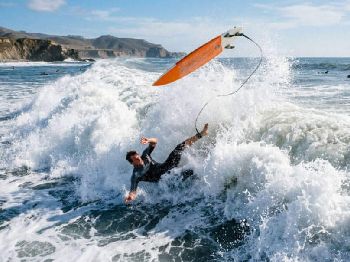
The wave picks you and the board up and throws you back: you are starting too late, and the breaking lip has caught the board before the nose is deep enough to slip under.
Your arms are bent underwater: bent arms reduce the depth of the nose and create resistance - lock your elbows straight and push with your shoulders and body weight, not your biceps.
You are getting washed sideways: your body is not streamlined under the water - keep your legs together, chin down, and body in line with the board direction.
You cannot get the board deep enough: if the board floats too high for your body weight, no amount of technique fixes it - switch to a lower-volume board or use the turtle roll until your strength improves.
One thing to focus on next session
Pick a small day with clean, waist-to-chest-high waves and focus only on the timing: paddle as hard as you can right up to the moment you push the nose under.
Every metre of paddle speed you carry into the duck dive makes the nose go deeper with less effort, and makes the whole sequence cleaner and faster to execute.
Most surfers who are struggling with duck dives are stopping their paddle too early - fix that one thing and every other element of the move will improve immediately.
Check the Sydney or Brisbane wind forecast for the next small, clean day to practise on.
Questions
Can I duck dive a longboard?
Not effectively - longboards float too high to push under the surface, which is why longboarders use the turtle roll (flipping the board upside down and holding on as the wave passes over).
What if I keep losing my board?
If the board is pulling out of your hands underwater, your grip on the rails is too narrow - widen your hand position toward the edges of the board and tighten your grip before the push begins.
How deep should I go?
Deep enough that the worst of the turbulence passes above you - in most beach-break whitewater this is around 0.5-1 metre, and in bigger surf you may need to go deeper to get below the churning zone.
Should I exhale or hold my breath?
Hold your breath for the underwater phase - exhaling reduces buoyancy and makes it harder to rise cleanly on the exit, and most duck dives in normal surf last only two to four seconds.