Reading a Beach Break: Banks, Peaks, Channels

Quick summary
The key to reading a beach break is understanding that the waves follow the sandbar, and the sandbar follows the swell and tide - spending 10 minutes watching from the beach before paddling out changes everything.
The channel is not just a rip: it is your fast lane to the lineup and your primary indicator of where the sandbar peak is sitting.
The how-to
After reading this, you will be able to assess a beach break from the sand, find the best peak, and paddle out efficiently through the channel on any given day.
Every beach break in Australia is different on any two visits: the sandbars shift after big swells, reform during calmer periods, and respond to seasonal patterns that vary by location and tidal range.
The surfers who always seem to be in the right spot are not guessing - they are reading two things before they ever touch the water: the shape of the breaking wave, and the colour of the water between the breaks.
You need to be comfortable riding unbroken waves before focusing on this - reading a break does not improve your pop-up, but it puts you under waves that are worth riding rather than the ones that close out or reform inconsistently.
What a sandbar does to a wave
A sandbar is a ridge of sand on the ocean floor that forces a swell to slow down and peak as the water depth decreases over it.
The wave breaks at the point where the depth becomes shallow enough to cause the crest to pitch forward - typically where the depth is around 1.3 times the wave height.
On either side of the sandbar the water is deeper, the wave travels faster without breaking, and the shoulder gradually peels away from the peak.
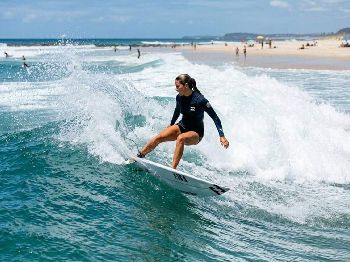
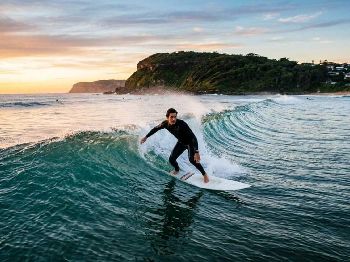
A well-formed sandbar produces a clear peak with rideable shoulders running left and right - what surfers call an A-frame.
A poorly formed sandbar - too flat, too wide, or pointing directly at shore - produces close-outs: waves that break simultaneously along their whole length with no rideable shoulder.

Reading the water from the beach
Stand at the top of the beach and watch the breaking waves for 10 to 15 minutes before paddling out.
Find where waves are consistently peaking and breaking at roughly the same spot - that is where the main sandbar is sitting.
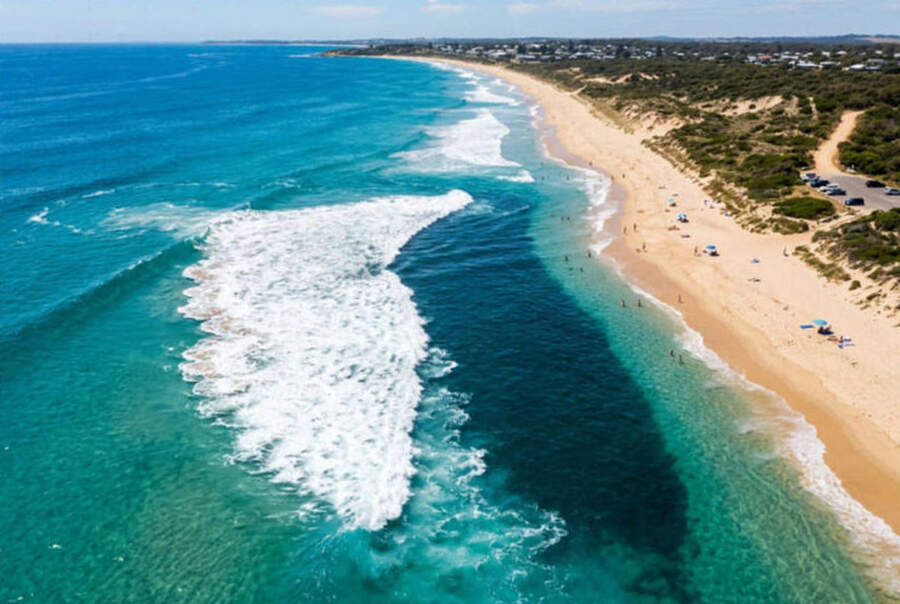
Look for the dark green or blue water between the breaking zones: this is the deeper water over the channel, where the sea floor drops away and waves do not break.
The channel is easier to spot if there is whitewash or surface turbulence in the breaks on either side: the calm water between them marks the gap in the sandbar.
Watch for the direction the whitewash is drifting after a set: it moves toward the channel and then out to sea in a rip, telling you exactly where the water is returning seaward.
The channel is not where waves break - it is where water goes when it wants to get back out to sea. Paddle there and the ocean does the work for you.
Also look for the horizon: where it is consistently uninterrupted by breaking whitewater, you are looking at deeper water and the channel location.
Finding the best peak
Not all peaks on a sandbar are equal - the best peak is the one that gives you the longest, most consistent ride before the wave closes out.
A wave that peels from one end to the other with the shoulder gradually sloping away has a well-shaped bar underneath it.
A wave that breaks everywhere at once - closing out - has a flat or wide sandbar where depth changes are gradual and simultaneous rather than focused.
At bigger beach breaks like those on the NSW mid-north coast and Queensland's Gold Coast, multiple sandbars often form at different depths, and the outer bars only break on larger swells while inner bars break almost every day.
On smaller swell days, watch the inner bar - typically 40 to 80 metres from shore at a typical Australian beach - for the most consistent ride.
On bigger swell days, the outer bar peaks become relevant, and the paddle out through the channel becomes longer and more critical to plan correctly.
Using the channel to paddle out
The channel is your highway to the lineup: paddle out through it and you avoid the worst of the whitewash and breaking swell that make the direct route exhausting.
Angle your entry to align with the channel from the beach - typically this means walking 20 to 50 metres along the beach before entering the water, rather than paddling straight out from where you exit the water.
Once in the channel, the rip flow will actively carry you seaward - you are using energy the ocean is already expending rather than fighting against it.
One caution: rip channels can carry you further out or to one side than you intended, particularly on bigger days - keep an eye on fixed landmarks on the beach to monitor how far you are drifting laterally.
If the channel is moving you sideways faster than expected, angle slightly against it rather than paddling directly against the flow, which rarely wins.
Positioning at the peak
Once in the lineup, sit where you saw the consistent peak from the beach - this is almost always further from shore than first-time visitors expect.
Watch the horizon for incoming sets: the wave will show as a bump on the horizon 10 to 20 seconds before it reaches you, and experienced surfers are already paddling to position before it arrives.
Position yourself on the peak, not on the shoulder - the shoulder is where the wave is already unbroken and other surfers have right of way on the wave from the peak.
Beach break peaks shift as sets arrive and departure: each big set moves sand and can shift the bar slightly, so the best peak after a set of six might be 10 metres left or right of where you were sitting.
The surfers who catch the most waves at a beach break are constantly micro-adjusting their position rather than anchoring to one spot.
How tide changes the break
Tidal range has a significant effect on how a beach break performs - a 1.5m tidal range is enough to transform a well-shaped peak into a close-out and back again within a few hours.
Low tide at many Australian beach breaks exposes more of the sandbar and produces steeper, more hollow waves - ideal for experienced surfers, but harder to manage for intermediates.
Mid-tide is often the most consistent window: the depth over the bar is in the sweet spot where waves peak and shoulder rather than dredging and closing out.
High tide deepens the water over the sandbar and can flatten the break entirely at some beaches - particularly at sheltered bay beaches where the bar is shallow and the tidal effect is amplified.
Check the tide times for your local beach and experiment with the same break at different stages - the difference between low and high tide at many NSW and QLD beach breaks is the difference between a great surf and a frustrating one.
Questions before your next session
Is the swell direction today hitting your beach at an angle that produces a left or right peak, and which direction does your home break work best?
What was the last significant swell that came through, and has the sandbar had time to rebuild, or is it still scoured and flat?
At what tide stage does your regular beach break perform best, and does today's tide window overlap with the forecast swell period?
Check tides and wind for your break at NSW tides and Sydney wind forecast on Seabreeze before your next session.