The Bottom Turn: Where Speed Comes From

Quick summary
Speed on a wave is made in the bottom turn, not by paddling harder into it.
Compress, look to the section you want, and drive the inside rail before you stand up tall.
The how-to
After this you can set a clean bottom turn that gives you the speed for a cutback or a hit on the lip.
You can already stand up and trim down the line.
The next thing that separates a passenger from a surfer is the first turn at the bottom of the wave.
Most people treat that turn as a flourish after they have speed.
It is the other way around.
The bottom turn is where the speed comes from.
Mick Fanning, three-time world champion, has long coached the same point: look where you want to go, then let the rail do the work.
Surfing Australia's high-performance coaching still starts every manoeuvre from that first drive off the bottom.
If the bottom turn is lazy, every hit above it is late.
Why the rail makes speed
A surfboard accelerates when you put the rail in the face and load the fins against the water.
That load stores energy the way a bent stick stores energy.
Release it toward the lip and you get a free burst you could not paddle for.
Stand tall and lean with your shoulders only and the rail never loads.
You skate, then stall, then wonder why the section outran you.
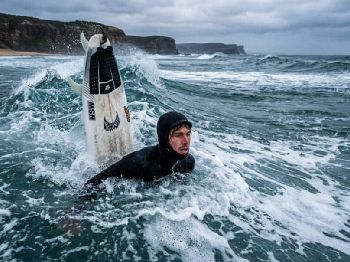
Water in an Australian winter beach break is usually 16 to 19C (61 to 66F) on the east coast, so a 3/2 or 4/3 still lets you bend the knees without the suit locking you upright.
If you cannot drop into a squat on land in that suit, you will not compress on a wave either.
Set the scene before you take off
Pick a peak with a bit of face, not a closeout.
Chest to head high is enough.
A grovel board in the 6'2 to 6'8 (1.88 to 2.03m) range with decent rail makes the lesson kinder than a thin 5'10.
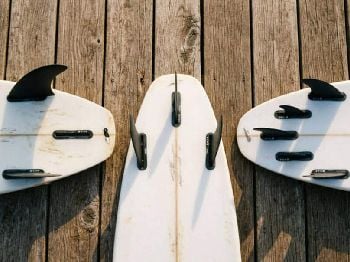
Fins in a thruster, not a runaway quad, so the board bites when you lean.
Check the wind on the Adelaide wind forecast if you are on a southern coast, or the local warnings if you are further east.
Offshore or light is what you want so the face holds while you learn the drive.
Time the tide on the NSW tide search so you are not fighting a draining closeout bank.
The turn, in order
Approach. Take off angled, not straight at the beach, so you already have a down-the-line line.
Two or three pumps on the drop are fine if the wave is fat.
If it is steep, just get to your feet and look to the bottom.
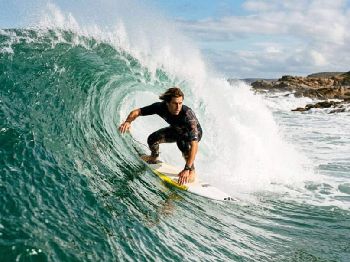
Compress. As you reach the flats, drop your hips and bend both knees until your thighs take the weight.
Hands stay low.
The back knee tucks in toward the front heel so the board can roll onto the toe-side or heel-side rail.
You should feel the rail bite before you feel your legs straighten.
Look. Your head turns to the section you want, usually the lip or the shoulder, before the board follows.
The board goes where the eyes go.
If you stare at your nose, you will drive into the flats and die.
Drive. Push through the legs and let the rail draw a long arc, not a flick.
Front foot steers.
Back foot loads the fins.
Hold that lean for a full second on a decent face.
A short jab is not a bottom turn.
Release. As the board starts up the face, start to stand taller so the rail unloads and the stored speed carries you to the lip or into a cutback.
That unweighting is the pop people chase with extra paddling.
The board goes where the eyes go, and the speed comes from the rail you just loaded.
What it should feel like
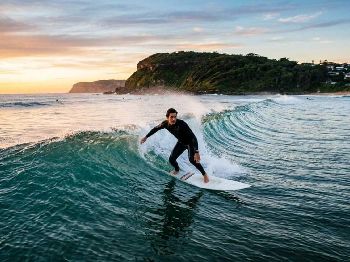
Right: a heavy, quiet push through the legs, spray off the inside rail, and a sudden glide as you release toward the lip.
Wrong: a skittering, high-body carve that washes off the fins and leaves you going slower than when you stood up.
If you hear the fins buzz or feel the tail slide, you leaned with your shoulders and left the rail behind.
Where people blow it
Standing up too soon. You never loaded the rail, so there is nothing to release.
Stay low until the board is already pointing at the section.
Looking at the nose. The board follows your head into the flats and you run out of face.
Pick a spot on the lip before you start the turn.
A tiny C-shaped jab. That is a direction change, not a drive.
Draw a longer arc and give the fins a second to bite.
Back foot too far forward. The tail never loads and the board pivots instead of accelerating.
Keep that foot over the fins.
Leaning from the waist. Your head goes out, the rail comes up, and you slide.
Bend the knees and keep your chest over the board.
When the wave is bigger
On a solid overhead bank the same sequence holds, you just start the compress earlier, halfway down the drop.
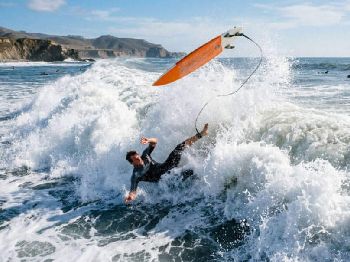
Late and tall on a bigger face is how people get pitched.
If the lip is already throwing, skip the long drive and just make the bottom with a shorter, deeper squat so you survive to the shoulder.
A helmet is not fashion on a shallow reef when you are learning to redirect that much speed.
Common questions
Does a longer board change the turn? Yes.
More rail in the water means a longer arc and a slower lean, so start the look even earlier.
What if the wave is onshore and crumbly? Keep the turn flatter and shorter, because there is no solid face to load against.
When do I add a cutback? Once you can release to the lip with speed left over.
The cutback is just the same rail load in the other direction.
What should I practise next session? Three waves where the only goal is a long, low bottom turn that still has speed at the lip.
Forget the floater.
If you leave the water with wet rail spray on your wetsuit chest, you did the job.