The Foil Gybe: Keep Flying Through the Turn

Quick summary
The flying gybe is won or lost before the wing ever moves, because a foil that has bled off speed at dead downwind cannot be rescued by hand work.
Bear away with the wing sheeted in slightly, carry that speed through the bottom of the turn, swap your feet as the board points downwind, then flip the wing and exit on a reach.
The how-to
After reading this you can carve a downwind turn, change your feet and your wing, and come out the other side still up on the foil.
Every rider who stalls a gybe blames their hands, but the foil was already sinking well before the wing changed sides.
A foil only makes lift while water is flowing fast across it, so speed is the currency you spend through the whole turn.
Sheeting out, standing tall or steering too hard all cost speed, and by dead downwind you have nothing left to spend.
That is why the counterintuitive move works: sheet in slightly as you bear away, so the foil accelerates into the turn instead of settling.
Preparation
Pick your water first, because a gybe eats more downwind ground than you expect and you want clean space to leeward.
Look upwind and downwind for other riders, swimmers and moorings, then pick a lane with plenty of clear water to leeward.
Gybe onto a reach that still gives you an exit back to the beach, and only do this in onshore or sideshore wind.
Never set up a gybe pointing at rocks, a groyne or a lee shore with nowhere to land.
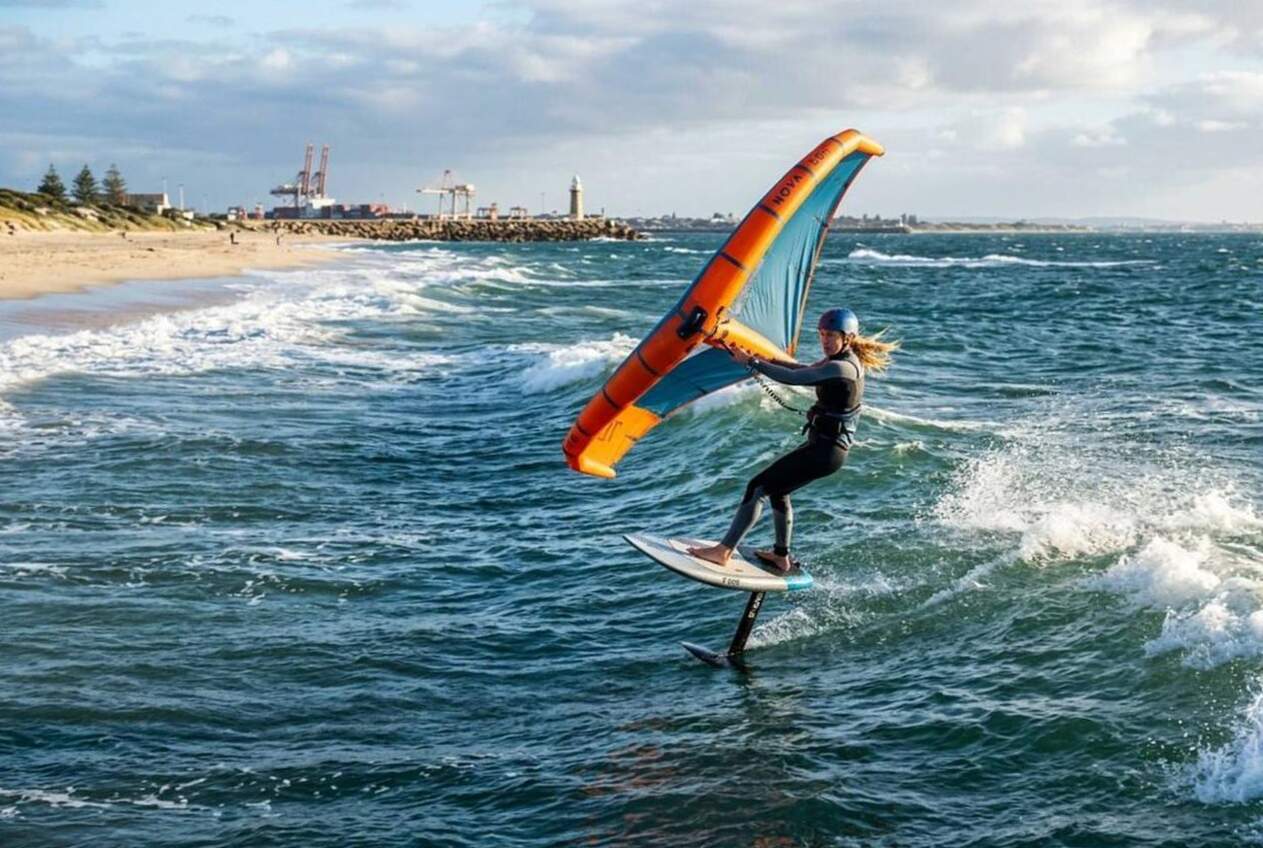
Around Perth that is exactly why Port Beach in North Fremantle and Woodman Point work so well in the south west sea breeze, with the wind onshore-ish on both beaches.
Watch the Perth wind forecast for a steady sea breeze day rather than a gusty frontal one before you go hunting your first flying gybes.
Initiation
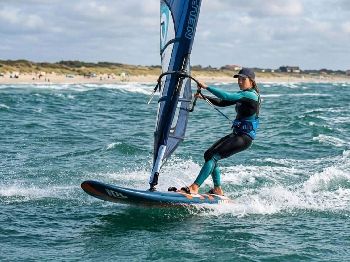
Build speed on a reach, get the board humming and settled at mid mast height, then commit to the turn as one smooth arc.
Roll your weight onto your toes, add gentle front foot pressure and let the board bear away rather than yanking it around.
Sheet in a touch as you turn away from the wind so the wing keeps pulling and the foil keeps loading up.
Turn your head and look through the exit of the turn, out to where you want to be riding in three seconds.
The right sensation is a continuous hum from the foil and growing pressure in your back foot as you accelerate downwind.
The wing flip is the last 20 per cent of a gybe, and the first 80 per cent is speed you built before you got there.
Commitment
Wait for dead downwind, because moving your feet while the board still holds any upwind angle will trip a rail and drop you.
When the board points straight downwind and the wing goes light overhead, the board is neutral and your feet are free to move.
Shift your back foot first, then your front, stepping across so you finish standing heel side for the new tack.
Keep the board flat and your knees soft during the swap, and keep looking out at the horizon instead of down at your feet.
Done well, the foot switch feels like a quiet half second with the hum never stopping underneath you.
Execution
Flip the wing fast, flagging it out downwind for an instant on the front hand, then grabbing the new back hand and powering up.
Speed matters far more than style here, because a slow flip lets the wing backwind and stall you at the worst possible moment.
Sheet in on the new side the instant your hands land, so the foil gets drive again before it loses ride height.
Recovery
Get back to a reach, because dead downwind is a low pressure, low control place to hang around any longer than you need.
Move your weight onto your heels, ease the board up towards the wind and let the foil settle at a steady height.
Failure diagnosis
The foil goes suddenly quiet, which means you sheeted out mid turn, so keep the wing powered and bear away harder on the next attempt.
Your feet arrive late, which means you looked down at the board, so fix your eyes on the exit and let your feet follow.
A rail catches during the swap, which means you switched too early, so wait until the board genuinely points downwind before your back foot lifts.
The wing backwinds and pulls you over, which means the flip was too slow, so flag it cleanly then power on the new side in one movement.
You touch down and keep fighting it, which means the turn is already over, so complete the gybe on the water and pump back up on the new tack.
Gear that makes it easier
Go slightly smaller on the wing than you think, because an overpowered gybe is twitchy and shoves you off balance right at the foot switch.
In 15 to 20 knots (28 to 37 km/h) an average adult commonly rides 4.5 to 6.0 m, which is a common starting point rather than a rule.
That same wind band is the best learning window, with enough pressure to accelerate downwind and not so much that mistakes really hurt.
A mid aspect front wing of roughly 1500 to 1800 cm2 is forgiving, because it keeps lifting at the slow speeds you hit near dead downwind.
High aspect race foils make very little low speed lift, so they fall away quickly in a turn and have to be powered through.
Post your gybe clips and questions in the Seabreeze forums , where local riders will tell you which phase of the turn you are actually losing.
Can I learn this on a small high aspect foil?
Yes, but you need more entry speed and constant power, because that shape stops lifting early once the turn slows you down.
What changes in light or gusty wind?
In light wind pump the wing hard before you bear away, and in gusty wind time your turn to arrive downwind on a gust rather than a lull.
Do I need a bigger board?
No, your current board is fine, although extra volume helps you restart quickly on the new tack when a gybe does not fly.
What should I learn next?
Once your gybes fly consistently, move to the tack, which turns you through the wind instead of around it and rewards the same speed mindset.