Wing Foil Upwind: Body, Board and Wing in Sync

Quick summary
Going upwind on a wing foil is primarily a body position problem: looking upwind, pressing your heels, and angling the board's nose into the wind produces more upwind progress than any amount of extra power from the wing.
The biggest mistake most intermediate foilers make is looking at the wing or downward, which immediately sends the board the wrong way.
The how-to
After reading this, you can apply the three body adjustments that turn a downwind-only session into a full upwind-downwind run - without fighting the water.
The transition from riding downwind to making meaningful progress upwind is the moment wing foiling becomes a sport you can do without a shuttle vehicle or a support crew.
Until you can get upwind, every session ends with a long walk back along the beach - which makes this the most useful single skill improvement available to an intermediate foiler.
The entry point here is that you should already be comfortable getting up on the foil and riding for extended periods before working on upwind technique - trying to go upwind while still managing basic balance is too many variables at once.

Why looking upwind is the first key
Your body follows your gaze on a foil board in the same way a bicycle follows the direction you look - it is a proprioceptive response, not a conscious one.
If you are looking at the wing, at your feet, or at the water in front of you, your shoulders naturally square to that direction, which flattens your torso and points the board downwind.
Looking upwind - directly toward the direction the wind is coming from - twists your shoulders and hips away from the board, imposing a torque through your feet that naturally angles the nose into the wind.
Practice this deliberately: pick a landmark upwind and fix your gaze on it for 10 seconds of riding without looking away, and watch how the board's heading changes without any conscious foot adjustment.
This is the fastest single improvement most foilers make - not because of equipment or wind strength, but because the body orientation was wrong.
Look where you want to go, not where you are. The board will follow your shoulders before your feet even know what to do.
Heel pressure and board angle
Pressing your heels into the board edges it toeside - the heel side - which on a wing foil angles the nose into the wind and generates lateral resistance from the foil's underwater components.
The foil mast and front wing act like a keel: when the board is edged correctly, the foil generates sideways resistance and lift that pushes you upwind rather than letting you slip sideways with the wind.
Not enough heel pressure and the board sits flat, the foil runs at zero angle of attack to the sideways drift, and you make leeway as fast as the wind pushes you.
Too much heel pressure overloads the edge and can trip the foil, dumping you to windward - find the point where the board edges but the foil stays smooth and consistent under you.
The correct heel pressure feels like a steady lean into the board from the ankle rather than a rigid, locked stance - it adjusts dynamically as the board speed and swell direction change under you.
Wing position for upwind
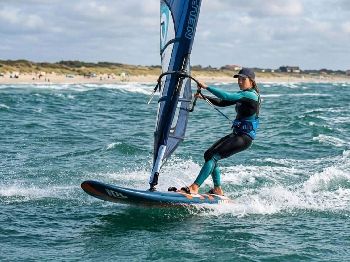
The wing position for upwind riding is more forward and more sheeted in than for neutral or downwind riding.
Hold the wing with your front hand forward on the boom and your back hand pulled closer to your front shoulder.
This sheets the wing in and generates more horizontal pull and less lift, translating to board speed rather than extra height on the foil.
Board speed is what generates upwind progress: a slow-moving foiler in a strong sheet-in is making less ground upwind than a faster foiler in moderate sheet with the wing slightly further forward.
The wing angle should be between 40 and 60 degrees to the water surface for upwind riding - too vertical and you generate mostly lift with little drive; too flat and you lose power and the foil drops back into the water.
If you are fighting to hold the wing at that angle, the wind is either too light for your current wing size or you are riding too slowly - building board speed first makes the wing easier to manage.
Tacking on a wing foil
A tack on a wing foil requires you to pass through the no-go zone - the area directly into the wind where neither upwind leg produces enough forward drive to maintain foil height.
The standard approach is to build speed on the upwind run, bear off slightly to generate extra board speed, then tack through the wind with enough momentum to carry the foil across the no-go zone before power drops to zero.
During the tack, the wing passes over your head from one side to the other - practice this transition slowly on the beach before attempting it at speed on the foil.
Common tack failure: hesitating mid-tack when power drops causes the foil to stall and the board to fall off the foil - commit through the turn without pausing in the head-to-wind position.
The water-start recovery after a failed tack is the most important skill to master alongside the tack itself, so that a failed attempt costs you 30 seconds rather than ending the session.
Wing selection for upwind work
Upwind progress is harder in winds below 12 knots for most intermediate foilers - the board speed needed for efficient upwind sailing requires enough wing power to sustain foil height at the heading required.
A wing one size larger than your downwind wing is often the right call for dedicated upwind practice: the extra power makes it easier to hold speed at the close-hauled angle, which is always slower than a broad reach.
Wing sizes for Australian east coast winter conditions typically run 5m to 6m for foilers in the 70 to 85 kg range, where the dominant 12 to 18 knot SE trades provide enough consistent power for upwind sessions without overloading the rig.
A longer mast - 75cm to 90cm - provides more clearance for the angled board during upwind riding and reduces the frequency of touchdowns that can interrupt the upwind run.
Common mistakes and how to correct them
Watching the wing: gaze goes down to the wing, shoulders follow, board turns downwind - fix by picking a landmark and keeping eyes forward and upwind.
Flat foot stance: equal pressure through heel and toe keeps the board flat and allows leeway - fix by consciously pressing the heels down until you can feel the board edge.
Too much wing power: an over-sheeted wing in gusty conditions creates erratic speed and overpowers the upwind track - ease the back hand slightly in gusts and re-trim when power stabilises.
Tacking too slowly: losing momentum mid-tack drops the foil and ends the turn - build more speed before initiating the tack than feels necessary, especially in light or fluky conditions.
Questions before your next upwind session
Is your current wing size generating enough power at close-hauled angles to maintain foil height, or do you drop back into the water every time you point upwind?
What is the wind direction relative to your training location, and which tack will take you directly upwind for the longest run before you need to tack?
Have you practised the tack transition on the beach with the wing, so the hand and body movement is automatic before you need it at speed?
Check your local wind forecast at Sydney wind forecast on Seabreeze to plan your upwind session timing around the steadiest part of the day.